
|
Research interest in my laboratory has been on the structure-function
relationship of biologically active proteins and glycoproteins.
We are interested in studying the regulation of mucin glycoprotein
biosynthesis and how the repertoire of glycosyltransferases
regulates the sites of mucin O-glycosylation. The facilities
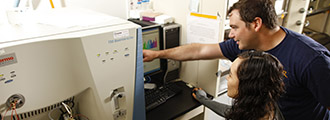
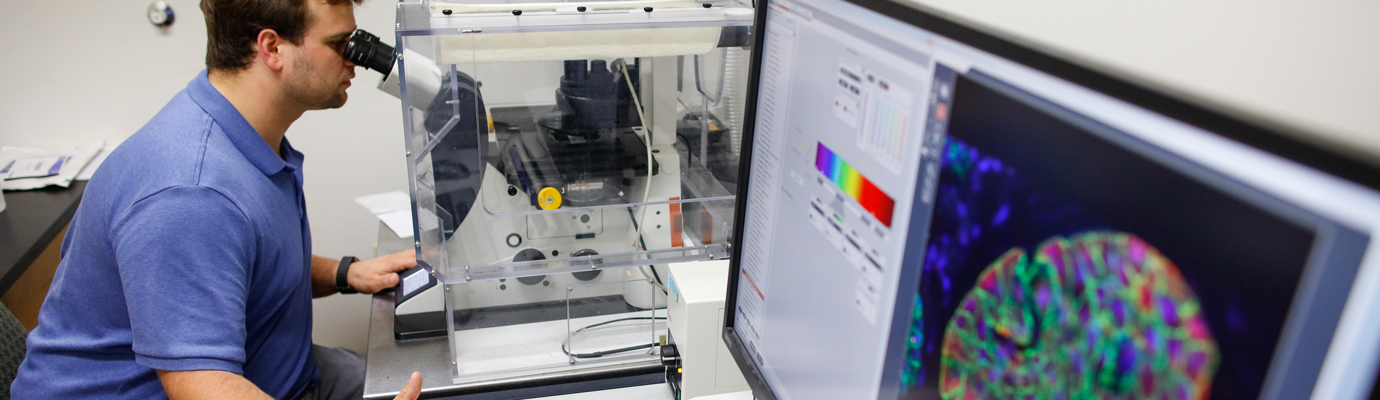
in our laboratory include Applied Biosystems 473A liquid/gas
phase sequencer, capillary electrophoresis system, peptide
synthesizer, amino acid analyzer, Voyager DE-STR MALD-TOF
mass spectrometer, and several HPLC systems.
We are also interested in studying the virulence factors
of the oral pathogens and development of agents which can
inhibit the adherence of oral pathogens. One of the on going
research project deals with the development of Carbohydrate-based
Peptidomimetics to prevent Candidiasis. The goal of this research
grant proposal is to test the hypothesis that peptidomimetics
of specific cell-surface carbohydrate structures can be used
to reduce the level of the in vivo oral candidiasis, which
accompanies salivary gland hypofunction. Peptide libraries
prepared using both phage display and synthetic chemical approach
are being screened for peptides which bind to either anti-candida
albican mannan or Ulex europeus lectin. Selected mimetics
will be tested in vivo with a surgical desalivated rat model
system.
Another research project studies the association of caries
and salivary analytes. Monoclonal and polyclonal antibodies
are being generated against salivary proteins and microbial
components. We will develop sandwich enzyme-linked immunoassays
(ELISA) to quantitate the levels of salivary proteins, glycosyltransferases
from Streptococcus mutans, and food preservative benzoate
in 4000 samples of resting saliva samples. The comprehensive
survey and the cluster analysis of multiple salivary components
should generate a useful data set to test for the association
of these components with the carries experience and to identify
parameters that will indicate increased risk for dental caries.
Another area of research interest is the proteomic analysis
of human salivary glands to map the spectrum of proteins which
are secreted by the normal human parotid and submandibular/
sublingual glands. Proteins are separated by two-dimensional
gel electrophoresis and Western blotting and are identified
by MALDI-TOF or Edman degradation. Samples from normal and
idiopathic dry mouth patients will be compared to identify
proteins which differ in their levels of expression.
|
| Bedi, G.S. (1995). Comparative study of four collagenolytic
enzymes from the culture supernatant of Porphyromonas gingivalis
(FAY-19M-1). Prep. Biochem. 25:133-154.
Bedi, G.S. (1997). Structural studies of the Asn-linked
carbohydrate chains of inducible rat parotid proline-rich
glycoprotein. Glycoconjugate J. 14:907-916.
Bedi, G.S., T. Zhou, and S.K. Bedi (1998). Production of
rat salivary cystatin variant polypeptides in Escherichia
coli. Arch. Oral Biol. 43:173-182.
Ten Hagen, K.G., D. Tetaert, F.K. Hagen, C. Richet, T.M.
Beres, J. Gagnon, M.M. Balys, B. VanWuyckhuyse, G.S. Bedi,
P. Degand, and L.A. Tabak (1999). Characterization of a UDP-GalNAc:polypeptide
N-acetylgalactosaminyltransferase which displays glycopeptide
N-acetylgalactosaminyltransferase activity. J. Biol.
Chem. 274:27867-27874.
|