

C. elegans as a model system for studying ion transport
The nematode C. elegans is both genomically-defined and genetically-tractable, and has emerged as a leading model system for the study of integrative physiology. In fact, more than 750 genes or ~4% of the worm genome encode proteins involved in ATP-dependent, secondary active, and passive channel-mediated transport processes suggesting that the electrical properties of individual cells could be conserved across species. My laboratory uses C. elegans as a model system to study epithelial membrane transport through a variety of novel approaches that are only possible in this well-characterized organism.
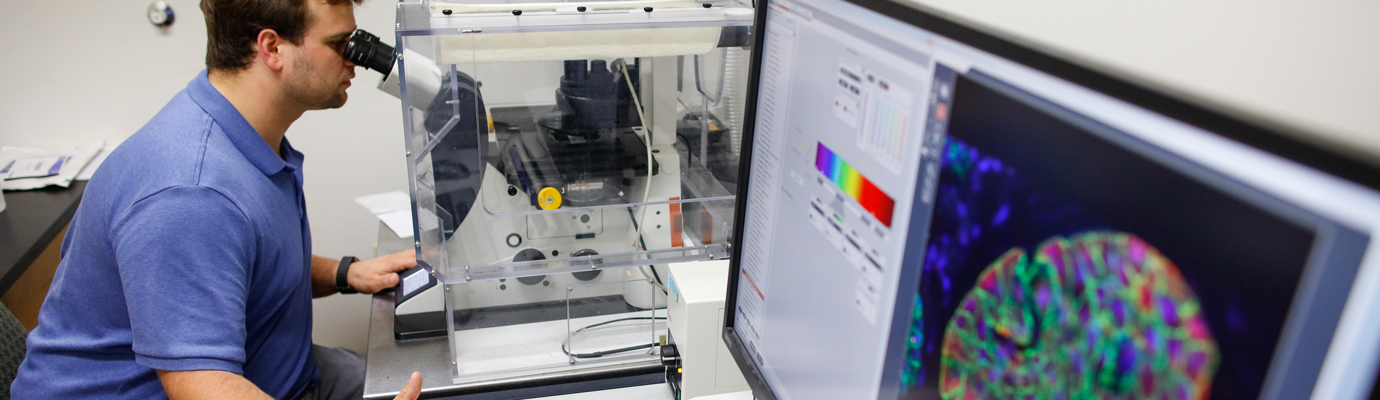
In particular, since nematodes are transparent, fluorescence-based measurements of ion flux in an intact animal can be readily accomplished. Fluorescence Resonance Energy Transfer (FRET) is used to look at Ca 2+-signaling with genetically encoded “chameleon” proteins that fuse two Green Fluorescent Protein (GFP) isoforms linked by a calmodulin calcium-binding domain. In addition, a pH-sensitive variant of GFP, “pHluorin”, is used via dual excitation ratio imaging to monitor cellular pH changes. Real-time fluorescent imaging, in combination with reverse genetics and a vast repertoire of readily available mutant strains, allows us to assess the contribution of membrane transport proteins to cellular homeostasis under normal physiological and stress-related conditions at single cell resolution in an intact, living organism.
For example, we have shown that knockdown of NHX-2, a Na-H exchanger expressed exclusively on the apical membrane of intestinal epithelial cells, results in acidification of the intestinal intracellular pH by 0.25 units. In addition, we have demonstrated that the activity of NHX-2 is indirectly coupled to that of OPT-2, the intestinal H +-oligopeptide cotransporter. Genetically, ablation of these two transport processes results in similar loss-of-function phenotypes: these include hallmarks of starvation, as well as an increase in the lifespan of the nematode.
The use of C. elegans as a model system to study the molecular hallmarks of senescence has garnered significant attention recently based upon findings that specific individual proteins can dramatically alter nematode adult lifespan, with no apparent loss of health or vitality. Characteristically, longevity arises in nematodes via three different venues: 1.) caloric restriction, 2.) neuroendocrine signaling pathways that recognize nutrient availability, and 3.) mitochondria respiratory chain function. In general, the molecular components and mutational phenotypes of these pathways are conserved from worm to man. We hypothesize that pHi acts as a synergistic messenger, and provides a metabolic context through which the actions of diverse cellular and trans-cellular signaling pathways are interpreted. One focus of our laboratory is to determine how intracellular pH influences the metabolic pathways that lead to longevity, and to identify new genes that control acid-base homeostasis in the intestine.
Bones and stones: calcium homeostasis, hypercalciuria, and bone mineral balance
Calcium homeostasis occurs through three major pathways: intestinal calcium absorption, renal calcium reabsorption, and calcium buffering through bone (de)mineralization. Our laboratory, in collaboration with Dr. David Bushinsky, Chief of Nephrology, uses two model systems in combination to study these processes.
The first of these is the Genetic Hypercalciuric (GHS) rat strain. This strain has been derived from selective inbreeding of the most hypercalciuric Sprague-Dawley (SD) rats for >65 generations. Urine calcium excretion of these GHS rats is ~8-10 fold higher than the parental SD strain. Over an 18 wk period the GHS rats spontaneously and progressively form kidney stones. Abnormalities have been observed in all three major facets of calcium homeostasis, and quantitative trait loci analysis has suggested between seven and eleven separate alleles are responsible for the hypercalciuric trait.
The second of these uses primary mouse embryonic calvarial cells in culture. Bones represent the main reservoir of proton buffering capacity in the body. Metabolic acidosis initially induces physicochemical dissolution of bone mineral resulting in buffering followed by cell-mediated increased bone resorption and decreased bone formation. Demineralization can also result in dramatic calcium release and hypercalciuria. Metabolic a cidosis can alter the expression of a number of genes in osteoblasts and increases osteoblastic PGE 2 secretion, which leads to an increase in RANK-L expression and induces osteoclastic bone resorption.
In order to globally compare changes in gene expression either in the kidney of the GHS rat, or in bone induced by metabolic acidosis, we have used high-density oligonucleotide microarray analysis. A comparison between individual hybridizations using a two class unpaired t-test led in each case to the identification of nearly 150 genes with a minimum change of 2-fold and p-values of <0.05, many of whose expression levels were validated by quantitative RT-PCR and/or Northern analysis.
We anticipate that the approach described here will allow us to determine the fundamental alterations in gene expression that first, are related to calcium oxalate and or calcium phosphate stone formation in the GHS rat, and second, that underlie the cell-mediated net calcium efflux from bone. Understanding these mechanisms may help us understand further the pathogenesis of stone formation in man, as well as allow us to devise strategies to preserve bone mineral during acidosis while maintaining its important proton buffering properties. |
|
Elble, R., Gi, J., Nehrke, K., DiBiasio, J., Kingsley, P., Kotlikoff, M.I., and Pauli, B.U. (2002) Molecular and functional characterization of a murine calcium-activated chloride channel expressed in smooth muscle. J Biol Chem., 277, 18586-18591
Nehrke, K., Arreola, J., Nguyen, H-V., Pilato, J., Richardson, L., Okunade, G. , Shull, G.E., Baggs, R. and Melvin, J.E. (2002) Saliva Secretion and Cell Volume Regulation by Parotid Gland Acinar Cells from Mice Lacking Expression of the Clcn2 Cl - Channel Gene. J Biol Chem. 277 :23604-23611
Nehrke, K. and Melvin, J.E. (2002) The NHX family of Na-H exchangers in Caenorhabditis elegans. J Biol Chem.277:29036-29044
Arreola, J., Begenisich, T., Nehrke, K., Nguyen, H-V., Park, K., Richardson, L., Yang, B., Lamb, F., Shutte, B.C., and Melvin, J.E. (2002) Secretion and Cell Volume Regulation by Salivary Acinar Cells from Mice Lacking Expression of the Clcn3 Cl - Channel Gene. J Physiol. 545 :207-216
Dickerson, L.W., Schutte, B.C., Yang, B., Bonthius, D.J., Barna, T.J., Bailey, M.C., Nehrke, K., Williamson, R.A. and Lamb, F.S. (2002) Altered GABAergic function accompanies hippocampal degeneration in mice lacking ClC-3 voltage-gated chloride channels. Brain Research958:227-250.
Nehrke, K., Quinne, C.C., and Begenisich, T. (2003)Molecular identification of the Ca 2+-activated K + channels in parotid acinar cells. Am J Physiol Cell Physiol. 284:C535-C546.
Joiner, W.J., Basavappa, S., Vidyasagar, S., Nehrke, K., Krishnan, S., Binder, H.J., Boulpaep, E.L., and Rajendran, V.M. (2003) Active K+ secretion through multiple KCa-type channels and regulation by IKCa channels in rat proximal colon. Am J Physiol Gastrointest Liver Physiol.285:G185-G196
Hoffman J.F., Joiner W., Nehrke K., Potapova O., Foye K., and Wickrema, A. (2003) The hSK4 (KCNN4) isoform is the Ca2+-activated K+ channel (Gardos channel) in human red blood cells. Proc Natl Acad Sci U S A. 100:7366-7371
Nehrke, K. (2003) A reduction in intestinal cell pHi due to loss of the C.elegans Na+/H+ exchanger NHX-2 increases lifespan. J Biol Chem278:44657-44666
Chen, Y., Zhao, Y.H., Kalaslavadi, T.B., Hamati, E., Nehrke, K., Le, A.D., Ann, D.K.,and Wu, R. (2004) Genome-wide search and identification of a novel gel-forming mucin MUC19/Muc19 in glandular tissues. Am J Respir Cell Mol Biol30:155-165
Denton, J., Nehrke, K., Rutledge, E., Morrison, R. and Strange, K. (2004) Alternative splicing of N- and C-termini of a C. elegans ClC channel alters gating and sensitivity to external Cl - and H +. J Physiol555: 97-114.
PubMed
Publication List
PubMed is maintained by the National
Library of Medicine
and provides complete abstracts of all 'nehrke k' publications,
as well as links to the full text of many articles (at journal
homepages).
|