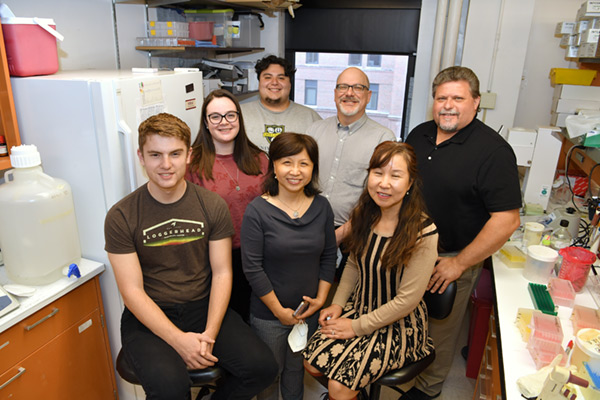
Zand Laboratory
Overview
My laboratory is focused on studying the role of B lymphocytes in solid organ transplant rejection, alloantibody generation, and long-lived immunologic memory. Our work is conducted with human B cells, plasma cells, and B cell lines. We are currently studying the role of T independent maturation of CD27- naive B cells into antibody secreting plasma cells as triggered by TLR-9 signalling. A second related project is to define the pathways by which polyclonal anti-thymocyte globulin causes apoptosis in human B cells and plasma cells. Finally, we have developed a discrete event stochastic computer model of memory T and B cell generation, and are working on ODE models of immunity to influenza and orthopox viruses. We are using these models to predict the kinetics of memory recall responses to viral antigen and alloantigen exposure in transplantation and biodefense. We are one of the core laboratories in the University of Rochester Center for Biodefense Immune Modeling.
Discrete Event Modeling of T and B Cell Memory
We are interested in computational models of B and T cell memory. These models allow us to create 10,000,000 "virtual" lymphocytes, assign them properties such as antigen specificity, memory vs. naive developmental states, and surface phenotype expression. In collaboration with Ollivier Hyrien and Andrei Yakovlev in the Department of Biostatistics and Computational Biology, we are developing new stochastic methods of estimating cell division and differentiation parameters from experimental data to populate these models. In addition, we have developed a prototype multicompartment model of B cell activation in transplant rejection. In collaboration with Hulin Wu, we are developing models of immune responses to influenza and orthopox virus infections.
B Cell and Plasma Cell Apoptosis in Transplantation
A second focus in the laboratory is translation research on alloantibody mediated rejection of kidney transplants, and how to treat or prevent this. To this end, we have examined the apoptotic inducing properties of several clinical agents, including polyclonal rabbit anti-thymocyte globulin.
B Cell Differentiation and Plasma Cell Maturation
We have developed several new in vitro methods of driving naive and memory B cells to a terminally differentiated plasma cell phenotype using the CD40L-IL4 and TLR-9 activation pathways. These systems are being used to generate data for computational models of B cell differentiation, and to study the basic immunobiology of plasma cell generation after innate immune system activation.
Recent Publications
Zand MS, Vo T, Huggins J, Felgar R, Liesveld J, Pellegrin T, Bozorgzadeh A, Sanz I, and Briggs BJ. 2005. Polyclonal rabbit antithymocyte globulin triggers B-cell and plasma cell apoptosis by multiple pathways. Transplantation 79(11):1507-1515. 
Zand MS, Bose A, Vo T, Coppage M, Pellegrin T, Arend L, Lee FE, Bozorgzadeh A, and Leong N. 2005. A renewable source of donor cells for repetitive monitoring of T- and B-cell alloreactivity. Am J Transplant 5(1):76-86.
Zand MS, Briggs BJ, Bose A, and Vo T. 2004. Discrete event modeling of CD4+ memory T cell generation. J Immunol 173(6):3763-3772.
Shah A, Nadasdy T, Arend L, Brennan J, Leong N, Coppage M, Orloff M, Demme R, and Zand MS. 2004. Treatment of C4d-positive acute humoral rejection with plasmapheresis and rabbit polyclonal antithymocyte globulin. Transplantation 77(9):1399-1405.
Zand MS, Li Y, Hancock W, Li XC, Roy-Chaudhury P, Zheng XX, and Strom TB. 2000. Interleukin-2 and interferon-gamma double knockout mice reject heterotopic cardiac allografts. Transplantation 70(9):1378-1381.
Current Funding
Rochester Center for Biodefense Immune Modeling
National Institutes of Health (NIH/NIAID N01-AI-50020)
10/2005 - 10/2010
Immune responses to influenza and orthopox viruses depend on the kinetics of B and T cell responses after activation. This 5 year project is designed to create and test computational models of immune responses to natural and modified influenza and orthopox viruses. My laboratory has two sub-projects in this center grant: (1) to experimentally derive parameters used to model B cell activation, maturation, and antibody secretion to vaccines and viral infection and (2) to develop a multicompartment stochastic discrete event model of human immune responses.
Immune Function and Biodefense in Children,
Elderly, and Immunocompromised Populations
National Institutes of Health (NIH/NIAID N01-AI-50029)
10/2005 - 10/2010
Children, the elderly and immunocompromised patients may have altered immune responses to viral and bacterial pathogens. As such, these individuals may be the first to be infected by bioterror agents, and the most susceptable to serious consequences of infection. In this project, my laboratory is working to create discrete event stochastic models of B and T cell immune responses of patients who have been treated with anti-TNF therapies.
Discrete Event Computer Simulation of B Cell
Mediated Kidney Transplant Rejection
Alternatives Research and Development Foundation
9/2005 - 8/2006
Humoral rejection of kidney transplants is mediated by host B cells that produce antibodies directed against HLA antigens expressed on the transplanted kidney. In this project, we are using an in vitro system for plasma cell differentiation to generate data concerning the kinetics of B cell activation and differentiation, and how various immunosuppressive medications influence this process. We are then using this data to populate a multi-compartment, stochastic, discrete event computer model. The goal of this work is to use such models to better predict the effects of such medications without the use of animal animal experimentation.
|