Refractive Errors
What is normal vision?
In order to better understand how refractive errors affect our vision, it's important
to understand how normal vision happens. For people with normal vision, the following
sequence takes place:
-
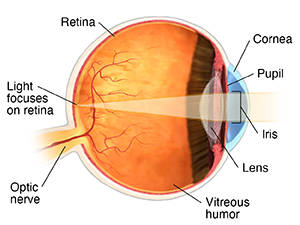
Light enters the eye through the cornea. This is the clear, dome-shaped surface that
covers the front of the eye.
-
From the cornea, the light passes through the pupil. The amount of light passing through
is controlled by the iris, the colored part of the eye.
-
From there, the light then hits the lens. This is the transparent structure inside
the eye that focuses light rays onto the retina.
-
Next, it passes through the vitreous humor. This is the clear, jelly-like substance
that fills the center of the eye and helps to keep the eye round in shape.
-
Finally, it reaches the retina. This is the light-sensitive nerve layer that lines
the back of the eye.
-
The optic nerve is then responsible for sending this information to the brain. The
brain interprets the impulses it receives into images.
What are refractive errors?
Refractive errors happen when the shape of the eye prevents light from focusing directly
on the retina. The following are the most common refractive errors. These errors affect
vision and may need corrective lenses or surgery for correction or improvement:
Astigmatism
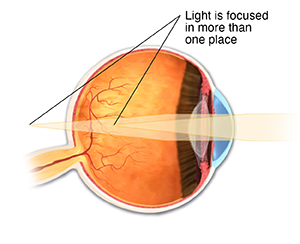
Astigmatism is a condition in which an abnormal curvature of the cornea can cause
2 focal points to fall in 2 different locations. This makes objects up close and at
a distance look blurry. Astigmatism may cause eye strain. It may be combined with
nearsightedness or farsightedness. Eyeglasses, contact lenses, or corrective surgery
may help to correct or improve the condition.
Farsightedness
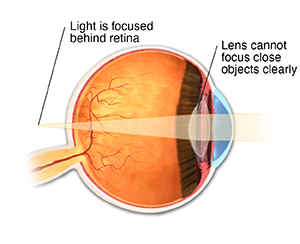
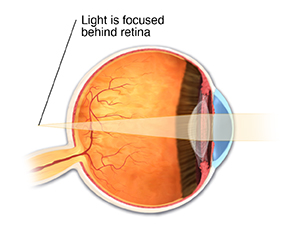
Farsightedness (hyperopia) is the most common refractive error. It occurs when an
image of a distant object becomes focused behind the retina. This happens either because
the eye is too short, or because the refractive power of the eye is too weak. This
condition makes close objects look out of focus. It may cause headaches or eye strain.
Eyeglasses or contact lenses may help to correct or improve farsightedness by adjusting
the focusing power to the retina. Corrective surgery may also help by changing the
shape of the cornea to a more spherical, round shape instead of an oval shape.
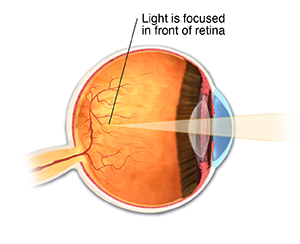
Nearsightedness
Nearsightedness (myopia) is the opposite of farsightedness. With this condition, an
image of a distant object becomes focused in front of the retina. This happens either
because the eye is too long, or because the refractive power of the eye is too strong.
This condition makes distant objects look out of focus. It may cause headaches or
eye strain.
Eyeglasses or contact lenses may help to correct or improve myopia by adjusting the
focusing power to the retina. Corrective surgery may also help by changing the shape
of the cornea to a more spherical, round shape instead of an oblong shape.
Presbyopia
Presbyopia is caused when the center of the eye lens hardens due to aging. This makes
it unable to accommodate near vision. This condition affects almost everyone over
time, starting as early as age 40. It even affects those with nearsightedness. Eyeglasses
or contact lenses may be prescribed to correct or improve the condition.