

University of Rochester Medical Center
SearchDirectoryNewsEventsStrong HealthURMC Home


Ph.D. (1990)
University of Liverpool, United Kingdom

David I. Yule, Ph.D.
Associate Professor of Pharmacology and Physiology; of Medicine, Gastroenterology Unit; and in the Center for Oral Biology

Primary Appointment:
Pharmacology and Physiology

GEBS Cluster Affiliation:
CMM-Cellular and Molecular Basis of Medicine


Research:
Mechanisms underlying Ca2+ signaling events in exocrine cells

Yule Lab Page


E-mail: David_Yule@urmc.rochester.edu
Contact Information:
University of Rochester
School of Medicine and Dentistry
601 Elmwood Ave, Box 711
Rochester, New York 14642
Medical Center, Room 4-5314
Phone: (585) 273-2154
Fax: (585) 273-2652
Research Overview
In exocrine acinar cells regulation of intracellular calcium plays a pivotal role in controlling fluid and protein secretion. Exposure of cells to neurotransmitters and hormones results in a rapid elevation of intracellular calcium. This increase in [Ca2+]i carries complex spatial and temporal information important to the physiology of the acinar cell. Research in this laboratory focuses on gaining a better understanding of the mechanisms which underlie these signaling patterns with a primary goal of relating this knowledge to the physiology and pathophysiology of exocrine cells.

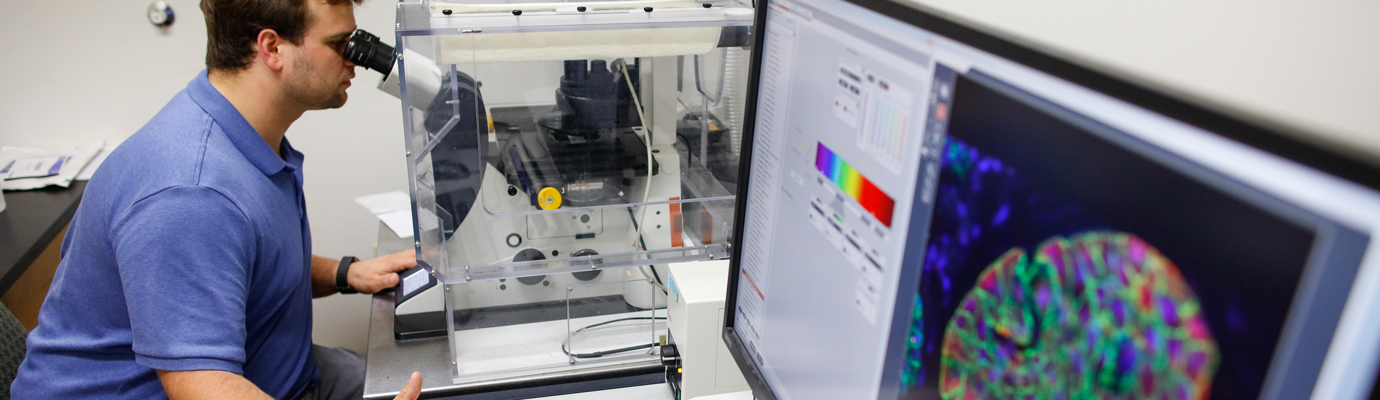
Although all Ca2+ mobilizing agonists in pancreatic acinar cells utilize the phosphoinositide-signaling (PI) pathway, stimulation by individual agents results in markedly different temporal and spatial patterns of Ca2+ signaling. One project is designed to understand at the molecular level how the cell effectively "knows" which PI-coupled agonist it is currently exposed to. Given that tremendous molecular diversity is expressed at all levels of this signaling pathway, our working hypothesis is that individual agonists do not couple to the signaling machinery in an identical fashion. This study involves precisely defining by molecular techniques the individual signaling proteins expressed in the acinar cell and then subsequently assessing if individual agonists utilize discrete and different elements of the PI-signaling pathway. We are utilizing fluorescence imaging techniques including high-speed confocal microscopy to monitor [Ca2+]i while manipulating the signaling pathway with neutralizing antibodies and antisense technology.

A further project relates to the organization and regulation of calcium release sites in exocrine cells. These organelles are defined by the expression of receptors for the second messenger Inositol 1,4,5-trisphosphate. In acinar cells the distribution of these receptors is tightly localized to an area associated with the actin cytoskeleton in the apical secretory pole of the cell. This distribution of receptors is the major factor in defining the spatial characteristics of the Ca2+ signal. The nature of the association with the cytoskeleton is being investigated. In addition the regulation of these receptors by phosphorylation and the consequences this may have for Ca2+ signaling are also being studied.

Recent Publications

Chen, Y., Warner, J.D., Yule, D.I., and Giovannucci, D.R. (2005) Spatiotemporal analysis of exocytosis in mouse parotid acinar cells. Am. J. Physiol. Cell Physiol. 289:C1209-C1219.

Melvin, J.E., Yule, D., Shuttleworth, T.J., and Begenisich, T. (2005) Regulation of fluid and electrolyte secretion in salivary gland acinar cells. Annu. Rev. Physiol. 67:445-469.

Mignen, O., Thompson, J.L., Yule, D.I., and Shuttleworth, T.J. (2005) Agonist activation of arachidonate-regulated Ca2+-selective (ARC) channels in murine parotid and pancreatic acinar cells. J. Physiol. 564.3:791-801.

Sneyd, J., Tsaneva-Atanasova, K., Reznikov, V., Bai, Y., Sanderson, M.J., and Yule, D.I. (2006) A method for determining the dependence of calcium oscillations on inositol trisphosphate oscillations. Proc. Natl. Acad. Sci. USA 103:1675-1680.

Wagner II, L.E., Betzenhauser, M.J., and Yule, D.I. (2006) ATP Binding to a uniquesite in the Type-1 S2¯ inositol 1,4,5-trisphosphate receptor defines susceptibility to phosphorylation by protein kinase A. J. Biol. Chem. 281:17410-17419.

Williams, J.A. and Yule, D.I. (2006) Stimulus-secretion coupling in pancreatic acinar cells. In: Physiology of the Gastrointestinal Tract, Fourth Edition, ed. L.R. Johnson, Academic Press.

Won, J.H. and Yule, D.I. (2006) Measurement of Ca2+ signaling dynamics in exocrine cells with total internal reflection microscopy. Am. J. Physiol. Gastrointest. Liver Physiol. 291:G146-G155.

Gin, E., Crampin E.J., Brown, D.A., Shuttleworth, T.J., Yule, D.I., and Sneyd, J. (2007) A mathematical model of fluid secretion from a parotid acinar cell. J. Theor. Biol. 248:64-80.

Wagner, L.E., Joseph, S.K., and Yule, D.I. (2008) Regulation of single inositol 1,4,5-triphosphate receptor channel activity by protein kinase A phosphorylation. J. Physiol. 586:3577-3596.

Betzenhauser, M.J., Wagner II, L.E., Iwai, M., Michikawa, T., Mikoshiba, K., and Yule, D.I. (2008) ATP modulation of Ca2+ release by Type-2 and Type-3 inositol (1,4,5)-triphosphate receptors: Differing ATP sensitivities and molecular determinants of action. J. Biol. Chem. 283:21579-21587.

PubMed Publication List

PubMed is maintained by the National Library of Medicine and provides complete abstracts of all 'yule di' publications, as well as links to the full text of many articles (at journal homepages).


Back to Pharmacology and Physiology

GEBS Clusters:
CMM

COB