

News from the McGrath Lab
News from the McGrath Lab
Super-Thin Membranes Used in Lab-on-a-Chip Diagnostic Devices
Monday, November 12, 2012
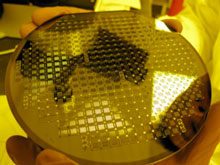
4" wafer with 160 membranes. (Photo by SiMPore Inc.)
Nano-porous silicon membranes developed at the University of Rochester's Hajim School of Engineering and Applied Sciences will soon be used to manufacture portable devices that can analyze DNA in remote settings.
A $600,000 grant from the National Science Foundation will fund a partnership among Associate Professor of Biomedical Engineering, James McGrath, SiMPore, Rochester Institute of Technology, and Integrated Nanotechnologies (INT) to fabricate the devices.
Dr. Jim McGrath Receives $900,000 in NSF Grants
Monday, September 24, 2012
Biomedical Engineering associate professor, Jim McGrath, Ph.D. has just received some important grants to develop new applications for the super-thin, nanoporous silicon membranes that have been developed at the Hajim School of Engineering & Applied Sciences. A nearly $600,000 National Science Foundation grant will partner McGrath's lab, SiMPore (the University-based startup that manufactures the membranes), RIT, and Integrated Nanotechnologies (INT), another local startup. They'll be using the membranes as filters in a portable INT device that can analyze DNA extracted from a drop of blood. This can be used to diagnose disease or detect pathogens, in the field, in a matter of minutes. They'll then miniaturize all of this onto a lab-on-a-chip (LOC).
Another $300,000 from NSF will fund McGrath's ongoing research to modify the membranes for additional uses; a $100,000 grant continuation from the Coulter Foundation will fund McGrath's efforts to develop a blood dialysis device, using a silicon membrane, that would be small enough to wear on a belt. Imagine what a godsend that would be, if people could remain mobile and active while undergoing continuous dialysis, instead of sitting four hours a day, three days a week in dialysis centers!