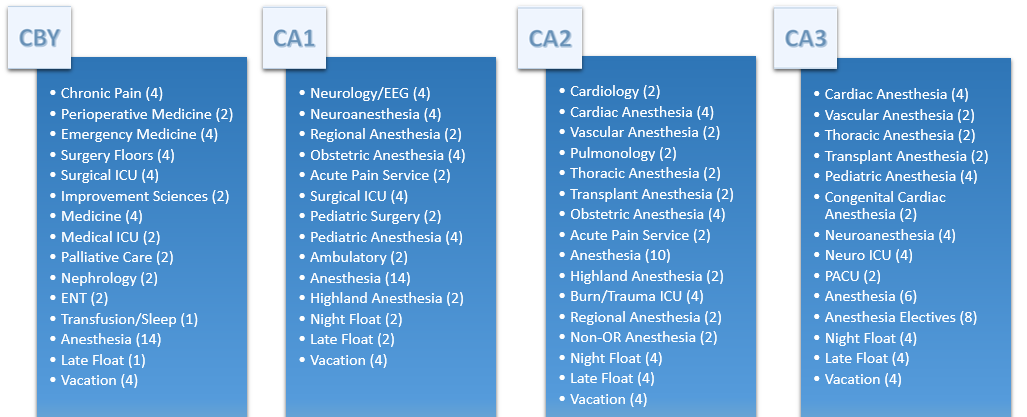
Curriculum Overview/Rotations

Key Elements of the Program

Clinical Training

Clinical ExperienceAs a group, our residents administer more than 30,000 anesthetics a year, providing anesthesia for all types of surgical procedures. Beginning with close observation during orientation, the level of attending supervision is adjusted down for each resident according to their skill and abilities allowing third-year residents much more responsibility, even with advanced anesthetics. This develops confidence and the highest level of performance. Being a large tertiary care center with a wide catchment area, most anesthetics are delivered under one roof—but encompass a variety of clinical areas including the MRI suite, the Electrophysiology and Cardiac Catheterization lab, the Gastroenterology Suite, and Electroconvulsive Therapy, to name a few.

Beyond daily OR experiences, URMC also provides a nearly unparalleled education in acute trauma care. Strong Memorial Hospital is the only level one trauma center in the Finger Lakes region supplying the highest level of care to over 1.2 million people.

Lastly, the URMC faculty members have been trained in many different institutions: Thus, they can each teach the core curriculum while including unique methods and techniques in order to broaden the education.

In the ClassroomAnatomical Dissection

On a base level, residents are trained in the core anesthesiology education and will be trained to perform above average. We offer a variety of educational activities in a host of different modalities—didactic and interactive, in the simulator and in the classroom. Recognizing that our residents are adult learners and process information across different domains, we provide a something for everyone. Continuing from the basic education, there are extensive rotations in order to meet ACGME guidelines as well as provide opportunities beyond the basics. For details, see our brochure above. This curriculum has proven results: Excellent performance by our graduates on the written and oral ABA board exams, and outstanding career placement.

Research

The department is involved in cutting-edge research in basic and clinical sciences. Work is funded by the National Institutes of Health, by industry, and by internally supported studies. Most of our faculty members are engaged in active research projects, and they encourage resident participation. Many residents present their research or case reports at the annual Midwest Anesthesia Residents' Conference and other conferences.

Atmosphere

Dr Glance with Resident Dr BreslerThe mission of the URMC Anesthesiology Department is to foster a true learning environment, focusing on the needs of our residents in order to reach the highest caliber of education. The faculty views residents as colleagues and friends—members of one team. Our faculty liken themselves to coaches—empowering our residents to own their education and facilitating the best game plan for carrying that out. Routing for our resident success, we strive to treat each according to his/her own needs, with the expectation that each resident will perform at his/her highest level.

Sample Curriculum:

We currently have positions for ten PGY-1 residents. These trainees rotate through a variety of subspecialties in their first year, but begin their training in anesthesiology in March of the PGY-1 year. They complete their PGY-1 rotations during their CA-1 year.

Below is sample schedule for a PGY-1:

July 5th – August 1st: Pulmonary Medicine

August 2nd – 29th: Nephrology

August 30th – September 26th: SICU

September 27th – October 24th: Medicine

October 24th – November 21st: MICU

November 22nd – December 5th: Nepediatrics

December 6th – December 19th: Vacation

December 20th – January 16th: Pediatrics

January 17th – February 13: ENT

February 14th – March 13th: Emergency Medicine

March 14th – April 22nd: CA-1 Orientation

April 25th – May 13th: Regular OR

May 14th – May 27th: Vacation

May 31st – June 17th: Regular OR

June 18th – June 30th:  Night Float

Those trainees who begin training with us as CA-1’s join our team in July with Orientation (we repeat this process twice a year). Below is sample schedule for a CA-1:

July 5th – August 13th: Orientation

August 16th  – October 15th : Regular OR

October 18th –29th: Preadmission Evaluation Center

November 1st – November 5th: Regular OR

November 8th – November 19th: Regional Anesthesia

November 20nd – December 4th: Night Float

December 6th – December 10th: Regular OR

December 11th – December 27th: Vacation

December 28th – January 14th: Regular OR

January 17th – February 13th: Cardiac 1

February 14th – March 13th: OB 1

March 14th – April 9th: Perioperative Pain Service

April 11th – April 24th: Vacation

April 25th – May 20th: SICU

May 23rd – June 17th:  Neuro 1

June 20th – July 1st: Post Anesthesia Care Unit

Contact Us

Program Coordinator

Email: Eva Weissman
Phone: (585) 275-1384
Fax: (585) 276-0122

Program Director

Email: Suzanne Karan
Fax: (585) 276-0122