
About the Translational Biomedical Science Program
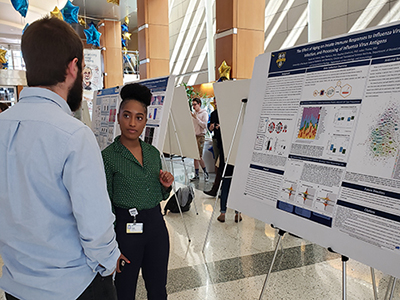
Raven Osborn, a third-year TBS-IIMP trainee, explains her research to a peer at the annual TBS Symposium on October 10, 2019.
Interdisciplinary & Multifaceted
The PhD in Translational Biomedical Science is unique as it is highly interdisciplinary. Each current trainee is working on an entirely different type of project, and no two theses end up alike. The current roster of mentors contains an extremely wide breadth of expertise, allowing for the trainees to receive an education unlike any other program. The knowledge that our trainees acquire throughout their time in the program is based in population and public health, basic science, team science, biostatistics, ethics, and many other areas.
Specific program objectives include:
- Provide in-depth mentoring to assure productive research training.
- Teach fundamental theory and knowledge in the subject areas of biostatistics, epidemiology, laboratory methods, human subjects research and analytical procedures essential to translational research.
- Provide a critical environment fostering inquiry, integrity, teaching and communication skills, high productivity, and working in a multi-disciplinary environment.
Research Rotations
Trainees are required to do three rotations during the first year of study. These rotations familiarize the trainee with faculty members who may end up serving as their mentor(s), and aid in discovering a thesis project. Trainees gain experience in research, attend seminars, and practice their communication skills in these rotations. At the end of the first year, trainees choose their mentor(s) and embark on a PhD thesis research program. True to the interdisciplinary nature of the program, trainees may choose as their primary research mentor(s) any faculty member within the University with an appropriate research program and funding mechanism to support the student after the first year.