

|
Research in my laboratory is focused on the causes, treatment,
and prevention of bladder cancer. Bladder cancer is among
the most common cancers in the United States. Initial and
recurrent bladder tumors develop due to mutation of DNA in
the cells that line the interior bladder wall. The DNA mutations
lead to abnormal protein function and amounts, and ultimately
un-regulated cell growth. One of these proteins, DBCCR1, is
known to be important in the development of bladder cancer
but the actual function of DBCCR1 is unknown. The laboratory
has recently demonstrated an association between DBCCR1 and
another protein, ASML3a. The amount of ASML3a is increased
in bladder tumors relative to normal bladder tissue, and thus
it may prove to be a way to detect or treat bladder cancer.
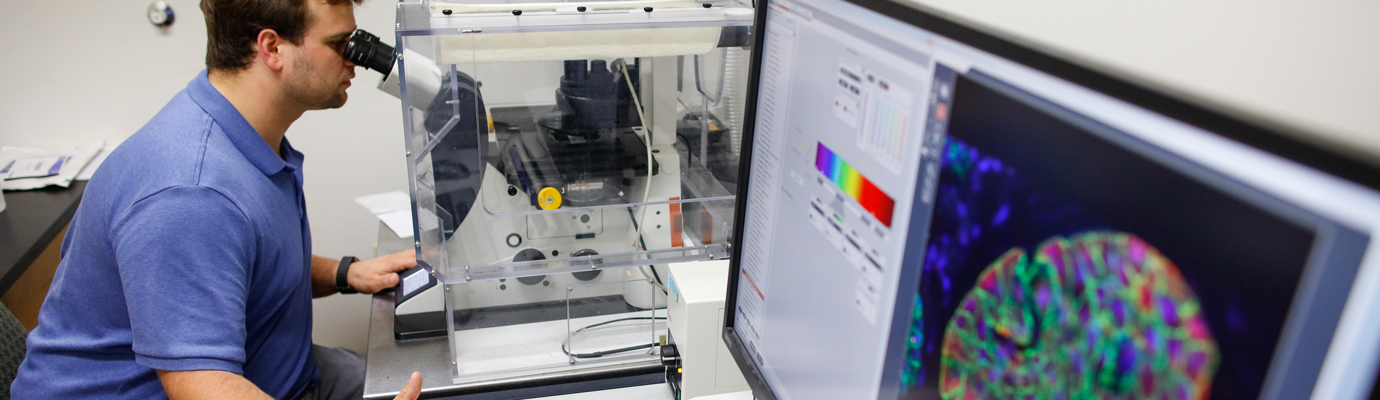
One of the great strengths of the laboratory is expertise
in cytometric techniques, both image analysis and flow cytometry.
Prior work applied these techniques to the study of clinical
specimens from bladder cancer patients and we showed that
single cell measurements of DNA content and determination
of chromosome copy number, and gene copy number by fluorescence
in situ hybridridization were both diagnostic and prognostic
for bladder cancer. Our studies on DBCCR1 employed imaging
of single cells over time to demonstrate DBCCR1 mediated cell
death, the first phenotype attributed to this putative tumor
suppressor gene.
We are developing an animal model of bladder cancer for use
in studying bladder tumorigenesis and for testing various
treatment and prevention strategies. In this transgenic mouse
model we have introduced a gene into mouse embryos that will
allow us to precisely control other genes in the mouse bladders
by adding the antibiotic doxycycline to their drinking water.
Thus abnormal proteins, proteins that we believe will cause
bladder tumors; can be switched on and off. This precise control
will allow us to study the development of bladder cancer at
the very earliest stages and devise sensitive detection methods
and refine treatment regimens.
The expertise developed in the study of bladder cancer has
recently been applied to the study of interstitial cystitis
(IC). IC is an inflammatory condition of the bladder. Individuals
with IC suffer from urinary frequency, urgency, and abdominal
pain. The etiology is unknown. The laboratory is studying
exfoliated cells in urine from IC patients enrolled in an
IC clinical trial. DNA cytometry has demonstrated changes
in cellular proliferation patterns in IC patients. Additionally
we are investigating the function of a substance found in
the urine of IC patients that has anti-proliferative activity
in vitro.
|
|
Borhan A, Reeder JE, O'Connell MJ, Wright KO, Wheeless LL,
di Sant'Agnese PA, McNally ML, Messing EM. Grade progression
and regression in recurrent urothelial cancer. Journal of
Urology, in press, 2003.
Wright KO, Messing EM, Reeder JE. DBCCR1 mediates death in
cultured bladder tumor cells. Oncogene, in press, 2003.
Wright KO, Messing EM, Reeder JE. Increased
expression of the acid sphingomyelinase-like protein ASML3a
in bladder tumors. J Urol 2002 Dec;168(6):2645-9.
Jung I, Reeder JE, Cox C, Siddiqui JF, O'Connell MJ, Collins
L, Yang Z, Messing EM, Wheeless LL. Chromosome
9 monosomy by fluorescence in situ hybridization of bladder
irrigation specimens is predictive of tumor recurrence.
J Urol 1999 Dec;162(6):1900-3
Reeder JE, O'Connell MJ, Yang Z, Morreale JF, Collins L,
Frank IN, Messing EM, Cockett AT, Cox C, Robinson RD, Wheeless
LL. DNA
cytometry and chromosome 9 aberrations by fluorescence in
situ hybridization of irrigation specimens from bladder cancer
patients. Urology 1998 May;51(5A Suppl):58-61.
Reeder JE, Morreale JF, O'Connell MJ, Stadler WM, Olopade
OF, Messing EM, Wheeless LL. Loss
of the CDKN2A/p16 locus detected in bladder irrigation specimens
by fluorescence in situ hybridization. J Urol 1997 Nov;158(5):1717-21.
Reeder JE, Cox C, Wheeless LL, Flint A, Liebert M, Grossman
HB. Variability
of DNA analysis by image cytometry. Bladder Tumor Marker Network
Cytometry 1997 Jun 1;28(2):176-80.
References are to the PubMed publications
list. PubMed is maintained by the National Library of Medicine
and provides abstracts of publications as well as links to
the full text of many articles (at journal homepages).
|