


Welcome to the Haber Lab
 Research Overview
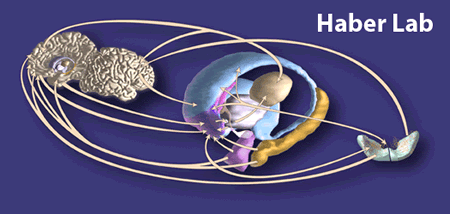
Dr. Haber's laboratory investigates the neural network that underlies incentive-based learning and decision-making leading to the development of action plans. The cortico-basal ganglia system is at the center of this circuit and comprises a diverse group of structures involved in reward and motivation, cognition, and motor control. The consequence of basal ganglia dysfunction is emphasized in the range of diseases that involve it, including mental health disorders such as obsessive-compulsive disorder, drug abuse and addiction, and schizophrenia, and motor control disorders including Parkinson’s disease. One set of experiments in Dr. Haber's laboratory address the hypothesis that the cortico-basal ganglia network processes information through both parallel and integrative circuits. A second set of studies focus on the pathway trajectories from different prefrontal areas to their targets. A third set of experiments focus on which pathways and terminals fields are likely to be involved in the therapeutic effects of during deep brain stimulation (DBS). A fourth set of studies address the changes in terminal fields and white matter tracts during postnatal development. Basal ganglia structures

Suzanne N. Haber, Ph.D.
Principal Investigator
Publications
View All Publications- Associations among mediodorsal thalamic-ventrolateral prefrontal cortical white matter fiber dispersion and OCD-related incompleteness.; Neuropsychopharmacology : official publication of the American College of Neuropsychopharmacology. 2026 Aug 26.
- A human subcortical connectome at 400 μm resolution.; bioRxiv : the preprint server for biology. 2026 Apr 03.
- Multi-dimensional diffusion MRI at ultra-high gradient strength for mapping axonal architecture and microstructure in the primate brain.; bioRxiv : the preprint server for biology. 2026 Feb 18.
- Medial prefrontal-thalamic white matter microstructure is associated with harm avoidance in OCD: a discovery and transdiagnostic replication study.; Neuropsychopharmacology : official publication of the American College of Neuropsychopharmacology. 2026 Jan 31.
Affiliations
- Pharmacology & Physiology
- Brain & Cognitive Sciences
- Neuroscience
- Psychiatry
- Conte Center for Research in OCD
- Del Monte Institute for Neuroscience
- Cellular and Molecular Pharmacology and Physiology Ph.D. Program
- Master’s Degree in Pharmacology
- Master’s Degree in Physiology
- Neurobiology & Anatomy Ph.D. Program
- Neuroscience Ph.D. Program
Contact Us
Haber Lab
Box 711
601 Elmwood Ave
Rochester, NY 14642
(585) 273-2652