



Intracellular Calcium Signaling
In the Yule lab, we are studying intracellular calcium signaling in cells which are typically, electrically non-excitable. In cells such as the liver, exocrine, pancreas, salivary glands and various cells in the blood, increases in intracellular calcium are fundamentally important for diverse processes including secretion of digestive enzymes and fluid, glucose metabolism together with cellular growth and differentiation.

An important event in triggering an elevation in intracellular calcium is the activation of intracellular Ca2+ release channels in the endoplasmic reticulum. In most cells we study, these channels come in two "flavors"--the inositol 1,4,5 trisphosphate receptor (IP3R) and the ryanodine receptor (RyR). We are interested in how these channels are regulated, inter-react and ultimately define the types of calcium signals we observe. To these ends, we use a variety of state of the art imaging and electrophysiological techniques, including high speed digital imaging, confocal microscopy and whole cell patch-clamp to monitor calcium signals with high spatial and temporal resolution. The hope is that a better understanding of the mechanisms which underlie these important signals will give insight into the control of important physiological processes in both normal physiology and disease states.
Current Research Projects
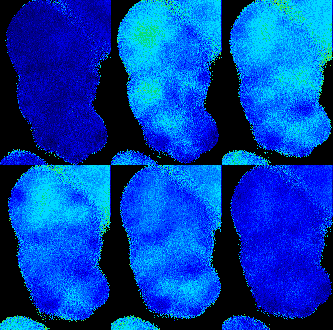 1. Determining the mechanisms whereby different agonists using traditionally the same intracellular messengers can generate agonist specific calcium signals and activate specific cellular processes.
2. Investigating if a genetic defect in the calcium signaling machinery expressed in salivary gland cells is responsible for patients with some forms of "dry mouth' disease.
3. Investigating defects in calcium signaling during acute pancreatitis.

David I. Yule, Ph.D.
Principal Investigator
Publications
View All Publications- Bcl-xL acts as an inhibitor of IP3R channels, thereby antagonizing Ca2+-driven apoptosis.; Cell death and differentiation. 2021 Nov 08.
- Pivotal role of type-1 inositol 1,4,5-trisphosphate receptor for glucagon-induced gluconeogenesis.; Cell calcium; Vol 90. 2020 Sep.
- An inside job: Annexin 1A-Inositol 1,4,5-trisphosphate receptor interaction conveys endoplasmic reticulum luminal Ca2+ sensitivity.; Cell calcium; Vol 90. 2020 Jul 08.
- Magnesium Acts as a Second Messenger in the Regulation of NMDA Receptor-Mediated CREB Signaling in Neurons.; Molecular neurobiology; Vol 57(6). 2020 Jun.
News
Affiliations
February 1, 2021
Amanda Wahl awarded a three-year NIH F31 Ruth L. Kirschstein Predoctoral Individual National Research Service Award
November 24, 2020
Lara Terry Published in JBC and will present at European Calcium Society General Assembly
August 29, 2016
Heilbronner and Yule Receive Awards at 2016 Convocation
July 5, 2016
David Yule appointed Louis C. Lasagna Professor
Contact Us
Yule Lab
Box 711
601 Elmwood Ave
Rochester, NY 14642
(585) 273-2652