

Research Programs
B Cells and Immune Diseases

Jennifer Nicholson, MS, Jennifer Anolik, MD, PhD and Javier Rangel-Moreno at American College of Rheumatology Convergence 2026 Conference
Defining the role of B cells in systemic autoimmunity has been instrumental in characterizing the impact of B cell depletion (BCD) on the human immune system and establishing B cell targeted therapies. This has been a major advance in the field of immunologic disease with broad implications in rheumatoid arthritis, lupus, diabetes, malignancy, and immune deficiency.
Findings demonstrating a link between the clinical response and the immunologic reconstitution with transitional B cells was the first delineation of a B regulatory cell population in humans, greatly advancing our understanding of BCD therapy and human B cell development pathways. A prominent publication defining new populations of human transitional B cells provided further fundamental insights into the developmental process followed by human B cells, identifying a new population of human transitional B cells. Recent work has elucidated a previously unrecognized cross-talk between the B cell compartment and neutrophil driven α interferon production in the bone marrow in systemic lupus erythematosus (SLE) that alters B cell development and selection, as well as a critical role for B cells in regulation of bone homeostasis in RA.
Program Faculty
Type III Interferon in Autoimmune Disease

Jennifer Barnas at Annual Meeting of American Association of Immunologists
Type I interferon production from nucleic acid-sensing pathways drives systemic lupus erythematosus pathogenesis according to current dogma. However, type III interferons (IFN-λ) can stimulate a similar gene expression profile utilizing a unique receptor. IFN-λ is detected in the blood, kidneys, and skin of lupus patients. The contribution of IFN-λ to lupus and lupus nephritis pathogenesis is currently unknown. The objective of this project is to identify which innate interferon pathways are dominant in the human renal microenvironment of lupus nephritis.
Immunohistochemistry and laser microdissection of patient renal biopsies will be used to assess in situ protein and RNA expression of innate interferons and their gene signatures. One working hypothesis is that nucleic acid sensors, IFN-α, and IFN-λ stimulate innate interferon production in human renal tubule epithelial cells to promote lupus pathogenesis.
Long-term goals include establishing the functional role of IFN-λ in lupus and the renal microenvironment including its contribution to renal fibrosis and end-stage kidney disease. Understanding how innate interferon pathways interconnect will allow for their therapeutic calibration for improved lupus patient outcome as well as in other autoimmune and viral diseases.
Program Faculty
Cell Processes in Fibrosis
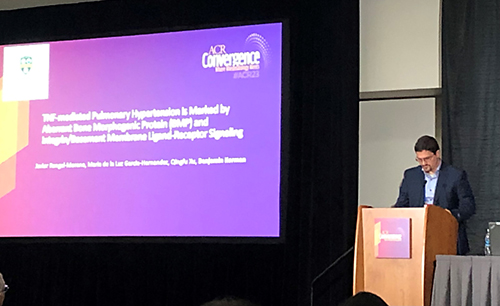
Benjamin Korman presents at American College of Rheumatology Convergence 2023
Systemic sclerosis (scleroderma) is a multi-system autoimmune disease characterized by fibrosis of the skin and internal organs, disease specific autoantibodies, and vascular disease. Adipose tissue and adipokines play a role in scleroderma and cutaneous fibrosis. Recent work has shown that adipocyte loss may be a primary event in fibrosis. Defining the role of adipocytes in skin fibrosis is pivotal to increasing the understanding of the pathogenic fibrosis occurring in this disease and elucidating potential treatment targets. In addition, the TNF-transgenic mouse model has proven a valuable tool in the further understanding of the pulmonary vascular disease in scleroderma and with additional characterization, may provide a mechanism for the pre-clinical investigation of potential targets for treatment.
Program Faculty
Therapeutic Targeting of Senescent Cells in Lupus
Targeting senescent cells in patients with lupus presents a potential novel approach to disease management and improved clinical outcomes. While it is known that lupus patients possess cells with a senescence-like phenotype, it is unknown whether these cells would respond to available senolytic drugs. Studying the effects of these drugs in vitro using patient and lupus mouse model samples will further fundamental insights into the potential role of senolytic drugs in the treatment of lupus.
Program Faculty
Human Skin Immunology
Little is known about the role that cutaneous B cells play in skin immunity, a significant gap in our understanding of the immunology of the skin. While cutaneous B cells are uncommon in healthy skin, they are present in inflamed skin and are most prevalent in skin lesions of patients with discoid lupus erythematosus (DLE). However, the phenotype and function of B cells in DLE lesions have not been studied and it is unknown whether cutaneous B cells play a role in DLE pathogenesis. Our initial studies of cutaneous B cells in DLE will support our long-term goals of better understanding the role of B cells in skin immunity and developing improved targeted therapies for skin disease.
Program Faculty
Pathologic Bone Resorption and New Bone Formation in Inflammatory Arthritis

Luz Garcia-Hernandez and Javier Rangel-Moreno present at American College of Rheumatology Convergence 2024
Bone remodeling is a dynamic and complex process finely orchestrated by cell interactions among bone-degrading osteoclasts, bone-synthesizing osteoblasts, T cells, B cells, and natural killer cells. An imbalance between osteoclast and osteoblast activity results in skeletal and joint diseases including osteoporosis, arthritis, and non-union bone repair. These diseases impact the quality of life of patients.