Letter from the Co-Directors: Winter 2025
Celebrating a Leader
UR CTSI is privileged to have had so many wonderful faculty and staff contribute to our success over the years. Ann Dozier, PhD, our function leader for Evaluation and Continuous Quality Improvement and a leader in our Recruitment and Retention efforts, is one such person. Ann, who is retiring this year, has contributed to the institute since the very first grant application to the CTSA Program all the way back in 2005-2006. She has served in a variety of roles with us ever since.Anyone who worked with Ann knows her personal warmth, professionalism, and her ability to tackle tough problems head on with grace and confidence. We are not the only ones at URMC who will miss her contributions. Thank you, Ann, for your many decades of service to UR CTSI, URMC, and the field of public health. We are all very lucky to have you as a colleague and friend.
High Points and Challenges
As we move into the end of the calendar year, we have a lot to celebrate. First, as many of you have already heard, we successfully renewed the NIH grant that supports much of the UR CTSI’s funding mechanisms and services. It was a long process and required an outstanding team effort. We are so grateful for the hard work and patience of all of our faculty and staff. We will celebrate this achievement sometime in 2026.
We launched Translational Science Grand Rounds, a monthly event that brings in local and national experts in translational science and research. You can track upcoming sessions here. Our next presentation is by Jennifer Dahne, PhD, of the Medical University of South Carolina. Her presentation is “Transforming Behavioral Health: Improving Outcomes via Digital and Telehealth Innovations” on January 8. Please join us for this virtual event.
This year, the Office of Clinical Research (OCR) worked with research teams across the institution as they dealt with a difficult administrative issue related to the Participant Payments system. Josh Cook led this effort with professionalism and patience. Once again, our thanks goes to him and the whole team. This was in addition to working hard on a 15-month project with the Wilmot Cancer Institute, migrating all Oncology electronic regulatory binders from a legacy system to the new Advarra eReg. This was a herculean effort for both the OCR and WCI Regulatory teams, highlighting the collaborative spirit of UR CTSI.
In October, OCR also successfully migrated the OnCore application to the cloud environment. Preparations for the move began in the spring and required close partnership with Advarra, as well as internal URochester partners. It was a textbook transition. Well done!
On the other side of the clinical research house, we are very excited for the Clinical Research Center to move back to its restored and renovated location after a catastrophic flood in late 2022. We plan to host a celebration for that grand re-opening soon. More to follow.
Continuing the theme of celebration, we were thrilled that the National Center for Deaf Health Research will continue to be funded by the CDC on their current grant. This will enable the center to continue its important work as an international leader in Deaf health research.
We would also like to thank Jonathan Raab, our communications director, for helping us navigate this challenging year and for producing timely updates to the institute faculty and staff, as well as keeping us connected to the broader University community. Thank you also to Melissa Trayhan for providing technical and best-practice expertise in maintaining and continuously improving our website, which is a key communications channel.
On the research front, Zidian Xie and Dongmei Li continue to publish, examining how digital channels affect e-cigarette perceptions and use. Zidian was also selected for the AIM-AHEAD All of Us Training Program, beginning this month and continuing through July.
The Informatics and Analytics team is continuing to pilot the de-identified Observational Medical Outcomes Partnership—OMOP—to new users during their soft launch of the service. A larger rollout will follow soon.
We are also launching new services in 2026, including a few related to AI. The Digital Innovation and Research Ethics Consultation Service—or DIRECT—under Jonathan Herington, PhD, and Kevin Boyd, MDiv, went live this fall, providing consultation to research teams on the ethical use of AI in research. We plan on announcing additional AI support services soon.
Education Mission
Our first cohort of K12 awardees have now joined our second-year Translational Scholars—early career faculty who benefit from funding, professional development, and networking focused on translational science and research. Jin Xiao, DDS, PhD, and Andrew Thomas, MS, have done an outstanding job rethinking our career development programs and adding valuable opportunities to increase engagement.
Our pilot grant award programs have also gotten an update, thanks to Rebecca Laird, MBA, MDiv, Edward Schwarz, PhD, and Olle Sahler, MD, MS, among others. Our education mission also extends to our events, including America’s Got Regulatory Science Talent. Joan Adamo, PhD, and Karen Grabowski organized a great event where students from across the University competed by presenting solutions to the FDA regulatory science focus areas. This is a popular program with a strong turnout every year and gets students thinking about translational science in a very contextual way.
At Translational Science Day this past October, we once again had very strong registrations and attendance. We are proud of the accomplishments of the contributors and organizers of the event from across our institute.
We also wish to congratulate Translational Biomedical Science PhD candidate Abigail Boss, who recently won the University-wide Three-Minute-Thesis competition. We are proud to have one of our students take first place!
Strategic Support for 2026
In 2026, we will support URMC’s new strategic vision. We are helping the institution become a clinical trails powerhouse through our robust administrative, infrastructure, service, and funding resources. We boost expertise in team science through our leadership in the CCOS CTSA Consortium coordinating center, collaborative workshops, and other efforts. Our student, early career faculty, and research staff education programs are building up the roles needed to conduct high-level research. Our new AI and other innovative services will help keep education and research teams on the cutting edge of technology and practice.
We are ready to help make URMC the best place to innovate, work, learn, and heal. We look forward to working with you on that journey.
Happy holidays and have a wonderful new year.
Sincerely,
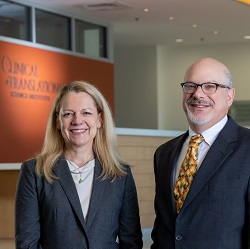
Co-Directors Karen Wilson, MD, MPH, and Martin Zand, MD, PhD
Jonathan Raab | 12/18/2025