Students Address FDA Priorities in America’s Got Regulatory Science Talent
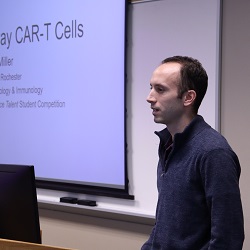
The annual America’s Got Regulatory Science Talent student competition hosted by the Office of Regulatory Support and financially supported by UR Ventures harnesses student creativity and passion to address the FDA’s regulatory science focus areas.“Thinking about regulatory science in the context of the FDA’s focus areas really helps students connect both their academic work and real-world interactions with regulated products to address regulatory science challenges,” said Joan Adamo, PhD, director of the Office of Regulatory Support. “This competition always draws students who are excited to share their ideas with the judges and one another. It’s really inspiring.”
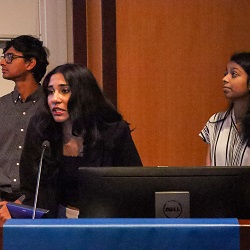
The contest was held in December. This year’s judges were Lisa DeLouise, PhD, MPD, associate professor of Dermatology and Biological Engineering; Corey Hoffman ‘17, PhD, biologist and contracting officer's representative, Biomedical Advanced Research and Development Authority; and Ronald Krall, MD, adjunct professor of Neurology, chairman of the board of Pierian Biosciences.
Nine teams competed, covering a variety of FDA focus areas of regulatory science. Of those teams, three were selected as placing winners for 2025.
First Place
Team: Patent Pending | Michaela Rymal and Bella Smith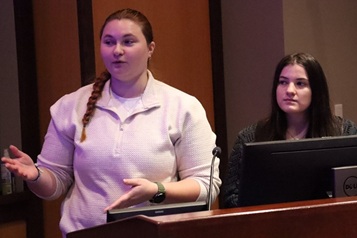
Presentation: “Predicate Revalidation Equivalency Safety Scoring (PRESS)”
Rymal and Smith are both in the Center for Medical Technology and Innovation Biomedical Engineering master’s program.
“We developed the idea for the pitch through a combination of what we learned in our FDA class as well as a lecture on medical ethics in our medical devices class,” Rymal said. “Through learning about the 510(k) process, we looked at its drawbacks and the impact they had on people's lives. That was what inspired us to really dig in and find a solution.”
Rymal and Smith hope to pitch their idea directly to the FDA.
Second Place
Team: KIMpossible | Michelle Eldred, Farah Kabir, and Collins Owusu-AnsahPresentation: Reducing FDA’s Reliance on Animal Studies: Kidney-on-a-Chip with Aptamer Biosensors
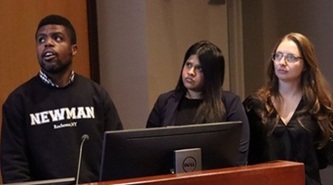 “The idea for our pitch was originally proposed by my teammate Farah, although the name was Michelle's idea,” said Owusu-Ansah, a master’s student in the Biomedical Engineering program. “As a team, we each submitted ideas, discussed, and ultimately voted to move forward with this concept because of its strong translational potential.”
The kidney-on-a-chip idea had strong resonance with the team.
“That final idea allowed us to bring together our individual strengths and apply them in a way that felt both meaningful and impactful, resulting in a regulatory solution we all believed in and were excited to work on,” said Farah Kabir, a PhD candidate in Biomedical Engineering.
“The project highlighted how human-relevant models can help detect toxicity earlier, reduce and refine animal studies, and ultimately support safer and more efficient drug development. It reinforced the importance of bridging bench-level innovation with regulatory needs to ensure research can realistically translate into clinical and regulatory impact.”
Third Place
Team: DELVE | Rhodalyn EssienPresentation: Digital Ecosystem for Linking Data and Validating Adverse Events

“With the rapid advancement of artificial intelligence, digital health technologies, and social media, I recognized that large, complex datasets are increasingly available but remain underutilized,” said Essien, a PhD candidate in the Pharmacology and Physiology program. “To address this gap, I proposed DELVE—Digital Ecosystem for Linking data and Validating adverse Events—a privacy-protected, hybrid data ecosystem designed to generate real time, high-quality, real-world evidence by integrating social media analytics, wearable biosensor data and e-health data.”
Essien would like to pitch this concept to the FDA, then, through collaboration with computational scientists, optimize the framework and pilot its use to evaluate its performance. The project would ultimately contribute to improving regulatory processes while protecting patient safety.
Jonathan Raab | 1/8/2026