

Advanced LASIK Technology
Advanced LASIK Technology
At Flaum Eye Institute, LASIK is guided by advanced imaging and laser technology designed for maximum precision and safety. The right tools enable our experienced surgeons to measure your eyes in extraordinary detail and offer advanced treatment options.
Flaum Eye Institute offers Custom All-Laser LASIK. This approach uses two advanced laser systems—one to create the corneal flap and another to reshape the cornea—allowing for greater precision, safety, and personalization.
As part of an integrated health system, our surgeons evaluate and adopt the latest technology based on clinical evidence and patient safety. The surgeons of the Flaum Eye Institute work with world-leading scientists at the University of Rochester’s Center for Visual Science and the Institute of Optics to improve LASIK and other vision correction technologies. This unique partnership results in some of the best and safest LASIK outcomes anywhere!
Why LASIK Technology Matters
No two eyes are exactly alike. Even patients with the same prescription can have different corneal shapes, thickness, pupil size, and visual characteristics.
Our technology allows us to:
- Map your eye in 3D
- Measure subtle visual imperfections
- Customize your treatment to your unique eye structure
- Improve precision and safety during surgery
Advanced technology enhances precision, but Flaum Eye Institute understands that outcomes also depend on careful screening and surgical expertise.
Because we use multiple advanced platforms, your surgeon can select the technology best suited to your vision.
Our LASIK Technology
All laser systems used at Flaum Eye Institute are FDA-approved and supported by extensive clinical research.
 Contura and iDesign Personalized Treatments
Wavefront-guided LASIK was originally developed through a partnership between the University of Rochester and industry. Continuous improvements to this technology make it the standard of care today. Because not one size fits all, we have two systems that create “fingerprints” of your vision.
Our systems measure how light travels through your eye. They detect subtle distortions that standard vision tests cannot identify. This information helps your surgeon determine the best treatment for your eyes, not just your prescription.
Multiple Laser Platforms
Depending on the right fit for your eyes, we use the Alcon EX 500 and VISX S4 excimer laser platforms to reshape your corneas during LASIK.
Features include:
- High-speed treatment
- Precise laser delivery
- Built-in eye tracking technology that adjusts for small eye movements
The procedure typically takes less than 10 minutes per eye.
Ziemer FEMTO LDV™ Femtosecond Laser
This laser creates the thin corneal flap used in LASIK before the excimer laser corrects your vision. Using a femtosecond laser (rather than a mechanical blade) allows for:
- Greater precision
- Consistent flap thickness
- Enhanced safety
- Less inflammation
This all-laser approach adds another layer of control and predictability.
Corneal Topography
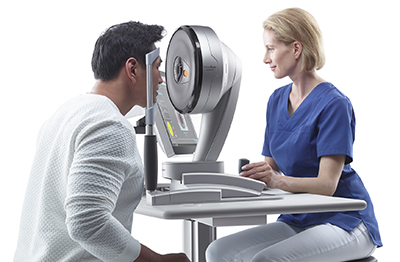 Our state-of-the-art corneal topographers create a detailed 3D map of your cornea. It measures:
- Corneal shape
- Elevation
- Thickness across the surface
This helps identify patients who may not be candidates for LASIK, such as those with subtle corneal irregularities. The system helps minimize surgical risk and supports safe treatment planning.
Corneal Thickness Measurement
Corneal thickness is a critical safety factor in LASIK. We carefully measure:
- Overall corneal thickness
- Residual tissue after treatment planning
If your cornea is too thin, your surgeon may recommend an alternative to LASIK, such as PRK.
Pupil Measurements
Your pupil size can affect night vision after LASIK. We measure your pupils in different lighting conditions to:
- Assess night-driving considerations
- Reduce the risk of glare and halos
- Guide customized treatment planning
Contrast Sensitivity Testing
Contrast sensitivity testing measures how well you see subtle differences between light and dark—especially in low-light settings.
This helps your surgeon better understand your overall visual quality before and after treatment.