

Miracle Kids 2026: Tommy Klein
Persistence, partnership, and playful learning open up a new world
Suzanne Klein waited eight years for her son to say, “I love you.”
She remembers the day: Nov. 25, 2025. She was in the kitchen with Tommy, who was eight, and had just handed him something to drink. After taking the glass, Tommy reached up and gently turned his mother’s face toward his own. Looking straight into her eyes, he said the phrase he had never said on his own.
In an instant, she began to cry. “I’d waited so long for that moment,” she would say later.
Then, from across the kitchen, came Tommy’s 10-year-old sister Ella’s voice, “I don’t know why you’re crying; I tell you I love you all the time!”
Laughter broke through the tears. It was a moment that captured everything about their family.
Long before that moment—and long before he became the boy he is today—Suzanne had been trying to understand how Tommy experienced the world. When Tommy was just three weeks old, Suzanne remembers rocking him and noticing something unusual. Instead of the coos and cries she was expecting, he made constant grunting noises. He didn’t cry to signal discomfort or hunger; if he woke in his crib, he would simply lie quietly. He resisted being held or rocked, preferring to be put down, which left Suzanne feeling uneasy.
“It’s one of those flashbulb memories,” she said. “I remember looking at my husband and saying, ‘I wonder if Tommy has autism.’”
The Signs Were Always There
In the months that followed, Suzanne found herself caught between worry and hope.
At times, things seemed to move in the right direction. By three months old, Tommy had a wide smile and made strong eye contact. Suzanne wondered if those early concerns had simply been part of a difficult newborn phase.
But as Tommy grew, other signs appeared. He didn’t seem motivated to move, and some developmental milestones came later than expected. At 11 months, he wasn’t pulling himself up to stand. He could spend long stretches happily waving objects, like a cabinet protector or a straw, in front of his eyes, watching them move.
Comparisons with his neurotypical older sister made the differences clearer.
“She was into everything,” Suzanne said. “Tommy was content to sit and watch.”
As delays continued, even with early physical therapy, Suzanne and her husband, Mike, knew they needed answers. When Tommy was 20 months old, GCH Developmental Pediatrician Susan Hyman, MD, confirmed what Suzanne and Mike had begun to suspect: Tommy had autism.
The diagnosis didn’t change who Tommy was, but it did mark the beginning of a journey that would require persistence, research, and advocacy.
Finding the Keys and Opening Doors
Diagnosis in hand, Suzanne didn’t wait for answers to come to her. She and Mike went out and got them.
Advocacy was a daily practice. Together, they read countless books on autism, dissecting therapy models and comparing strategies, emailing the authors and researchers to ask questions about methods and outcomes. They tracked Tommy’s responses, noting what worked and what didn’t.
When local therapists didn’t know how to implement these methods, Suzanne became their guide. She showed them how to run sessions, engage Tommy using his own interests, and measure his progress against research-backed benchmarks.
Suzanne became certified in the Parent Early Start Denver Model, an evidence-based, early-intervention program that uses a play-based approach to naturally teach foundational communication and social skills to babies and toddlers. She learned firsthand how to support social engagement and communication in everyday moments such as meals, bath time, and even trips to the grocery store. But the Early Start Denver Model was only part of the picture. Suzanne and Mike were simultaneously drawing from a range of evidence-based frameworks—Pivotal Response Treatment, gestalt language learning, and behavioral principles—weaving together what fit Tommy rather than committing to any single theory. It was an integrated, often head-spinning process of learning and adapting in real time. And they weren’t doing it alone or from a distance.
They directly sought out leading researchers in the field, breaking down doors to get expert guidance from people like Dr. Laurie Vismara from the Autism Research Institute and Dr. Lynne Koegel from Stanford Medicine; not just taking courses, but building relationships with world-renowned experts who could help them understand what their son needed. Each small intervention helped frame a structured, individualized program tailored to Tommy’s needs.
These relationships and interventions also laid a foundation for the next crucial step: JASPER (Joint Attention, Symbolic Play, Engagement, and Regulation), a play-based therapy designed to develop social communication through guided interaction and play. In March 2022, Tommy enrolled in a research study at the Golisano Children’s Hospital’s Division of Developmental and Behavioral Pediatrics (DBP), which included comparing multiple different intervention approaches—one of which was JASPER—and DTT (Discrete Trial Teaching). The hospital was the only site in the region offering the program and was partnering with sites across the country, including UCLA, on the study, giving Tommy rare access to this promising therapy.
For Suzanne, the opportunity stood out for another reason: It was the first intervention she encountered that was implemented with the same commitment as the research behind it, something families often struggle to find.
“I was literally considering moving to California to get him into a study there,” she said. “Interventions like JASPER just weren’t available.”
Before JASPER, Tommy’s play and communication were often limited and repetitive.
“He had lots of scripting; speech that sounded like words but was hard to understand once you listened closely,” said psychologist Ally Jordan, PhD, assistant professor in the Division of Developmental and Behavioral Pediatrics at GCH.
He might spend long stretches focused on a single object, like a door, or on solitary routines that didn’t invite interaction.
“Doors are one of his favorite things ever… anything he played with became a door,” said behavior analyst Emma Beach, BCBA, health project coordinator in the Division of Developmental and Behavioral Pediatrics.
Through twice-weekly sessions over six months, the child-led program leveraged Tommy’s natural curiosity, using his interests to create meaningful scenarios that encouraged initiation, joint attention, and creative play. As the research study neared completion, there was a push to actively translate research to practice—by finding ways to make JASPER available as a local clinical service accessible to patients and families outside of research. Suzanne was a huge supporter of this from the start.
Beach and Jordan emphasized that Tommy’s growth wasn’t just about therapy; it was the combination of his family’s advocacy and their active participation in planning and generalizing skills into everyday life that made the intervention transformative.
For Suzanne, the change was striking. Everyday moments—play at home, conversations during routines, even shared jokes—reflected the skills Tommy was learning in JASPER. “I don’t know if Tommy would be verbal without JASPER,” she said. “It was the first therapy where we saw him respond in a big way, and his development truly took off.”
Tommy’s journey with JASPER began with a research study at URMC, one Suzanne discovered and pursued herself, rather than being recruited through the usual channels. After the study concluded, he participated in Golisano’s practice phase, helping clinicians refine the approach for the local setting. The insights from that work contributed to the launch of a permanent clinical program at Golisano, giving families in the region ongoing access to this innovative, play-based intervention, and showing how an engaged family can help shape lasting change.
Beach calls Suzanne “an amazing advocate” who is “an incredible person to collaborate with. She wants an active role in the development of Tommy’s treatment goals and plans, and I think that’s so critical and so helpful for us as the interventionists.”
“She’s not asking if services are available; she’s finding them, creating them, pushing for them,” Jordan said. “She’s been an integral piece in getting this program up and running.”
The Sign Says Welcome
The combination of JASPER, his care team’s work, his family’s advocacy and support, and the encouragement and companionship of Ella have transformed Tommy’s development. Together, they helped create an environment in which Tommy could build confidence, communication, and connection in ways that carried far beyond the clinic.
His vibrant and playful personality fills a room. At home, he delights in routines and imaginative games.
He loves pointing out street signs. He’s drawn to letters, songs, and phrases that he repeats with enthusiasm. His bright blue eyes light up when something captures his attention, and when he wants someone to really listen, he’ll gently turn their face so they’re looking right at him.
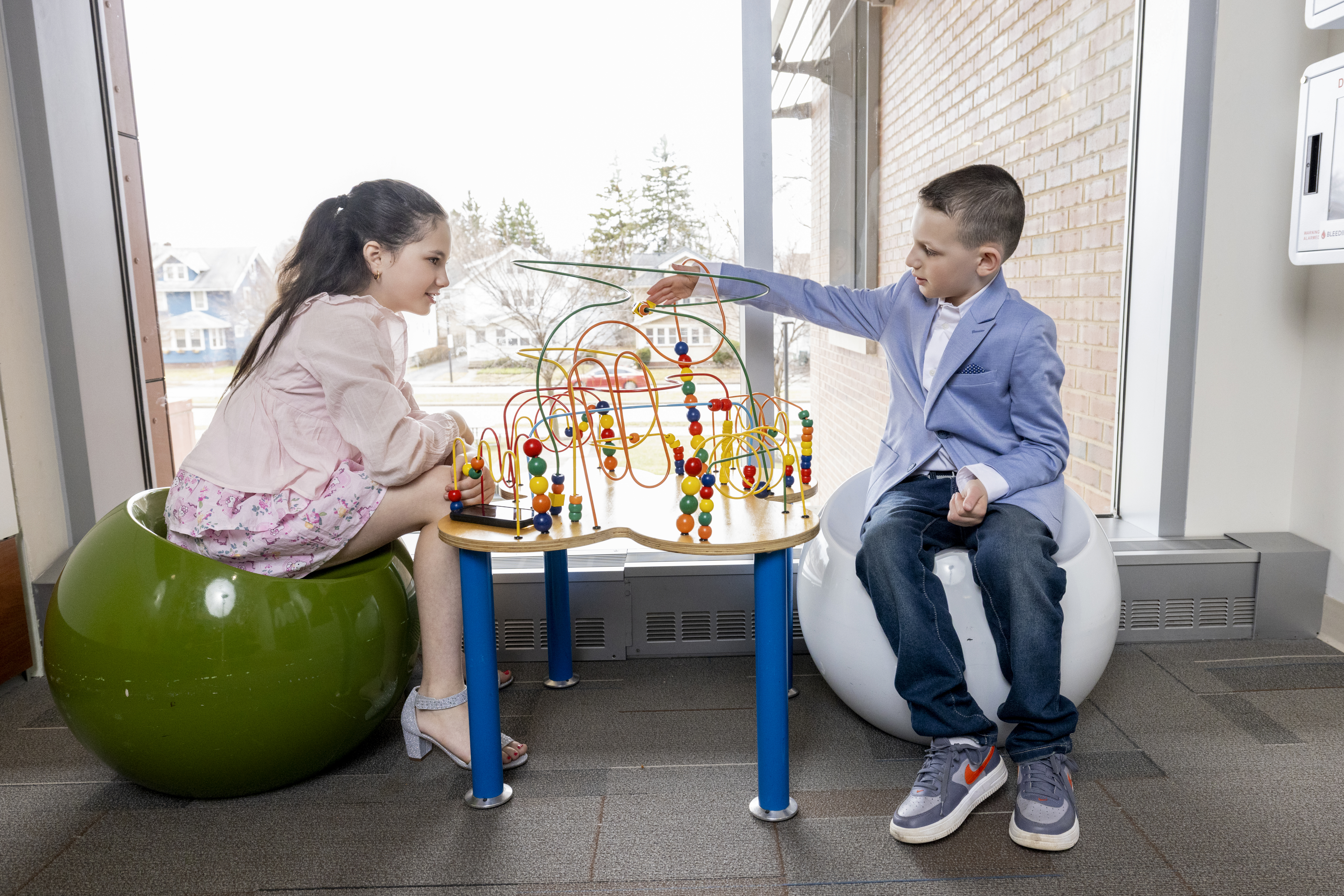
With Ella, Tommy’s playful side shines brightest. Whether they’re playing games or simply spending time together, Ella has become both a teammate and a cheerleader, helping her brother navigate the world while celebrating his unique perspective. She often joins him in the waiting room for his appointments.
Outside the home, Tommy approaches the world with an openness that draws people in. “He finds joy in anything; things we take for granted,” said Beach.
That joy is often the first thing people notice. “When I go out to greet him, he pops up with the biggest smile,” said Jordan. “It’s a great way to end my day twice a week.”
For Suzanne, those smiles reflect the boy she has always known. “He has just got this really warm, loving way about him,” she said. “Seeing the world through his eyes is definitely special.”
Today, Tommy’s life is filled with connection: at home with his family; in therapy sessions, where he continues to grow; and in the everyday moments when his curiosity and joy shine through.
Holding the Door Open for Others
Tommy’s story is about more than one child’s progress.
“It matters because it shows what family support can do,” said Beach. “It matters because an individualized intervention can make a difference. And it matters because there is always a need for more positive and authentic representation of autism and neurodiversity in today’s world, and Tommy and his family’s story serves as a great example of that.”
Tommy’s journey hasn’t always been easy. “Progress may not always look the way you expect,” Suzanne said. “Sometimes the road is longer and harder than you imagined, but the moments along the way—the first ‘I love you,’ the first hug, the first laughter, the first meaningful connection—make everything worth it.”
“Tommy has truly taught us more about perseverance, joy, and seeing the world in a different way than we could have ever imagined,” she said. “Our lives are richer because of him.”
To other parents navigating a similar journey, her message is about patience and perseverance, even when progress is hard to see.
“Sometimes it feels like you’re working so hard and not seeing progress yet. You feel like you’re drowning in quicksand while working so hard,” she said. “But Dr. Vismara always told me it was simmering, all those hours of work. At the time it was hard to wait for those skills to emerge, but they did.”
And through it all, she says, parents have to hold on to what they know in their guts.
“You know your child better than anyone else,” she said. “If they don’t have you, who do they have?”