

Pushing ahead: Precision medicine, national leadership in lymphoma
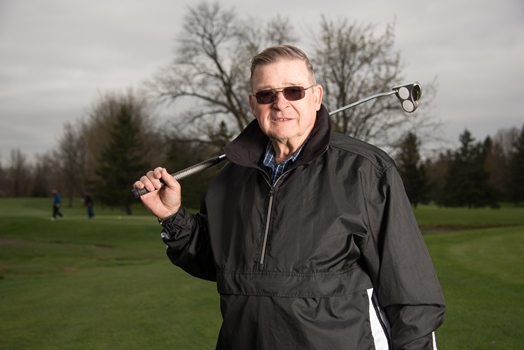 At 74,Steve Coreyrefuses to give up anything.
Despite his aggressive, incurable lymphoma, he gets out on the golf course every week, weather permitting. The retired engineer also keeps himself busy withhis family and their camp.
Diagnosed withdiffuse large B-celllymphoma in 2014, Coreyparticipated in a clinical trial at Wilmot Cancer Institute that put him in remission for nine months. When his cancer came back, his oncologist, CarlaCasulo, M.D., laid out his options.Hechose a new targeted therapythathas kept his cancer at bayso far.
“The pill I’m taking could stop working next week,”says Corey, who lives in Penn Yan, N.Y.“But every day it keeps the cancer from coming back is another day for someone to pour something from one vial into anotherand maybe find an answer.”
Wilmot’s lymphomaprogramishelping to lead the search for those answers.They are collaborating with experts in fields such asimmunology and hematopathology to understand better how these cancers of the immune system behave. They’re looking for answers in the biology of these diseases—in the molecular make-upof tumors and in the non-malignant cells that surround these cancers. They’realsotesting novel therapies andtherapeuticcombinations to find ways to make them more effective without making them more toxic.
Their workisshapingthe way lymphomas are treated around the world.
“We can now apply basic scientific knowledge of these diseases to make a precise diagnosis and can often go one step further to use targeted therapy to control the specific lymphoma affecting a patient,” says CliveZent, M.D., who leads Wilmot’s lymphoma team.
Challenge of prediction
Over the last 20 years, researchers have been uncovering the complexity of lymphoma and the challenges it presents for treatment.
The term “lymphoma” applies to more than 60 diseases with very distinct characteristics. Some of thesecancersgrow slowly, and some are aggressive. Some require immediate treatment, while others needonlyactive surveillanceand supportive management unless they progress.Somerespond well to standard therapies, but othersdon’t.And sometimes, they changefrom one type of lymphoma to another.
Their behavior often can’t be predicted at diagnosis, which complicates choosing the best course of action.
In follicular lymphoma, for example,manypatients willnot require treatment for several years and often respond well when initial therapy is started.Although most follicular lymphomas are not curable with current therapy, patients with this disease can live for decadeswith this slow-growing cancer, evenif their disease returns later.
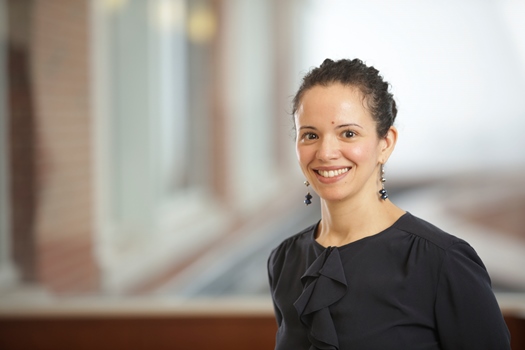 However, in a study that has garnered international attention, Casulo identified thatabout 20 percent of people with this common non-Hodgkin lymphomarelapsewithin two years.There’s no way to identify them before their cancer comes back.
Casulowas also able to establish that patients who relapse early also have poor survival outcomes. Her study showed that about half of them will die within five years — regardless of which treatments they receive — a finding that brought urgency to addressing these patients’ needs.
“We can’t wait two years to find out whether they will relapse or not,”Casulosays. “We need to identify them at diagnosis.”
Her findings have been validated by researchers around the world, and they have prompted a flurry of studies to find out more about what makes these patients differentandwhat treatments will be most effective for them.
Casulois continuing to study this group, collaborating withhematopathologistRichardBurack, M.D., Ph.D., toidentifythe biologic characteristics of these patients using samples from Wilmot’s own tissue bank.
Beyond Rochester, the National Cancer Institute’sLymphoma Steering Committeehas designated this early-relapse group a priority populationfor further dedicated study on a national scale.As part of that effort,Wilmot hematologist Paul Barr, M.D., is designing the largest cooperative groupclinicaltrial in the countryfocused on these patients.
This randomized, phase 2 study will be conducted atWilmot andmanyothercancer centersnationwideled byNCI’s National Clinical Trials Network. It willcomparestandard chemotherapywithtwo novel treatment strategies for patients who relapse early.
“Making follicular lymphoma a manageable chronic disease for more patients — or even curable for some — is possible in our lifetime,” Barr says.
Personalizing therapies
At Wilmot, specialized pathologists are looking at ways to discern why some lymphomas that seem similar can behave so differently. They are studying lymphoma’s genetic fingerprints and other molecular features to understand their influence on treatment and prognosis.
“It’s like looking at spots on a dog,” sayshematopathologistAndrew Evans, M.D., Ph.D.“On the outside, a Dalmatian looks different than a cocker spaniel, but you need to understand inside what makes them different biologically.”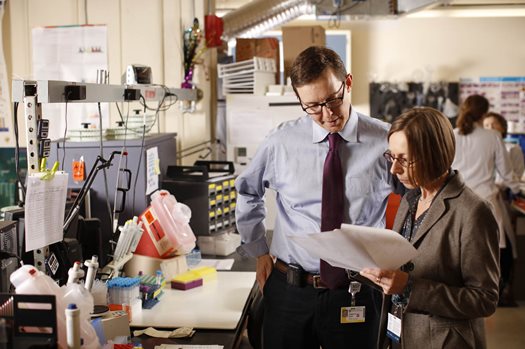
Evans,Burackand their colleagues are approaching this from a number of angles. They are looking to identify molecular changes that could signal when a low-grade lymphoma will become more aggressive. They are examining lymphomas at different points in time and from different locations in the body to understand how the disease changes and interacts with their environment.
“We need to understand lymphoma at a finer level,” Evans says.
That understanding is driving a shift away from one-size-fits-all treatment, as investigators find new ways to undermine the cancer’s survival mechanisms.
“The better we understand all of the different lymphomas, the more we recognize that the treatment approaches need to be personalized,” says Louis Sandy Constine, M.D., a Wilmot radiation oncologist who helps lead national and international committees dedicated to developing criteria and guidelines for using radiation therapy to treat lymphoma.“This is a dynamic field with new discoveries that open doors for new approaches to treatment.”
Oneexampleischronic lymphocytic leukemia,also called small lymphocytic lymphoma in some patients.CLLis the most prevalent form of blood cancer in the United States. Until a few years ago, it was a devastating disease for patients who didn’t respond to standard chemotherapy.
Through participation in national clinical trials, Wilmot contributed to the development of three drugs that have revolutionized the treatment of CLL. These drugs — ibrutinib,idelalisibandvenetoclax— work by interfering with the lymphoma cells’ ability to grow unchecked. They were given accelerated approval by the U.S. Food and Drug Administration over the last two years after nationwide clinical trials.
Advancing treatment
Clinical trialsare a priority for Wilmot’s lymphoma program, whichenrollsabout25percent of patientsneeding treatmentonthese studies.By participating in cooperative groups like SWOG and partnering with industry, Wilmot can stayat the forefront of lymphoma care and offer patients access to new treatments and technology.
“We’re constantly thinking not just about how we are treating patients today, but how we are going to treat them in 20 years and planning for the future,” Barr says.
Wilmot’s portfolio of lymphoma trials includes new techniques for blood and marrow transplants, targeted therapies, and immunotherapies that attack the cancer cells in different ways. The availability of trials gives patients more options if they don’t respond to standard treatments or when their therapies stop working.
“A quarter of our patients are getting treatments today that may not bewidelyavailable,”says Jonathan W.Friedberg, M.D.,M.M.Sc., Wilmot’s director and a lymphoma expertwho has ledinternational efforts to design trials and educate other hematologists andoncologists about new findings.
For example, Wilmot is one of the only cancer centers in New York state to offer CAR T-cell therapy trials for patients with lymphoma. This novel therapy involves re-engineering a patient’s immune cells and training them to attack the cancer.So far,twopatients at Wilmot have participated in these trials, and they have gone into remission.
The first patient at Wilmot to undergo CAR T-cell therapy, Ed Foster of Elmira, went into remission for nine months, allowing him to return to his work as a physician and to enjoy hunting and fishing. Although his cancer returned and he later died, his experience in the trial continues to inform the researchers at Wilmot and nationwide who are also part of this study.
“We were able to take a biopsy of his tumor and were able to study it to find out how it escaped the CAR T-cell therapy,” Friedberg says. “We think we understand why it progressed and this will informfuture research efforts to preventthese recurrent events.”
Even after trials close and therapies are approved by the FDA,clinical investigatorscontinue tofollow patients who are on those drugs.For example, Wilmot’s team maintains a database that includes informationon500CLL patients they’ve treated since2014. This data allows them to see how patients are doing in the real world — not justinthe defined conditions of a clinical trial.
They are looking at how well patients are tolerating medications like ibrutinib andidelalisib,which patients have had to stop taking them and why, and what happens to those patients after they discontinue thosedrugs. They’reinvestigatingthe impact of the shift from chemotherapy totargeted agentson patients’ risk for infections or secondary cancers and on the risk of cognitive problems like chemo-brain.
“This database allows us to look at the big picture,”Barr says. “Are we improving not justonetreatment but also patients’ lives as a whole?That’s something that you can’t study in a clinical trial.”
Collaboration and observation
As with CLL, Wilmot has helped establish an international database to follow cases of hairy cell leukemia, a rare and slow-growing lymphoid malignancy that can be serious if left untreated. As one of 23 institutions worldwide to become a North American Center of Excellence for Hairy Cell Leukemia, Wilmot is also helped develop management guidelines for this disease that were published earlier this year.
Collaborations such as this are amongthe strengths of Wilmot’s lymphoma program. Their reputation forworking togetherhas brought themmanyinvitations to participate in importantnational and internationalprojects.
Another exampleis the Lymphoma Epidemiology of Outcomes (LEO) Cohort Study, which will follow12,000patients overfive yearsto learn more about the possible causes, best treatments and survivorship in non-Hodgkin lymphoma.Seven other prominent medical centers, including Mayo Clinic, MD Anderson and Washington University of St. Louis, are also participating in this project.
At Wilmot, about four patients per week agree to be followed as part of thisobservationalstudy, whichincludes genetic analysis of their cancers, clinical outcomes and information that patients report about their health. It will help researchers better understand how lymphomas develop, what factors lead to their progression and how these diverse diseases respond to a variety of treatments and other conditions.
“With this consortium, we are poised to make major contributions to the understanding and treatment of lymphoma,” says Friedberg, one of the principal investigators on the LEO project.CasuloandBurackare also principal investigators.
Although the LEO Cohort Study is observational, italsoprovides an infrastructure for the participatingcenterstowork togetheron therapeutic trials — studies that test new treatments or regimens.
Friedberg,for example, isplanningalargerandomized clinical trialthat includes the LEO centers to evaluate whetheradding vitamin D to standard treatment for follicular lymphoma will improve outcomes.Funded with more than $3 million by the National Cancer Institute, this studycould provide a relatively simple, inexpensive way to improve overall survival amongthese patients.
“This could have incredibly broad impact,” Friedberg says. “If the trial is positive, thiscouldbecome part of standard practice worldwide.”
For the patients at Wilmot, access to clinical trialsmeans that impact can come sooner and that more options are on the horizon.
ForSteve Corey,a trial testing thecombination ofibrutinib with the standard treatment for his lymphoma — a chemotherapy regimen known as R-CHOP —broughtremission for nine months.It also brought time for another drug to become available and keep his cancer at bay.
Even though his cancer came back, he’s confident in his team’s expertise and interest in new therapies.
“I’ve been blessed with good teams and good science,” Corey says. “Every day is another day you may get a break.”