
Wilmot Cancer Institute Wins $7.7M Award, Thanks to Clinical Trials Leadership
During the past 10 years, the University of Rochester Medicine Wilmot Cancer Institute has been the top enrolling site in the U.S. for large, cancer-related clinical trials through the cooperative group, SWOG. In recognition of this achievement, the National Cancer Institute awarded Wilmot $7.7 million to support those types of groundbreaking studies for the next six years.
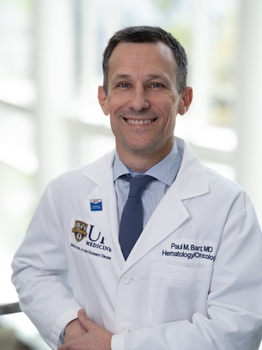
“The whole purpose of oncology cooperative groups is to conduct large clinical trials that are meant to be practice-changing — trials that alter the way we treat cancer patients and bring in safer and more effective therapies,” said Paul Barr, MD, assistant director for Clinical Research at Wilmot and principal investigator for the grant. “It’s an honor to be among the 20 sites that received this award.”
The NCI grant is called a “lead academic participating site” or LAPS award. It invests in the operation of clinical studies and also recognizes Wilmot’s leadership within the National Clinical Trial Network (NCTN) and other alliances. Wilmot has been a top participant in NCTN programs for 50 years.
Since Wilmot became part of the LAPS-funded network in 2019, its oncologists have enrolled nearly 900 patients in large cooperative group trials, Barr said.
“We firmly believe that membership in the national network enables Wilmot to bring promising investigations to our own cancer community, accelerates advances in cancer biology, and improves patient care, cancer survival, and quality of life for patients,” he said.
Why are Clinical Trials Important for Cancer Patients?
Clinical trials provide access to new therapies that are not yet widely available as standard options. If a new treatment from a study proves to be more effective than standard therapy, clinical trial participants are the first to benefit.
NCI-designated cancer centers such as Wilmot, deemed to be the most elite centers in the country, are in the best position to advance care with clinical trials.
Both cancer-related and non-cancer clinical trials have been a longstanding strength at University of Rochester Medicine, which recently reopened a renovated Clinical Research Center on campus.
Types of Clinical Trials for Cancer
- Cooperative group trials. Hundreds of patients volunteer to be randomly assigned to treatment protocols that evaluate a new therapy or improve upon an existing therapy. Top oncology experts design these studies to address an important problem in cancer care. Not all academic centers can offer cooperative group trials, which improve outcomes so significantly that they change treatment guidelines. The NCI funds cooperative group trials.
- Pharmaceutical company-sponsored studies. These trials can also break new ground and involve collaborations with large cancer centers.
- Investigator-initiated trials (IITs) are innovative because they begin when an oncologist discovers a problem within a smaller group of patients in a certain geographic region and designs a study to serve that patient population. Wilmot investigators sponsor these types of studies.
“All of these trials are valuable and benefit patients,” Barr said. “What’s important to note is that this grant and every clinical trial that we offer speaks to a collective effort to bring the best care to patients,” said Barr, professor, Department of Medicine, Hematology/Oncology.
“It’s never one group or one person’s impact,” he said. “The only way something like the LAPS award gets funded is through collaboration, cooperation, and leadership.”
Author
