

Erythroid Lineage Differentiation
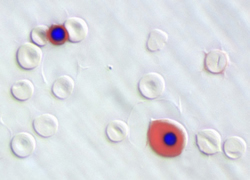
Immunohistochemical analysis of fetal blood for the
presence of embryonic globin reveals two primitive
erythroid cells: a late stage primitive erythroid precursor
(lower right) and a “pyrenocyte” (upper left).
The first hematopoietic cells to emerge during mammalian embryogenesis are "primitive" red cells that are necessary for survival and growth of the fetus. We have determined that primitive erythroid cells enter the bloodstream with the onset of cardiac contractions (McGrath at al. Blood, 2003), where they mature in a semisynchronous cohort and ultimately enucleate (Kingsley, et al. Blood, 2004) by interacting with macrophage cells (McGrath, et al. Blood, 2008). Furthermore, globin expression is dynamically regulated as primitive erythroid cells mature (Kingsley, et al. Blood, 2006). Our studies, taken together, indicate that the primitive erythroid lineage in mice is "mammalian", rather than "non-mammalian" in character, and can thus serve as an important model of mammalian erythroid differentiation. We are currently investigating global gene expression in carefully staged primary primitive and definitive erythroid cells isolated from murine embryos and fetuses.
References
- Nemkov T, Kingsley PD, Dzieciatkowska M, Malik J, McGrath KE, Hansen KC, D’Alessandro A*, Palis J*. Circulating primitive erythroblasts in the murine embryo undergo complex proteomic and metabolomic changes during terminal maturation. Blood Advances 6:3072-3089, 2022.
- Huang Y-S, Delgadillo LF, Cyr KH, Kingsley PD, An X, McGrath KE, Narla M, Waugh R, Wan J, Palis J. Circulating primitive erythroblasts establish a functional, Protein 4.1-dependent cytoskeletal network prior to enucleating. Scientific Reports 7:5164, 2017.
- Malik J, Kim AR, Tyre KA, Cherukuri AR, Palis J. Erythropoietin critically regulates murine and human primitive erythroblast survival and terminal maturation. Haematologica, 98:1778-1787, 2013
- McGrath KE, Frame JM, Fromm GJ, Koniski AD, Kingsley PD, Little J, Bulger M, Palis J. A transient definitive erythroid lineage with unique regulation of the beta-globin locus in the mammalian embryo. Blood, 117:4600-4608, 2011.
- McGrath KE, Bushnell T, Palis J. Multispectral imaging of hematopoietic cells: where flow meets morphology. J Immunol Methods 336:91-97, 2008.
- McGrath KE, Kingsley PD, Koniski AD, Porter RL, Bushnell TP, Palis J: Enucleation of primitive erythroid cells generates a transient population of “pyrenocytes” in the mammalian fetus. Blood 111:2409-2417, 2008.
- Kingsley PD, Malik J, Emerson RL, Bushnell TP, McGrath KE, Bloedorn LA, Bulger M, Palis J: “Maturational” globin switching in primary primitive erythroid cells. Blood 107:1667-1672, 2006.
- Kingsley PD, Malik J, Fantauzzo KA, Palis J: Yolk sac-derived primitive erythroblasts enucleate during mammalian embryogenesis. Blood 104:19-25, 2004. (Plenary paper)
- McGrath KE, Koniski AD, Malik J, Palis J: Circulation is established in a step-wise pattern in the mammalian embryo. Blood 101:1669-1676, 2003. (Plenary paper)