

Skin-to-Skin Care
Kangaroo Care
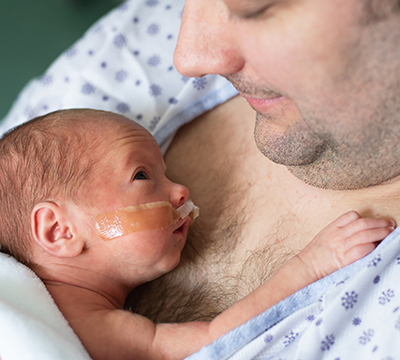
Did you know that you can make a big difference in your baby’s development? Your presence and touch in the NICU is one of the most important parts of your baby’s care.
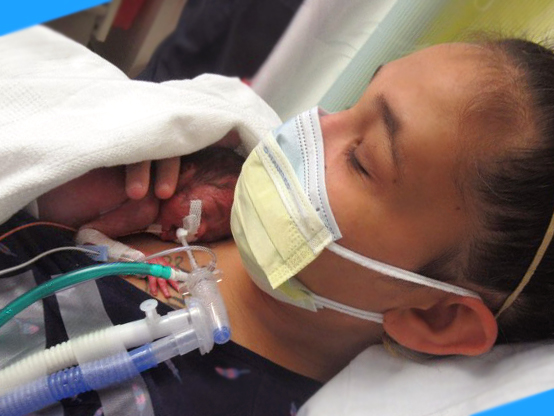
Kangaroo care or skin-to-skin care involves direct contact when an infant is placed skin-to-skin on their parent’s bare chest. A mom or dad may gently hold their baby where they can be cuddled and hear comforting sounds of their parent’s heartbeat and voice. Even in the stressful environment of the NICU, parent and child can quietly bond and get to know one another. Kangaroo care is easy to do, inexpensive, and has many benefits for both babies and parents.
How to Perform Kangaroo Care
In order to transfer your baby from their isolette or crib to your chest, you will complete either a sitting or standing transfer with the help of your baby’s nurse, respiratory therapist, and/or provider.
- Watch the Kangaroo Care Standing Transfer video to review what a standing transfer looks like.
- Watch the Kangaroo Care Sitting Transfer video to learn how to transfer your baby from their bed to your chest using a sitting transfer.
What is the PAIRED Initiative?
In 2022 Golisano Children's joined the PAIRED initiative, which was created to implement family-centered care. A large part of this initiative was focused on improving the rates of skin-to-skin care between babies and parents.
Benefits
Some benefits of Kangaroo Care include:
- Assists with thermoregulation
- Increases immune protection for infant
- Helps to stabilize heart rate, respiratory rate, and blood pressure
- Improves infant’s sleep quality
- Reduces infant’s stress
- Increases breast milk production and improves infant’s readiness to breastfeed
- Promotes parental involvement
Literature on Kangaroo Care
This literature review provides a helpful overview of the benefits of skin-to-skin (kangaroo) care. Across multiple studies, skin-to-skin contact is shown to support important aspects of a baby’s health, including improved weight gain, better breastfeeding, and enhanced brain development. It also helps babies stay calm and stable while strengthening the bond between parent and child.
Overall, the evidence suggests that skin-to-skin care is a simple, safe, and effective practice that parents can use to support both the immediate and long-term health of their baby. Please see the review of the articles below to learn more!
"Impact of Kangaroo Care on Premature Infant Weight Gain"
Authors: Melvina Evereklian and Bobbie Posmontier
- Kangaroo care means holding your baby skin-to-skin on your chest, and it’s especially helpful for premature babies. The article explains that babies who receive this type of care often gain weight better, because it keeps them warm, calm, and helps them use their energy for growing instead of staying stable.
- It’s a simple, safe, and low-cost way for parents to support their baby’s health. Even though it’s very effective, it isn’t always used as much as it could be, often because parents and staff may not realize how beneficial it is.
"The Effects of Kangaroo Mother Care on the Time to Breastfeeding Initiation Among Preterm and LBW Infants: A Meta-analysis of Published Studies"
Authors: Alemayehu Gonie Mekonnen, Sisay Shewasinad Yehualashet, Alebachew Demelas Bayleyegn
- Kangaroo care (skin-to-skin contact) helps make breastfeeding easier and more successful, especially for premature babies. Being close to your baby helps your body produce more milk and helps your baby learn to start breastfeeding sooner and feed better.
- It also helps babies stay calm and stable, which makes feeding easier overall. In simple terms, holding your baby skin-to-skin not only strengthens your bond—it directly supports better breastfeeding and nutrition for your baby.
"Understanding Kangaroo Care and its Benefits to Preterm Infants"
Authors: Marsha L Campbell-Yeo, Timothy C Disher, Britney L Benoit, C. Celeste Johnston
- Kangaroo care (holding your baby skin-to-skin on your chest) is a natural and effective way to support your baby’s health—especially for premature infants. Research shows it can help babies stay warm, breathe and sleep better, gain weight, fight infections, and even support brain development, while also lowering stress and the risk of complications.
- For parents, it’s more than just bonding—it’s an important part of your baby’s care. This close contact can help you feel more confident, improve milk production, and strengthen your connection with your baby, all while helping them grow stronger and healthier.
"Kangaroo Mother Care had a Protective Effect on the Volume of Brain Structures in Young Adults Born Preterm"
Authors: N. Charpak, R. Tessier, J. Gabriel Ruiz, F. Uriza, J. Tiberio Hernandez, D. Cortes, A. Montealegre-Pomar
- Kangaroo care (holding your baby skin-to-skin) doesn’t just help in the short term—it may have lasting effects on your baby’s brain development. This study followed premature babies all the way into adulthood and found that those who received kangaroo care as infants had larger and better-developed brain areas linked to learning, memory, attention, and coordination.
- For parents, this means that something as simple as holding your baby close can support how their brain grows and functions—not just now, but even years later. In other words, your touch isn’t just comforting—it may help shape your child’s long-term development and abilities.