
Translation is Key: Auerbach Receives Holloway Translational Science Lectureship Award
Translating preclinical research to bedside practice is always top of mind for David S. Auerbach, PhD, the recipient of the Robert G. Holloway CTSI Translational Science Lectureship Award for 2026.
“My wife, who is a physician, once said to me, ‘please explain to me how I will someday use what you are researching,’” Auerbach said. “I often return to this question when writing grants and designing research studies. Will I be able to translate my preclinical results to the bedside? Will these results be translational and relevant in other fields of medicine?”
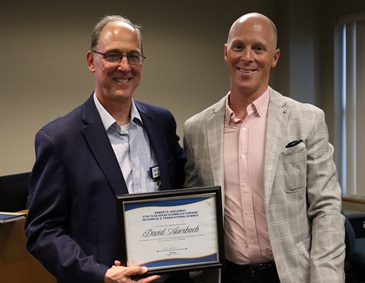 As Assistant Professor of Pharmacology and Medicine Cardiology at SUNY Upstate Medical University, Auerbach uses pre-clinical translational models and clinical datasets to investigate the prevalence, risk, and mechanisms for electrical disturbances of the brain and heart. This includes epilepsy, seizures, arrhythmias, sudden cardiac death, and sudden unexpected death in epilepsy (SUDEP).
Auerbach credits his participation in the Early Career Development Program under the CTSI-KL2 Award—now the Translational Science Scholars program—as a key moment in his career. The program in its various forms has supported researchers like Auerbach since 2006. Its aim is to advance high-quality research and support scholars as they transition into independent investigators, collaborators, mentors, and leaders in translational science.
“That period of CTSI funding helped me secure subsequent federal and foundation funding and publish manuscripts as I grew my research program,” Auerbach said.
Auerbach has expertise in taking a multi-system and multi-disciplinary approach to studying diseases of the brain and heart. He is a member and chair of many scientific committees, delivered platform talks, and published 39 peer-reviewed articles.
Robert Holloway, MD, MPH, was the founding director of the KL2 Career Development Program and served in that role for seventeen years. In July 2023, the CTSI established the Robert G. Holloway Translational Science Lectureship Award to honor past KL2 awardees and Translational Science Scholars program alumni.
Auerbach was a postdoctoral research fellow and junior faculty of Medicine-Cardiology at the Aab Cardiovascular Research Institute from 2014-2018, where he was mentored by Robert Dirksen, PhD, and Aruther Moss, MD, and benefited from the guidance of Wojciech Zareba MD, PhD, and Robert Gross, MD, PhD.
“Bob Dirksen gave me full access to his equipment, and most valuably, he met with me once a week to discuss plans for upcoming grants, manuscripts, interpreting results, and career advice,” Auerbach said.
“Gross, Moss, and Zareba are international leaders in their field with very busy schedules, but they were always willing to meet. As physician-scientists, each of them brought great perspectives to my research projects. Shortly before Dr. Moss passed away, I recall going to his house, sitting at his dining room table, and going through a manuscript I was preparing.”
That kind of team-based mentorship enabled Auerbach to develop a strong portfolio of scientific research findings that set the stage for the development of his independent research program.
“While I compiled exciting results indicating the link between Long QT Syndrome [LQTS] and epilepsy, I needed to gain expertise in clinical research.”
Auerbach prepared a KL2 Career Development Award application, which helped him assemble a formalized training plan with his mentor team.
“This was such a valuable experience as it helped add new tools to my toolbox and broaden my research program,” Auerbach said. “I showed that, yes, people with LQTS are at an increased risk of seizures and epilepsy, and people with LQTS are at an increased risk of lethal arrhythmias when on anti-seizure medications and anti-depressants. While I showed associations and increased risk, I did not know the mechanism for these results. It provided the clinical basis for taking these results back to the bench to investigate the mechanisms.”
This resulted in numerous publications born out of his time with the KL2 Award. Auerbach has gone on to a successful independent research career at SUNY Upstate and co-chaired a large group of international experts in SUDEP. He is also on the Board of Directors for Empowering People’s Independence, which provides care, education, training, advocacy, and support for people with developmental disabilities, epilepsy, and brain injury.
The Holloway Translational Science Lectureship Award includes an invitation to be the keynote speaker at CTSI’s Translational Science Day, which will be held on Wednesday, October 28, 2026 at the Saunders Research Building and Helen Wood Hall. Auerbach will present “Looking Beyond the Classically Studied Organ: Bedside-to-Bench Approaches to Study Electrical Disturbances in the Brain and Heart.
Jonathan Raab | 9/14/2026
