One Slide, One Clue, One Life-Changing Diagnosis
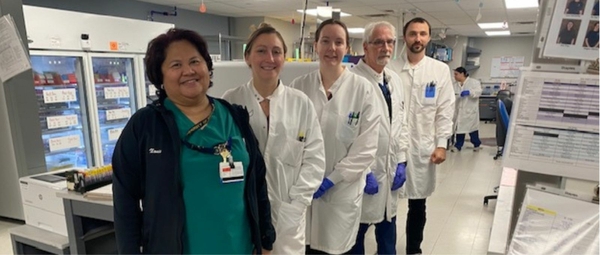
A sharp eye and decades of experience helped solve a medical mystery for a newborn and her mother at URochester Medicine.
A family traveled to Rochester from out of state after their newborn began experiencing unexplained symptoms. Their local providers had been unable to determine a cause. At Golisano Children’s, pediatric hematologist Nick Farris, MD, serving as a consultant to Pediatric Hospital Medicine and Infectious Diseases teams, explored multiple possibilities, including hemophagocytic lymphohistiocytosis (HLH), a life-threatening immune disorder in which the body attacks its own blood cells.
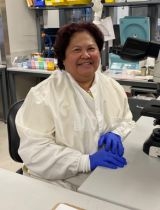
As part of the evaluation, a routine complete blood count with differential (CBCD) was performed. The sample was reviewed by Nonie Varley, assistant supervisor of Pathology & Laboratory Medicine's Core Hematology Lab, a role she’s held since 2007 when she relocated from the Philippines.
While examining the blood smear, Varley noticed something unusual: structures within the baby’s red blood cells that resembled parasites. Though sparse—only about two per field—the finding immediately caught her attention. She promptly consulted with pathologist Richard Burack, PhD, and shared her suspicion of babesiosis, a rare tick-borne disease caused by parasites that infect red blood cells.
The diagnosis was particularly challenging because babesiosis is extremely rare in infants and could easily have been missed.
“I immediately recognized it as a parasite,” Varley recalls. “I was surprised because this type of parasite is rarely seen in our area. Working in the Philippines gave me the opportunity to be exposed to various forms of parasites. That is why I still get excited when I discover parasites on a sample.”
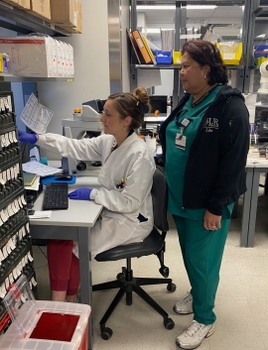
Further investigation revealed that the mother had unknowingly contracted the infection prior to giving birth. Because she had no symptoms, it had gone undetected.
Dr. Burack credits Varley’s expertise and instincts for making the connection. “Her experience in the Philippines, combined with decades of work in the URochester laboratory, allowed this family to finally receive the correct diagnosis,” he said. “With appropriate antibiotic treatment, the infant recovered and the family was able to return home with answers.”
He added, “For two decades, Nonie has been my go-to expert for identifying blood parasites. She has also trained many of us in reviewing blood smears. It’s fitting that she was the one who made this diagnosis.” Without it, the infant may have continued to suffer from the effects of babesiosis.
This case is a powerful reminder that behind every test result is a highly trained, licensed medical laboratory professional whose expertise can change—and even save—lives.
“The contributions by all our laboratory staff are imperative to patient care, something we never lose sight of. Receiving recognition for a unique case like this is appreciated by our entire team.”