

Miracle Kids 2026: Aubrey Wright
A heart in crisis, a team in sync
The Wright family thought the hardest part of the night was already behind them.
On January 19, 2025, they had driven nearly an hour through a blizzard to return home from vacation. After finally pulling into their driveway, everyone felt relieved to be back safely. Then, an emergency weather alert blared suddenly from 10-year-old Aubrey’s phone. The sharp, unexpected sound startled her. Her heart began to race, and she looked like she might lose consciousness.
This wasn’t out of the norm for Aubrey. About a year and half prior, she had begun having fainting episodes every few months. She was evaluated by cardiologists and neurologists, underwent brain scans and heart monitoring, and completed extensive testing. Everything came back as normal.
Doctors ultimately diagnosed her with vasovagal syncope, a common cause of fainting that can occur when blood pressure drops suddenly. Her parents learned to recognize the signs and respond quickly by laying her down and elevating her legs. Within minutes, she would recover.
This night was different. The usual routine didn’t work. Aubrey’s heart kept racing. She became pale and unresponsive, and within minutes, her body stiffened. She was turning blue. Her parents dialed 911; Aubrey had gone into cardiac arrest.
A Race Against Time
As first responders rushed her to the hospital, her condition remained unstable. She suffered another cardiac arrest in the ambulance on the way to Mercy Hospital of Buffalo, where she was intubated. From there, she was transferred to Golisano Children’s Hospital of Buffalo for higher-level pediatric care. Over the next several hours, Aubrey went into cardiac arrest multiple times — at least seven between the initial 911 call and the moment physicians made the decision to place her on extracorporeal membrane oxygenation, or ECMO, a form of life support that temporarily takes over the work of the heart and lungs when they can no longer function on their own.
“It felt like constant alarms and constant motion,” said Aubrey’s mother, Sarah. “We didn’t know from one minute to the next what was going to happen.”
After getting Aubrey stabilized on ECMO, her Buffalo physicians determined she needed more specialized cardiac care than they could provide at their hospital. Aubrey needed to get to Rochester.
The Cardiac Intensive Care Unit at Golisano Children’s Hospital in Rochester operates within a unique regional model. Cardiologists rotate among Rochester, Buffalo, and Syracuse—creating seamless communication across institutions. “Before Aubrey’s arrival, we already knew exactly what Buffalo had done,” said Hannah Pascucci, NP. “We had discussed her course, received her rhythm strips, and were able to prepare immediately to get Aubrey the care she needed.”
When Aubrey arrived, she was admitted directly to the Cardiac Intensive Care Unit, where a large team of physicians, nurses, and specialists were ready to act. For her parents, the atmosphere immediately felt different.
“They had already thought through everything,” said Sarah. “Plan A through Plan F. That was the first time in 24 hours that we felt like we could take a breath. It was the first time we felt hope.”
Searching for Answers
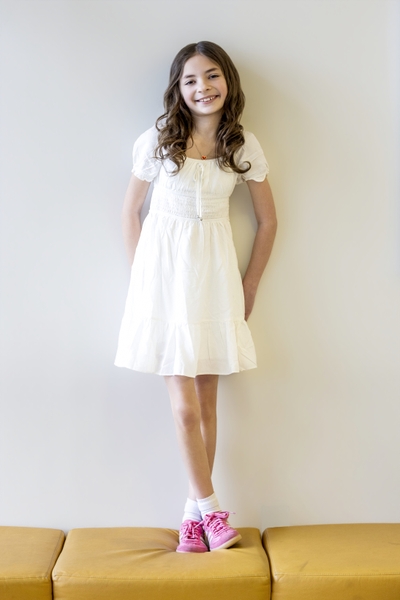
Because Aubrey’s earlier testing had shown no structural abnormalities in her heart, the pediatric cardiology team suspected a very rare electrical disorder, one that does not appear on routine exams.
Justin Smith, MD, pediatric cardiac intensivist, was on call the night that Aubrey arrived at Golisano Children’s Hospital and had been in close contact with the Buffalo critical care team up through her transfer. “The pattern of Aubrey’s symptoms helped us piece things together quickly,” said Smith. “The heart rhythm EMS documented when she first collapsed immediately raised our suspicion. As we continued to see additional fast arrhythmias during her care, the pattern became very consistent with catecholaminergic polymorphic ventricular tachycardia, or CPVT.”
Genetic testing was ordered, and within days they had confirmation. CPVT is a condition caused by a genetic mutation that disrupts the heart’s electrical signaling during times of stress. “The body’s fight-or-flight response releases adrenaline, and for individuals with CPVT, that release can send the heart into dangerous abnormal rhythms,” explained Smith.
In Aubrey’s case, the loud, unexpected weather alert from her phone was the catalyst for the arrhythmia that led to her cardiac arrests.
After learning that a genetic mutation was the cause of Aubrey’s diagnosis, her parents also underwent testing. Their results showed that Aubrey’s mutation was de novo, meaning her CPVT was not inherited, but developed spontaneously.
Stabilizing and Protecting Her Future
Aubrey remained sedated on ECMO while physicians worked carefully to manage her heart rhythm and determine the right combination of medications.
“Her arrhythmias were exceptionally challenging,” explained Smith. “We wanted her heart rate to slow, but then it would go too slow. Once it picked up, it went too fast.”
To keep Aubrey’s heart within a safe rhythm, her care team used two critical supports: a continuous beta blocker infusion and a pacemaker. The beta blocker reduced the effects of adrenaline, helping prevent rapid, chaotic rhythms. The pacemaker acted as a safety net, sending small electrical pulses to maintain a steady heartbeat whenever her heart rate dropped too low.
After five days, Aubrey’s heart rhythm gradually improved, and she was able to come off of ECMO. With her heart now supporting her circulation again, physicians began the careful process of reducing her sedation. Doctors cautioned her parents that it could take hours for Aubrey to respond. Instead, she opened her eyes in minutes.
Within 10 days, Aubrey was off the ventilator, a recovery her team describes as remarkable.
Once she was stable, Aubrey received an implantable cardioverter defibrillator (ICD), a small device placed in her chest that functions as both a pacemaker and defibrillator. “The device serves two purposes: pacing her heart if it beats too slowly while she’s on antiarrhythmic medications, and monitoring for and stopping fast arrhythmias with an internal shock, should they occur,” explained Smith. It now acts as a safeguard, protecting her from both extremes of the rhythm instability that marked her earliest days in the hospital.
Aubrey remembers very little from the early part of her hospitalization. Her memories begin in the final five days before discharge, when her playful personality had clearly returned.
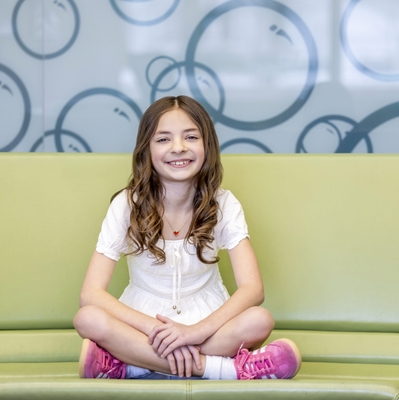
At one point, while clinicians documented an ECMO-related wound on her neck for the plastic surgery team, Aubrey struck a playful pose for the camera. It was a small moment, but for the team who had watched her fight for her life days earlier, it felt enormous. “It was so fun getting to see Aubrey recover,” said Pascucci. “Her resilience, and her family’s resilience, was so impressive to us.”
Finally, after 22 days at Golisano Children’s Hospital, and with her new ICD placed, it was time for Aubrey to go home.
Finding Her Rhythm Again
Today, Aubrey’s life looks much like it did before January 19. To manage her CPVT, she takes two anti-arrhythmic medications and a blood pressure medication each day.
She returned to school in May 2025 with a dedicated nurse accompanying her throughout the day. By September, she rode the bus for the first time since her cardiac arrests, a milestone that marked a return to independence.
One of Aubrey’s biggest goals was returning to cheerleading. After many follow-up appointments and a successful stress test with her cardiology team, she was cleared to return to activity with precautions. Just six months after her cardiac arrests, she rejoined her squad as a tumbler. Later that season, the team traveled to Syracuse and won a state championship.
“She wanted her normal back,” said Sarah. “And she worked hard to get there.”
Aubrey embraces her story with admirable confidence. She quickly learned how to pronounce her diagnosis (catecholaminergic polymorphic ventricular tachycardia) and often explains it to classmates in her own words. She talks openly about her defibrillator and “battle scars.” “She’s proud of what she has overcome,” said Sarah. “And she uses it to push herself forward.”
Inspired by the team who cared for her, Aubrey now says she wants to be a pediatric cardiac nurse someday, ideally in the same Cardiac Intensive Care Unit where her life was saved.