
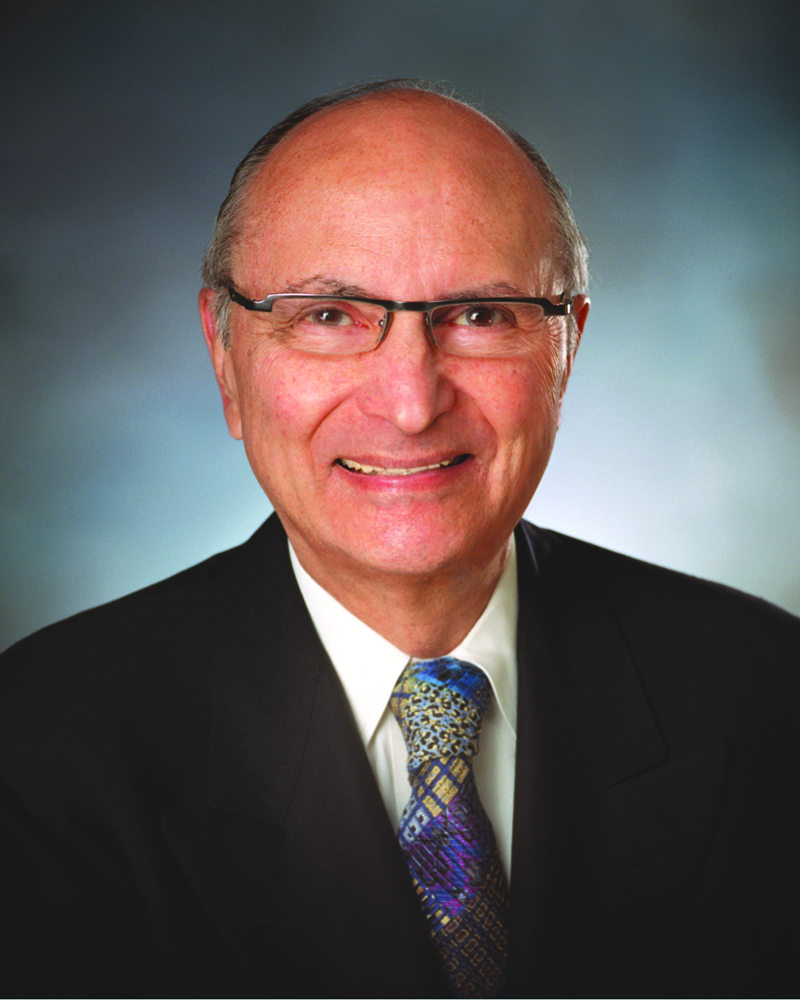
Dr. James Aquavella, who Pioneered Sight-Giving Surgeries, Dies at 94
James Aquavella, MD, didn’t just blaze trails—he made it possible for other people to see them. Sunsets, too. And the faces of loved ones.
The pioneering ophthalmic surgeon, whose nearly 70-year career helped transform the field, died May 14 at age 94, just a year after his retirement. He is remembered as a devoted doctor, a forward-thinking researcher, a mentor to many current faculty, and a strong supporter of the university who had a particular interest in fine art.
“For many within our department, he was more than a colleague or teacher — he was a trusted mentor, a guiding presence, and a dear friend,” said Ophthalmology Chair and Flaum Eye Institute Director David DiLoreto, MD, PhD. “His dedication to patients and to the advancement of ophthalmology established a standard to which we all continue to aspire.”
Gullapalli Rao, MBBS, adjunct professor of Ophthalmology, who worked with him for some 50 years, said Aquavella led the way in cornea and cataract surgeries, therapeutic contact lenses, and refractive surgery. He was the first in New York and among the first nationwide to offer ambulatory surgeries and was the first in the U.S. to perform artificial cornea transplants for infants.
He was “a surgeon par excellence, a superb clinician, a natural leader, passionate about innovation and employing best practices, an outstanding mentor, and a caring individual,” Rao said. “His work ethic and discipline were exemplary traits from which I have benefitted immensely.”
Aquavella was the first fellowship-trained corneal surgeon in the U.S. He earned his bachelor’s degree from Johns Hopkins in 1952 and his MD from the University of Naples in 1957. He came to Rochester in 1961 and practiced at Park Avenue, Park Ridge, St. Mary’s and Highland hospitals before joining SMD in 1977 as a clinical associate professor of Ophthalmology. Aquavella was director of SMD’s Corneal Research Laboratory from 1982 to 1999 and became a professor of Ophthalmology in 2003. Since 2015 he had held the Catherine E. Aquavella Distinguished Professorship in Ophthalmology at URochester Medicine—a professorship he endowed in honor of his late wife.
Steven Feldon, MD, MBA, professor and chair emeritus of Ophthalmology, cited Aquavella’s offer to join the faculty full-time and bring his private practice into the department as a key factor in his own decision to commit to University of Rochester Medicine.
“Jim made sure I was properly introduced to the community, both professionally and socially,” Feldon recalled. “Within weeks on the job, I met with his former cornea fellow and practice partner, Gullapalli ‘Nag’ Rao, the founding director and CEO of the famous L.V. Prasad Eye Institute. A few months after this introduction I was Nag’s guest in Hyderabad. We laid the groundwork for the enduring partnership between the Flaum Eye Institute and LVPEI. This partnership established FEI as a global presence in ophthalmic research, education, and patient care.”
Aquavella was a founder and past president of the Cornea Society, a director of the Eye Bank Association of America, a consultant to the Food and Drug Administration and Tissue Banks International, and a past president of the Contact Lens Association of Ophthalmology.
He was an internationally recognized lecturer, textbook author, and researcher with more than 350 publications. His research interests included the ocular surface tear film, cornea wound healing and keratoprosthesis (artificial cornea transplantation), which restored vision for many patients who did not respond to traditional corneal transplants. Feldon said Aquavella developed one of the first climate-controlled labs in the country for the study of dry eye.
Krystel Huxlin, MD, the James V. Aquavella Professor of Ophthalmology, began working closely with him in 2004 when she started to do research on cornea and refractive surgery.
“When I think of Dr. James Aquavella—my friend, colleague and mentor—I will always see what he created, championed, taught,” she said. “I believe this is true of all of us who knew him personally, and just as importantly, of those who did not. He created legacy on many fronts and as such, he will always be part of our ophthalmic practice, research history and institutional accomplishments. Personally though, I will miss his wit, his fathomless wisdom, his worldliness and his simple daily presence in our lives. Safe travels, Jim.”
A Generational Legacy
Aquavella donated $4 million to the University in 2013 in honor of his late wife, funding the endowed professorships named in the couple’s honor. Catherine Aquavella was a nurse, educator, and administrator who helped build the foundation for URochester Medicine’s Flaum Eye Institute. Aquavella’s gift took the University’s comprehensive campaign over the $1 billion mark.
The couple’s interest in art spurred additional philanthropy. They donated 15 works from 17th and 18th century Europe and America to the Memorial Art Gallery.
“Looking back over history, the greatest scientists—from people like Galileo to DaVinci to Isaac Newton—were all devoted to the advancement of their fields as well as to art, music, and the humanities overall,” Aquavella said after one donation. “Such a commitment contributes to a more complete image of an individual, as the humanities provide a lens through which to see and appreciate the world and a foundation to better understand the human experience along with the richness and beauty of it.”
Aquavella was survived by several nieces and nephews and a stepdaughter. His funeral mass was scheduled for 9:30 a.m. Thursday, May 21, at St Louis Church, 60 S. Main St., Pittsford.
Until his recent health issues, he remained active as a clinician lecturer, mentor and researcher, a larger-than-life personality whose influence was woven deep into the department and Flaum, Feldon said.