
News and Honors
News and Honors
URMC Awarded Nearly $6 Million to Study Deadly Bone Infections
Monday, November 6, 2017
Bone infection, while relatively rare, can be debilitating and potentially fatal. In recent years, researchers in the Center for Musculoskeletal Research at the University of Rochester Medical Center have made several discoveries that position them to advance new treatments and possible cures for bone infections. Now, a nearly $6 million, 5 year award from the National Institute of Arthritis and Musculoskeletal and Skin Disease at the National Institutes of Health, will allow the group to create a new multidisciplinary research program devoted to studying bone infections.
The CMSR has been among the top five NIH-funded orthopaedic research centers in the nation for over ten years, and Edward Schwarz, Ph.D., Burton Professor of Orthopaedics and director of the CMSR, has been the top NIH-funded orthopaedic researcher in the nation three years running. This new grant, awarded to Schwarz and throng of researchers from across the University of Rochester and beyond, brings the center's total forecasted earnings for 2017 to $28 million.
Of the millions of Americans who have joint replacement surgeries each year, less than five percent come away with an infection. But this minority of patients must endure a long and difficult road to recovery, if they recover at all. The vast majority of these infections are caused by a bacteria called Staphylococcus aureus, including the dreaded methicillin-resistant strain (MRSA), which causes sepsis and death in 13 percent of infected patients.
Patients who survive these infections face multiple surgeries to remove infected tissue, months of strong antibiotic treatments, and a high likelihood of re-infection. For a long time, researchers have been working to understand how this bacteria evades treatment and Schwarz believes he has figured out.
Together with Karen Bentley, director of the Electron Microscopy Core at URMC, Schwarz showed that the bacteria can crawl deep into tiny channels in bones, possibly taking shelter there and later emerging to re-establish an infection. Though S. aureus was originally thought to be incapable of movement, Bentley and Schwarz, in collaboration with James McGrath, Ph.D., professor of Biomedical Engineering at URMC, and his spin-off company, SiMPore Inc., showed that this bacteria can migrate through tiny pores in membranes in the lab.
This new grant will allow Schwarz and Hani A. Awad, Ph.D., professor of Biomedical Engineering and Orthopaedics in the CMSR, to investigate exactly how S. aureus gets into bone and develop new treatments that target those mechanisms. Microbiologists Steven Gill, Ph.D., and Paul Dunman, Ph.D., in the Department of Microbiology and Immunology, will help the team develop new antibiotics to inhibit bone infection, which will be 3D printed into spacers that replace infected joint implants. Delivering the antibiotic at the site of infection may save patients' limbs and lives.
Schwarz has also been working to understand what makes certain patients more susceptible to S. aureus infections than others, including why some patients recover relatively easily, while others die.
"Death following surgical site infection is not random," said Schwarz. "By studying patient immune responses to this bacteria, we might be able to predict who will be fine and who will need extra medical attention."
S. aureus can also become resistant to antibiotics, making it extremely deadly and difficult to eradicate. Better understanding patients' immune reactions to the bacteria may provide new approaches to defeating it.
In an international study of more than 300 patients with infected total joint replacements, Schwarz and his team including John Daiss, Ph.D., and Chao Xie, M.D., in the CMSR, found that patients fared well if their immune systems attacked a certain S. aureus protein, and poorly if they attacked another. Patients who produced antibodies attacking autolysin, a protein important for cell division, were protected. Those who produced antibodies against a family of iron sensing determinant (Isd) proteins, which help S. aureus sap nutrients from its host, were more likely to experience sepsis and even die.
It is unclear why antibodies that attack Isd proteins are bad for patients, and Schwarz is determined to use this new funding to figure it out. He will also analyze the full complement of antibodies produced by patients infected with several types of staph bacteria to see if there are more good- and bad-cop antibodies that could help inform new treatments.
The Clinical Research Core of this program will be run by Stephen L. Kates, M.D., at Virginia Commonwealth University.
Musculoskeletal Researchers Engage Local Under-Represented Students in Science
Wednesday, May 24, 2017
Since January of 2017, a group of students and faculty in the Center for Musculoskeletal Research at the University of Rochester Medical Center have been mentoring under-represented or economically disadvantaged teens in Rochester. The so-called MedClub holds monthly hands-on science lessons and provides guidance to middle and high school students in the Greater Rochester area who are interested in science or medicine.
MedClub grew out of a partnership between the CMSR and the Champion Academy, an extreme mentoring and empowerment initiative led by Rochester City School District alumnus and Super Bowl champion Roland Williams. The Champion Academy is a year-round program that aims to instill its 300 student participants with character and "unbreakable belief" that they can achieve their dreams, whatever they might be.
For a handful of those students, like Nigel King, a 10th grader enrolled in Champion Academy, the dream is to become a doctor or scientist. "I joined MedClub to further my knowledge of medicine because of my mom," said Nigel. "She has diabetes and I almost lost her three times, so that made me want to know more about her disease."
Once a month, about 30 students take a break from regular Champion Academy programming to join MedClub. These students get a chance to perform hands-on science experiments ranging from owl pellet dissections to learning how drugs can be delivered in hydrogels. The students also get some insider knowledge about medical and graduate school from MedClub mentors. In February, the students toured the CMSR and got a behind-the-scenes peek at life in a lab.
Other students, like Nigel, hope that MedClub can give them a foundation of knowledge to help them reach their goals. Eighth grader Shakira Jones hopes to someday become a geriatric nurse after caring for her grandmother who battled breast cancer. She believes joining programs like Med Club now will give her a leg up later.
Nigel and Shakira are among seven Champion Academy students who will continue scientific training in URMC's Science and Technology Entry Program (STEP) this summer. MedClub mentors encouraged the students to apply for the NYS-funded summer science program for under-represented students and helped them with their applications.
Alayna Loiselle, Ph.D., assistant professor of Orthopaedics in the CMSR who spearheads MedClub, feels the program also benefits the mentors. Partnering with the Champion Academy offers CMSR graduate students the chance to directly interact with high-risk youth in our community, and learn to be mentors.
"This has been a fantastic opportunity for our graduate students to expand their mentoring and teaching skills," said Loiselle. "Seeing the enthusiasm that the MedClub students have for science is a great reminder to the mentors of how fortunate we are to be able to conduct science as a career."
Edward Schwarz, Ph.D., Burton Professor of Orthopaedics and CMSR director added, "MedClub is a perfect symbiosis that is changing hearts and minds, while educating the next generation of medical professionals in Rochester. I'm very grateful to Roland Williams and the amazing staff at the Champion Academy for this remarkable partnership. We are thrilled to provide a portal for these kids and young professionals to continue their quest for scientific and medical knowledge, which will ultimately help them achieve their dreams."
Inclusion of under-represented individuals has been a mission of the CMSR since its inception in 2000.MedClub is funded through 2021 as part of the Enrichment Program in the CMSR's NIH-funded Resource-Based Center for Musculoskeletal Biology and Medicine grant (P30 AR069655).
Susanne Pritchard Pallo | 5/24/2017
Bones made to order: UR Medical Center attempting to use 3-D printing, stem cells to regenerate bone tissue
Monday, February 27, 2017
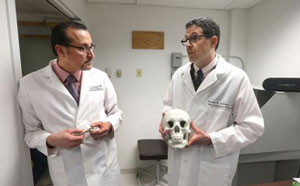
Hani Awad (left) and Edward Schwarz
This news story appeared in the Democrat & Chronicle on February 27, 2017. It features University of Rochester biomedical engineering professors Hani Awad and Edward Schwarz, who are leading the way in using 3-D printers and stem cells to create bone replacements for patients
Imagine getting a made-to-order bone implanted in your body that's composed of your own cells.
Scientists at the University of Rochester Medical Center have been developing a procedure to use 3-D printing and stem cells from the patient to create bones made of regenerated tissue.
This multi-step procedure still has a ways to go before it is tested on humans and can become part of the services provided by URMC's Center for Musculoskeletal Research. But it's the latest example of how 3-D printing, which is increasingly finding its place in manufacturing, is leaving its mark in medicine.
"It is changing the way we do a lot of things," said Hani Awad, who is associate director of the center and professor of biomedical engineering with a specialty in tissue engineering.
Biomedical research, as it is being done in this initiative, is an important component of the medical center's identity.
"Part of our mission is that we want to do research that is impactful," said Stephen Dewhurst, vice dean for research at the medical center.