

Group Therapy
Group Therapy
Part of Strong Memorial Hospital
If you are experiencing a mental health crisis or need a same-day evaluation, call the Behavioral Health Crisis Call Line at (585) 275-8686 or visit our Emergency Mental Health Care page.
Overview
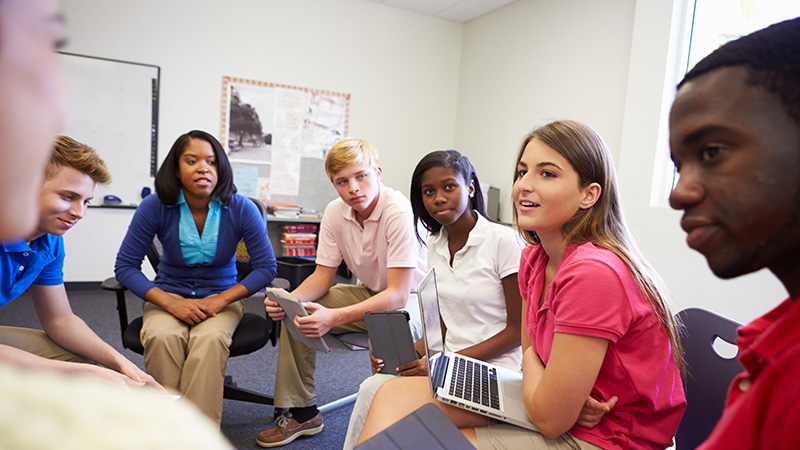
Group therapy for children and adolescents provides a great opportunity to learn and practice skills with support and coaching from group leaders. During group sessions, youth connect with peers and see that they are not alone. The entire group learns to work together on shared problems.
About Our Groups
We offer group therapy for children and adolescents with a wide range of needs and challenges. Skills learned include emotion regulation, coping, and communication strategies.
Acceptance and Commitment (ACT) Art
This teen group uses art therapy and Acceptance and Commitment Therapy (ACT) principles to help members identify their values, examine their choices, and increase their self-esteem.
ALLY
The primary focus of this group is to provide a safe, inclusive, and affirming environment to foster relationships, interpersonal skills, and the evolution of identity.
Anger Management Group
This teen group uses social learning and cognitive-behavioral approaches to help its members explore anger schemas, identify the functions of anger, and develop coping strategies.
Cognitive Behavioral Therapy (CBT) for Anxiety
These groups allow participants to develop a better understanding of anxiety, as well as learn and practice a variety of relaxation and coping skills, including cognitive and behavioral strategies. There are separate groups for children and teens.
Dialectical Behavioral Therapy (DBT) Skills
In these groups, teens and their parents learn emotion regulation strategies. Skills covered include mindfulness, distress tolerance, emotion regulation, interpersonal effectiveness, and middle path skills.
Grief Group
This group is for adolescents who have experienced a significant loss and would benefit from a space to recognize and process feelings of grief. Each group session is structured with a check in, activity/discussion, and a mindful moment. The mindful moment is designed to help wrap up the discussion and assist participants in preparing themselves to transition out of group. Parents/guardians will receive information to help support their participant.
Guild of Adventure
This is an interactive, imaginative group that uses collaborative storytelling and role play through games, such as Dungeons and Dragons, to support the development of social and emotional skills. Participants will collaboratively build the world they will play in and design their personal character. Using storytelling, group members will practice problem solving, communication, and emotion regulation skills, as well as perspective taking through action-packed adventures. Participants should have good abilities to engage in imaginative play and ideally have knowledge of, or interest, in role-playing games.
PEERS (Program for the Education and Enrichment of Relational Skills)
This program enables teens and their parents to participate in step-by-step social skills training developed at UCLA for teens on the autism spectrum. Skills covered in group include using humor, entering and exiting conversations, and arranging get-togethers.
PEERs For Preschoolers (ages 4-6)
Peers for Preschoolers (P4P) is an Evidence-Based social skills program that teaches children ages 4 to 6 how to make and keep friends. P4P is a strengths-based, neuro-affirming approach that builds on the child’s strengths and skills related to making and keeping friends. P4P differs from other social skills groups in that caregivers are highly involved, serving as social coaches both during sessions and at home. This group is beneficial for children with Autism Spectrum Disorder, Attention-Deficit/Hyperactivity Disorder, or other social challenges. Contact us for eligibility requirements.
Social Savvy Gaming Group Ages 13 to 18
Group members learn and practice social, coping, and communication skills through video games. Topics covered in group include making friends, problem-solving, listening skills, building distress tolerance, understanding conversation skills, patience with turn-taking, giving constructive feedback and compliments, and coping strategies. Games will be selected by leaders to achieve these goals. Group leaders will provide equipment, and members will not be permitted to bring their own equipment. This group is ideal for those who have already completed a round of Social Skills group.
Social Skills
Group members learn and practice social, coping and communication skills. Examples of skills covered include making friends, problem-solving, conversation skills and effective coping strategies. Groups are offered for children and teens ranging in age from preschool to high school. (Typically, there is no more than a two-year age span for each group.)
Social Thinking/Drama
In these groups, members use drama therapy techniques including improvisation, storytelling and role playing to practice and expand their social thinking and related social skills such as cognitive flexibility and perspective taking. These groups are mixed gender, and separate groups based on age.
Super Group
This group is appropriate for children and teens that have an interest in pop culture (superheroes or otherwise) and art making. Using different concepts from Acceptance and Commitment Therapy, group members will examine the challenges that they are currently facing, as well as learning skills such as mindfulness and self-compassion to work through these challenges.
Teen Relationships
This group helps teen girls develop skills to form and maintain healthy relationships. Topics covered include trust, boundaries, communication, self-esteem, and social media safety.
Our Approach
Group therapy combines clinical guidance with peer interaction to help youth practice new behaviors and coping strategies in real time. Participants work together on shared challenges while clinicians provide coaching, structure, and support to help them apply what they learn to everyday situations.
Our groups are typically structured as follows:
- The group meets once a week at the same time for a total of 12 sessions.
- Each session lasts between 45 and 60 minutes.
- The groups consist of 4 to 8 children or teens.
- There are two group leaders per group. PEERS groups include an additional leader who facilitates the parent group.
Contact Us
For more information or to schedule an appointment, please call (585) 279-7800.
Locations
Pediatric Behavioral Health & Wellness
1860 South Avenue
Rochester, NY 14620
200 East River Road
Rochester, NY 14623
Hours
Pediatric Behavioral Health & Wellness Outpatient Services
Monday – Thursday, 8:00 a.m. – 7:00 p.m.
Friday, 8:00 a.m. – 5:00 p.m.
Saturday (at select locations), 8:30 a.m. – 2:00 p.m.