

Pediatric Critical Care Sedation Services
Pediatric Critical Care Sedation Services
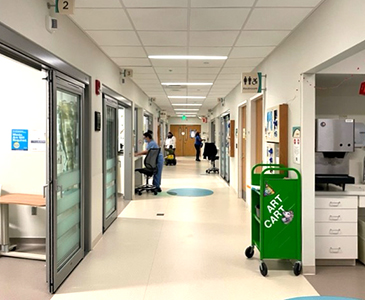
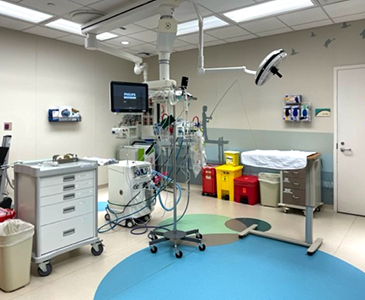
The Pediatric Critical Care Sedation service provides sedation support for children and adolescents undergoing specialized imaging and/or procedures in our Pediatric Imaging and Procedural Suite, located on the ground floor of the Children’s Hospital Tower, unit G-GCH. We work collaboratively with Pediatric Imaging and our medical and surgical subspecialists to ensure safe and excellent care is delivered. Sedations are provided 7 days a week.
This service is available for both Golisano Children’s Hospital inpatients and for children coming in from home as outpatients.All levels of sedation are provided and our approach is tailored to the specific needs of the child. Minimal sedation is provided with oral, intranasal and inhaled medications (i.e., nitrous oxide). Moderate and deep sedation is provided with either oral, intramuscular or intravenous medications and patients are carefully monitored throughout with specialized monitoring equipment.
The sedation service actively participates in the Pediatric Research Consortium, presents research and is active with the Society for Pediatric Sedation, and is committed to quality improvement including becoming a Center of Excellence in Sedation.
Supports to help you and your child through a medical procedure.
Understanding Sedation
- Pediatric sedation involves using one or more medications, or sometimes non-medication techniques, to help a child stay calm and comfortable during a diagnostic test or procedure. The purpose is to lessen awareness, anxiety, and discomfort while keeping your child safe. During your visit, your child’s care team will create and customized plan, considering factors such as your child’s age, developmental level, medical history, weight and the type of test/procedure being done.
- It is important to know that pediatric procedural sedation is not the same as anesthesia. The medications used are intended to achieve the appropriate level of sedation—mild, moderate, or deep—depending on what the procedure requires
Procedures That May Require Sedation
- MRI (Magnetic Resonance Imaging)/ PET (Positron emission tomography)
- CT (Computed Tomography)
- Lumbar Puncture: for diagnostics and/or medication administration
- Spinraza injections: Spinal Muscular Atrophy (SMA) therapy
- Bone marrow aspirate and/or biopsy
- Auditory brainstem response (ABR): hearing exam
- Lab draws and vaccines
- IV and Peripherally Inserted Central Catheters (PICC) placement
- Echocardiogram (ECHO)
- Eye Exams
- Various dressing changes for wounds/wound care
- Botox injections
- Urology procedures: Voiding Cystourethrogram (VCUGs)
- Various Interventional Radiology (IR) procedures
How We Provide Comfort
Topical Anesthetics
- Lidocaine cream: Topical anesthetic used to numb the skin for temporary relief from pain
- 1% lidocaine “J-Tip:” Needle free injection system that uses high pressure jet injection to deliver a small amount of local anesthetic, such as lidocaine, under the skin to numb a specific area
Communication/Distraction
Clear communication and age/developmentally appropriate distraction techniques help reduce anxiety and improve the patient experience. The sedation team will explain procedures in simple language, use storytelling and/or medical play to prepare your child and provide toys, tablets or music during procedures to keep them calm and engaged.
- Cinema vision: In our MRI department, we have “cinema vision” googles that let your child relax and watch a movie during their scan. This immersive experience helps patients remain still for extended periods, often minimizing the need for sedation. Music can also be played during your child’s scan if they prefer as well.
- Vecta Mobile Sensory: The Vecta is a versatile sensory tool featuring a color-changing bubble tube, and LED projector that casts vibrant images on walls or ceilings, and a CD player. Its fiber optic light strands provide interactive sensory stimulation for children with additional sensory needs.
- iPads: Our Child Life Specialists offer interactive tools, including iPads with games/videos for procedural distraction and custom preparation tools that familiarize children with MRIs, CT scans, X-rays, PICC lines, ultrasounds and a variety of other procedures.
- Projector: Our procedure room is equipped with a projector that allows for streaming of YouTube and other media on the wall, offering procedural support and distraction for patients.
Sedation/Pain Medications
- Midazolam (Versed): Medication that can be given orally and intranasally to help ease anxiety; can help the child to relax and forget
- Fentanyl (Sublimaze): Pain medication that can be given intranasally or via IV and is used to supplement sedation and relieve pain
- Ketamine: Medication that can be given orally, intranasally, IV or intramuscularly that is used for sedation and pain relief
- Dexmedtomidine (Precedex): Medication given intranasally or IV that is fast acting sedative that reduces anxiety, offers mild pain relief and induces a sleep-like state
- Propofol: Medication given via IV that is a short acting medication that works quickly resulting in sedation