

The Science of Our Memories
What does it mean to miss a lunch date, forget an appointment, or misplace keys? Are these moments of normal forgetfulness or signs of something more sinister?

While there is overlap between normal forgetting and memory loss associated with dementia or Alzheimer’s disease, Anton Porsteinsson, MD, who has spent decades treating and studying these neurodegenerative disorders, pays close attention to frequency, intensity, and progression as three key areas that tell the difference. “At first it may be subtle, but forgetting that becomes persistent, forgetting things that are important—particularly when reminders do not bring back the memory recall—that is worrisome.”
Just five years ago, memory changes like this could take a year or more of clinical evaluations to receive a diagnosis. Today, a blood test can reveal an objective Alzheimer’s disease diagnosis in just days. And since 2024, URochester has been able to offer patients in the early stages of the disease lecanemab and donanemab, both FDA-approved treatments that can slow symptom progression. “Everything seemed to happen so slowly in Alzheimer's disease research and care until it suddenly didn’t,” said Porsteinsson. “In the last five years, there’s been an incredible acceleration of discovery, including blood biomarkers and new medications. These open new opportunities, and I believe that we’re going to see great advances over the next decade.”
About Lecanemab and Donanemab
URochester Research at the Center: AD-Care Celebrates 40 Years
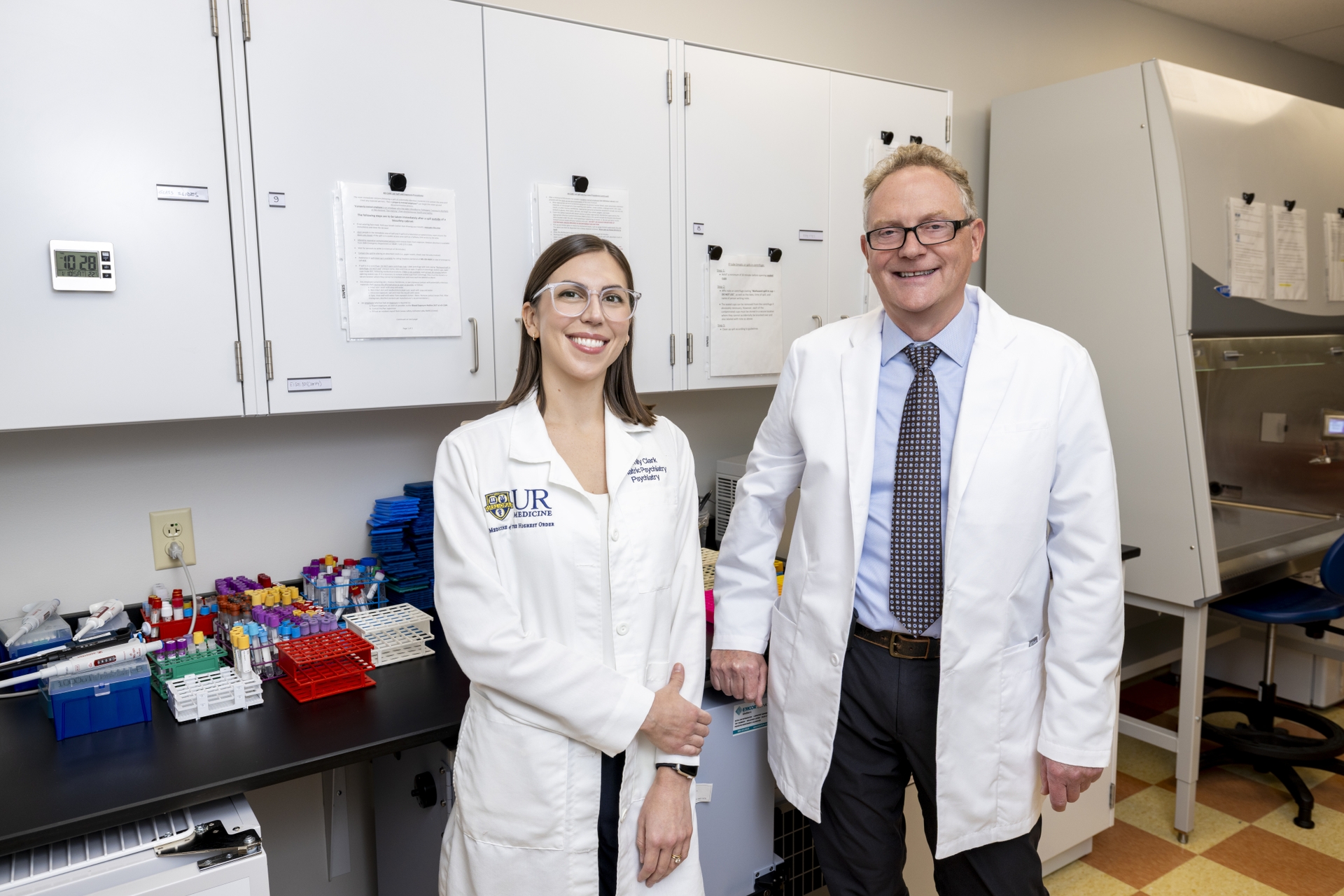
Today, the Biologics Treatment Center, led by Geriatric Psychiatrist Emily Clark, DO, provides patients across upstate and western New York clinical access to anti-amyloid antibodies. Over 100 patients with early symptomatic Alzheimer’s disease are receiving treatment with anti-amyloid antibodies.
“While the monoclonal antibodies against amyloid are really kind of the leaders at this point, it's not all that we're looking at when it comes to treatment,” Clark said. “There's constantly been this search not only for medications or interventions that can modify, slow, or stop the disease, but also ways to try to better treat the disease symptoms.”
Preventative measures are also being investigated. It’s well understood that the accumulation of amyloid protein in the brain is one of the earliest indicators of the disease, which can start 20 years before symptoms begin. AHEAD 345 is a current trial that the program is a part of. Working with asymptomatic people who largely have a family history of the disease, researchers are studying prevention methods. PET scans reveal whether a subject has signs of amyloid accumulation. In this four-year, double-blind, placebo-controlled trial, researchers are using lecanemab to determine whether earlier treatment leads to better outcomes. Already working to expand options for Prevention, AD-CARE is launching two ambitious prevention studies late this year, including using trontinemab, a monoclonal antibody that is attached to a protein called Brainshuttle, which allows the medication to cross the blood-brain barrier more easily.
Back to the Basics: Understanding Alzheimer’s from a Cellular Level

How Alzheimer’s disease develops remains largely a mystery to scientists. They understand that age, genetics, and environmental factors can all play a role, but it is a complex mix of brain changes that causes the disease to develop over many years. That mix can involve a buildup of amyloid plaques that clump together over a long period of time and disrupt cell communication, and modifications of tau protein, changing into tangles that destroy the cell’s internal transport system. These eventually lead to cell death, but this process can take decades, and why it starts is still unknown.

Inflammation was long thought to promote the disease until Neuroscience Professor M. Kerry O’Banion, MD, PhD, turned this understanding on its head. Twenty years ago, he discovered that inflammation is not always bad and that it can actually improve the disease's pathology and may hold it at bay. Today, he continues to study inflammation; part of his research aims to understand the role that microglia, the brain’s immune cells, may play in pathology. Recently, a study led by Lia Calcines-Rodríguez, a Neuroscience graduate student in his lab, found differences in how these cells behave in male and female brains.
“It is well documented that males and females are diagnosed with Alzheimer’s disease at different rates,” said O’Banion, professor of Neuroscience and Neurology. “But we still do not have a great understanding of why this is the case.”
His expertise in brain inflammation is also key to understanding potential gene mechanisms in mammalian longevity that contribute to healthy lifespans. He, Vera Gorbunova, PhD, the Doris Johns Cherry Professor of Biology and Medicine, and other researchers are studying comparative genomics of longevity and Alzheimer’s disease. “We are asking whether genes involved in resilience to aging alter the course of Alzheimer's pathology in mouse models,” said O’Banion. “Understanding the mechanisms at play could be cues that become future targets for therapeutics.”
Understanding the Decline of “Our Mind’s Eye”
The Role of Our Genes
Neta Rosenzweig, PhD, recently joined URochester Medicine as an assistant professor of Microbiology and Immunology and Neuroscience. She investigates interactions between immune and brain cells, how they vary with respect to genetics, and if those beneficial interactions can be therapeutically harnessed while detrimental ones are suppressed.

“Up until about 10 years ago, it was a very niche field,” said Rosenzweig, “but now it’s being accepted that the immune system has a very central role in Alzheimer's. These cells are not just bystanders but also play a role in the etiology of the disease.”
Rosenzweig is specifically interested in apolipoprotein E, or APOE, a gene that makes a protein necessary to transport cholesterol and other lipids to cells, including the cells of the immune system and the brain. APOE has three common versions, or alleles: APOE2, APOE3 and APOE4, and each person typically inherits one copy from each biological parent. Previous research has found, that about 65% of Alzheimer’s patients carry at least one APOE4 copy. While APOE2 is considered protective, because people who carry two copies are almost never diagnosed with Alzheimer’s. This is also the rarest combination to have of the three common APOE versions. But scientists still do not fully understand why different versions of APOE have such markedly different disease outcomes. “My lab is trying to understand this. Why are these people so resistant to Alzheimer's? Are there beneficial immune interactions that confer resilience to Alzheimer's, and could we potentially harness those mechanisms therapeutically for those who do not have the protective genetic makeup?”
Supporting Novel Research
- Rosenzweig and O’Banion are leading a project to investigate neutrophils and microglia in the brain of mice with the protective APOE2 variant.
- Margot Mayer-Proschel, PhD, and Arefin Tanzil, PhD, will investigate how treatments affect the brain over time and if treatment efficacy can be monitored using fluid biomarkers.
- Felix Yarovinsky, MD, O’Banion, and Ania Majewska, PhD, aim to understand how new microglia, which emerge during inflammation, survive in the brain.
Prevention and the Future of Care
The number of Americans faced with an Alzheimer’s diagnosis is projected to double by 2060. David Gill, MD, a neurologist at URochester Medicine, has witnessed a transformation in his clinic over the last decade in how patients are tested and what can be offered in terms of treatment. “We are much more certain of the diagnosis, and that has been a dramatic change. The blood tests we have are over 90% accurate,” said Gill. “We really can be as sure about Alzheimer's disease as we can about diabetes and other things, and that's a big change.”

Gill anticipates new treatments to slow Alzheimer’s symptoms and hopes that new tests for non-Alzheimer’s dementias will be the next wave to change the field over the course of the next decade. “If we can slow [the disease] down by even by 50 percent, I think for the vast majority of patients, Alzheimer's disease will not play a large part in their life,” said Gill. “For most people in their 70s or 80s, if you slow it down enough, they'll be able to follow their regular life as they would normally.”
Prevention is also a part of the future. He and his team are starting a Healthy Brain Aging Program to work with and follow patients who may be at risk for memory loss but currently have normal cognition. The small-group-based interventions will primarily focus on four things: being more physically active, being more social, doing more mentally challenging activities, and following a more heart-healthy diet.

Giving Hope: The Baker Family
When Alzheimer’s disease presented itself in the Baker Family, through its matriarch, Natalie Baker, the family learned the devastating breadth and depth of how the disease can slowly affect not only an individual but an entire family. The Baker siblings, through their family’s foundation established by Natalie and Robert Baker, who were connected to the University of Rochester for over 50 years, wanted to find a way to support research that could change the disease course for other individuals and families. “When we learned of Dr. Gill’s Healthy Aging Program, it was the perfect fit,” Natalie’s daughter, Nancy Baker, said. “Supporting research aimed at prevention was the way our family could honor our mother, Natalie, and help others who find themselves stricken by this devastatingly cruel disease.”
Originally shared in NEUROSCIENCE Volume 30
