

News from Pediatrics
News from Pediatrics
Regional Collaboration Helps Provide Life-Saving Surgery for Twin Boys
Tuesday, December 1, 2020
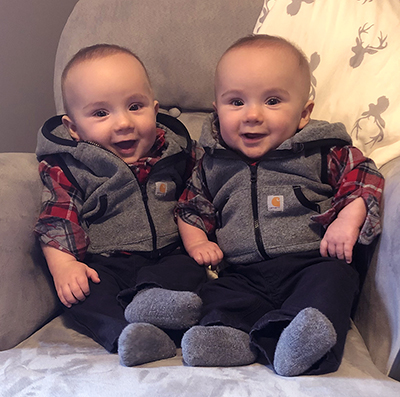 12/1/2020 - After Rachel Markle gave birth to her twin sons – Chase and Bentley – at 34 weeks at Crouse Hospital in Syracuse, NY, the hospital’s neonatologist detected that Chase had a heart murmur.
While the initial diagnoses wasn’t cause for concern, the hospital contacted Matthew Egan, M.D., a local pediatric cardiologist, to come perform an echocardiogram. Before he arrived at the hospital, however, he got a call from the cardiac sonographer:
“They told me to stop coming to the hospital because they found that both babies had Tetralogy of Fallot,” said Egan.
Tetralogy of Fallot is a condition which causes oxygen-poor blood to flow out of the heart and into the rest of the body. Left untreated, it can be fatal.
“It was a unique experience – to have twins with a heart problem that wasn’t detected beforehand. I had to deliver bad news that both had significant heart problems that would need surgery,” said Egan
The Markle family was able to take Chase and Bentley home from the hospital, but treatment would need to be arranged relatively quickly.
“When we came home from the NICU, you wouldn’t even know anything was wrong with them,” said Rachel, “but it was a condition that could’ve killed them in six months if they didn’t get surgery”
Fortunately, Egan had the resources and infrastructure to put the surgery in motion and keep the family in the upstate New York region. Egan participates in the Regional Pediatric Cardiology Program – a collaboration between Golisano Children’s Hospital (GCH) in Rochester, Oishei Children’s Hospital of Buffalo, Crouse Hospital, SUNY Upstate Medical University in Syracuse, and several referring providers in each city. Every week - on Tuesdays and Thursdays - cardiologists from these regions have a teleconference call to discuss kids who potentially need surgery.
“We present all the info at these conferences, including the echocardiogram images, advocate for the type of surgery and timing, and come to a shared decision,” said Egan.
This collaboration serves two critical purposes. First, it allows each case to be examined by a team of cardio-experts, each of whom offer valuable insight.
“You’re never just getting one opinion, you’re getting the opinions of the cardiologists from Buffalo, Rochester, and Syracuse and the surgery team,” said Egan. “One unique thing about cardiology is that every single defect is different, everyone has different backgrounds, and one thing we do well is weigh the different options and work together toward a solution.”
Second, the collaborative helps provide the best standard of care for children, keeps cardiology programs in all three regions viable, and prevents families from having to undergo difficult travel to neighboring regions for treatment.
“It’s tough when you have multiple, big medical systems trying to work together without competition getting in the way,” said Egan, “but if you don’t align, patients are going to have to travel five or six hours to get the care they would need. We want to show the community we’re doing the best thing for the patient.”
George Alfieris, M.D. director of pediatric surgery at GCH, typically has the final say on what surgeries are possible. In the case of Chase and Bentley, the need for tetralogy surgery – which involves widening the pulmonary valve and enlarging the passage to improve bloodflow - was clear. The major challenge involved timing: in order to assist the Markle family, the cardio group wanted to coordinate the operations on either consecutive days or the same day.
“We wanted to what was best for the family but keep it safe,” said Egan.
Fortunately, they were able to schedule the surgeries on the same day. The transition to GCH was smooth and Alfieris put the Markle family at ease, according to Rachel.
“He came in and said that he’d treat my kids as if they were his own kids, and if it were his kids he would’ve done this surgery. Because we hadn’t seen him before, we appreciated his confidence.”
The surgeries were successful, and the twins can now receive their post-op care in Syracuse, where Dr. Egan has seen them several times.
“Both kids are really thriving and doing great,” said Egan.
The success of this case – and many others like it – prove the viability of the Regional Pediatric Cardiology Program for providing the best surgical treatment for kids across the tri-city region while allowing families to get follow-up care close to home, and will also help build capacity for each region to expand services, according to Nader Atallah, M.D., program director for Regional Cardiology.
“This collaboration will allow us to pool our resources together in order to deliver consistent and effective care to children and adults with congenital heart disease across Upstate and Western New York, and we will also be able to develop new programs that would elevate our pediatric cardiac services to the level provided at larger, nationally recognized programs,” he said.
Cross-Sector Partnerships Help Underrepresented Communities SARS-COV-2 Crisis
Tuesday, October 6, 2020
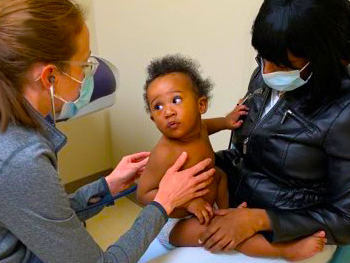
Academic medical centers must establish cross-sector and cross-discipline community partnerships, and these partnerships are critical for effective crisis response in lieu of the COVID pandemic, according to a new paper published in the Journal of American Medical Association by authors from the Department of Pediatrics at the University of Rochester Medical Center (URMC).
The paper, “Leveraging Cross-Sector Partnerships to Preserve Child Health: A Call to Action in a Time of Crisis,” cites several examples of effective community partnerships that the Department of Pediatrics utilized in Monroe County to provide continued pediatric care, behavioral health services, and food/meal distribution during the pandemic. The paper’s co-authors argue that these community partnerships are critical for counteracting the damaging effects that the pandemic has on children and families from underrepresented communities, which include unemployment and reduced income for caregivers, school closures impacting daily schedules, and disruption of critical school wraparound services
“We felt that the emphasis on COVID impact was focused on economic outcomes with adults, so we wanted to give attention to the pediatric community and generate partnerships to address disparities,” said lead author Jeff Yaeger, M.D. M.P.H., assistant professor from the Department of Public Health Sciences. Patrick Brophy, M.D. chair in the Department of Pediatrics, and Jeffrey Kaczorowski, M.D., professor in the Department of Pediatrics, were co-authors.
The study draws examples from past catastrophic events, such as the 1918 influenza pandemic, as well as Hurricanes Katrina and Sandy, to indicate that children and families living in poverty are at the highest risk of experiencing poor outcomes during crisis scenarios, including homelessness, unemployment, food insecurity, and trauma/violence.
The Department of Pediatrics shifted to enhance and leverage existing partnerships on March 11 – when the first SARS-COV-2 resident was diagnosed in Monroe County - so that children and families could continue to receive services they needed. These partnerships were comprised of local school districts, pediatric and family medicine practices, accountable care organizations (ACOs), health insurers, and the New York State and Monroe County Departments of Health.
These collaborations helped support a multi-tiered plan. First, the Department of Pediatrics worked with primary care practices caring for children to limit foot traffic through clinics. This included a transition to telemedicine appointments for everything but essential preventive visits - defined as screenings and immunizations for children up to two years.
This arrangement presented two potential obstacles: Loss of revenue for these pediatric practices due to a decline of in-person visits, as well as challenges to ensure safe transportation for essential visits for families. To address these concerns the Department of Pediatrics partnered with local ACOs and the Monroe County Medical Society to successfully increase reimbursement for telemedicine encounters, and also worked with local banks and small business development corporations to help practices receive grants and loans through the federal CARES act.
To secure safe transportation for essential vaccination and immunization visits, the Department of Pediatrics collaborated with the Rochester Transportation Services (RTS) to coordinate the deployment of eleven vans to provide free transportation for more than 500 low- income infants and children to preventive visits.
“We anticipated that immunizations would drop, but due to these partnerships we actually averted that situation and didn’t see a significant decrease,” said Yager.
In addition, The Department of Pediatrics worked with practices and mental health providers to develop a tiered protocol to assess and manage children and youth with behavioral and mental health concerns, and coordinated this effort with the local school districts, their mental health counselors, and community-based organizations to ensure that behavioral health services could be continued for high-risk children.
For children’s nutrition, staffing shortages and requirements for an in-person interview restricted new applicants for the Women, Infants, and Children (WIC) program - which provides nutritious foods to pregnant, breastfeeding, postpartum women, and infants and children up to the age of five. By collaborating with New York State and the Monroe County Department of Health, the Department of Pediatrics was able to obtain a temporary regulation change so that new enrollees could join through a simple call-in process, and continue to receive food services that were interrupted through the closure of schools.
While data was not available at the time of submission, new information reveals the success of several of these interventions: vaccine rates and lead screening rates stayed consistent, whereas theses rates dropped dramatically at all ages throughout the rest of the country. In addition, behavioral health visits through telemedicine were maintained at 100 percent of pre-COVID, volume, according to Yaeger.
“These results make the case for the integrated-community approach, and since many these partnerships had already been established, it gave us a unique capability in Rochester to implement changes in how to address health related-services in our families,” said Yaeger.
The strong inter-connectedness of these partnerships – and their success in addressing food insecurity, vaccine rates, and behavioral health - also could potentially help the Department of Pediatrics at URMC to continue to address health disparities that affect underrepresented populations, according to Brophy.
“The foundation is there to address another the public health crisis that facing us, which is structural racism,” said Brophy.
The study’s co-authors are currently examining the equity of the community response in all faces, both to inform how to enhance these services in case of another SARS-COV-2 lockdown, and also in continuing these services where needed - such as telemedicine - after the virus subsides.
“We understand more than before the challenges we face to keep our children healthy and maintain community infrastructure. We will continue to look at the data for health promotion and access to care - see if and where improvements can be made - and partner with our community going forward on behalf of our kids and families, especially those affected by racism and poverty,” says Kaczorowski.
Golisano Behavioral Health & Wellness Building Opens with Ribbon-Cutting Ceremony
Wednesday, June 17, 2020
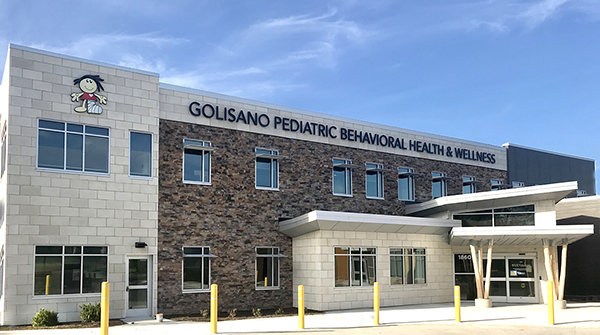
Golisano Behavioral Health and Wellness building, June 18, 2020
The Golisano Behavioral Health and Wellness Building opened on June 18 with an official ribbon-cutting ceremony.
This building, established in 2017 thanks to a $5 million gift from Tom Golisano, and completed thanks to the contributions of additional donors, will help address the rising need for pediatric behavioral health in the region.
“This new facility will help us implement a comprehensive strategy that focuses on early recognition and treatment, as well as community partnerships, to help reduce the number of children at risk, and give families new reason to hope,” says Michael Scharf, M.D., associate professor in the Department of Psychiatry and chief of the Division of Child & Adolescent Psychiatry.
Read More: Golisano Behavioral Health & Wellness Building Opens with Ribbon-Cutting CeremonyJoint Research Project to Study Evidence of Transmission and Antibodies in Breast Milk of COVID-19 Positive Mothers
Monday, June 8, 2020
A collaborative project between researchers at the University of Rochester Medical Center (URMC), New York University (NYU) and University of Idaho will examine whether mothers can transmit COVID-19 through breast milk, and whether the breast milk itself has immunological properties against the disease.
URMC was funded by the Bill and Melinda Gates Foundation and the National Institutes of Health (NIH) for roughly $600,000 the next 2 years for this study that could result in critical guidance for an issue that currently lacks high quality evidence. The research group is led by Dr. Kirsi Jarvinen-Seppo in the Department of Pediatrics.
Since the onset of the COVID-19 pandemic, major health organizations have often provided contradictory advice on whether and/or when to separate COVID-19 positive mothers and their newborns, according to co-investigator Bridget Young, Ph.D., assistant professor in the Department of Pediatrics at URMC. Other co-investigators include Casey Rosen-Carole. M.D., medical director of lactation services and programs at URMC, Antti Seppo, Ph.D., research associate professor in the Department of Pediatrics, Martin Zand, M.D., Ph.D., professor of medicine and medical humanities in the Division of Nephrology, David Topham, Ph.D., Professor in the Department of Microbiology and Immunology, and Mark Sangster, Ph.D., Research Professor also in the Department of Microbiology and Immunology.
“We only want to sequester a mother from her baby if it’s medically necessary,” said Young, “However, the issue is very confusing for practitioners who don’t have sufficient evidence, and that’s what drove the urgency. We’re looking to drive the evidence so we can provide the best care.”
Thus far, there have been very few studies that have examined breast milk in COVID-19 mothers, according to Young. Combined case reports of 68 breast milk samples found evidence of the virus in only 9; and whether or not detected virus is infectious remains unknown.
“Lots of viruses aren’t present in breast milk,” said Young, “If a mom has influenza, we don’t tell her to stop breast feeding her babies. A lot of factors in breast milk help keep babies healthy. Plus, there’s a lot of data showing that moms vaccinated against influenza provide specific influenza antibodies that help their infants remain healthy.”
Young’s hypothesis is that similar to the flu, COVID-19 antibodies will be found in the mother’s breast milk. “We’re particularly interested in when antibodies may appear in breast milk, how long antibodies are present, and how much protection these antibodies provide the baby,” said Young.
“Breast milk is a tricky sample to work with” Young states, “And collecting the samples in a manner that ensures no contamination is critical. Our team has a lot of experience conducting these types of breast milk studies, and supporting breastfeeding parents”.
The study will examine breast milk from 50 COVID-19 positive mothers to gauge both transmission risk and evidence of antibodies. In addition to examining breast milk, the study will also determine whether the COVID-19 virus is detected on the physical breast itself by taking swabs before and after washing.
“A newborn baby nurses an average 10-12 times a day, so it’s important to know whether physical contact with the breast carries risk,” said Young.
Describing the Lung in Unprecedented Detail
Wednesday, March 4, 2020
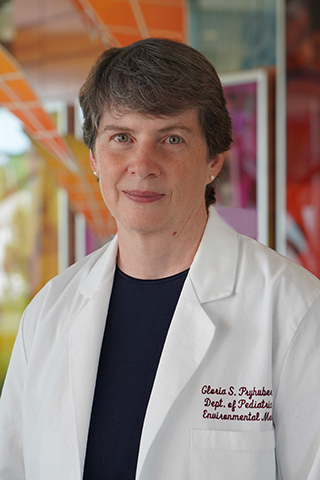
Gloria Pryhuber, M.D., professor at the University of Rochester Medical Center, along with several URMC, national, and international, collaborators, received renewed funding to continue research as part of the NIH-sponsored Lung Development Molecular Atlas Program (LungMAP) and the Human BioMolecular Atlas Program (HuBMAP) collaboratives.
 Pryhuber’s research program has received national recognition for its unique and innovative abilities to study fundamental processes in human lung growth and maturation. Her lab created the BioRepository for Investigation of Diseases of the Lung (BRINDL) which now contains more than 250 human lung sets, with 50 normal by history and histopathology and more than 70 with a specified disease, spanning mid-late gestation to adult age. Working with the United States Organ Procurement and Transplantation Network (OPTN), the lab accepted donated organs when they cannot be placed for transplantation, and respectfully preserves and distributes lung samples — representing late gestation through early adulthood to support molecular, temporal and spatial characterization of functionally and anatomically defined cell types — to many research communities locally and nationally.
With the rapid development of technologies allowing comprehensive analysis, single-cell and single-nuclei gene expression, DNA chromatin conformation, proteomes and lipidomes, the potential discoveries supported by the BRINDL repository are nearly limitless. Collaborating Pediatric Pathologists Gail Deutsch. M.D., of the Seattle Children’s Hospital, and Philip J. Katzman, M.D., of URMC, evaluate each sample for evidence of disease and structural integrity. With the excellent support of the URMC Genomics Research Core, Flow Cytometry Core, and CTSI Informatics, the lab has collaborated to generate large datasets of whole tissue, single cell and single nuclear, gene and protein expression by cell type and pediatric age.
Pryhuber has also recently co-edited a text book, "Updates on Neonatal Chronic Lung Disease", a valuable resource for Neonatologists and Fellows in training, with chapters written by experts in histopathology, diagnosis, mechanisms, nutritional and ventilatory management of bronchopulmonary dysplasia, children’s interstitial lung diseases (chILD) and their neurologic and inflammatory complications.