menu

Mentoring Resources

Mentorship Accordions

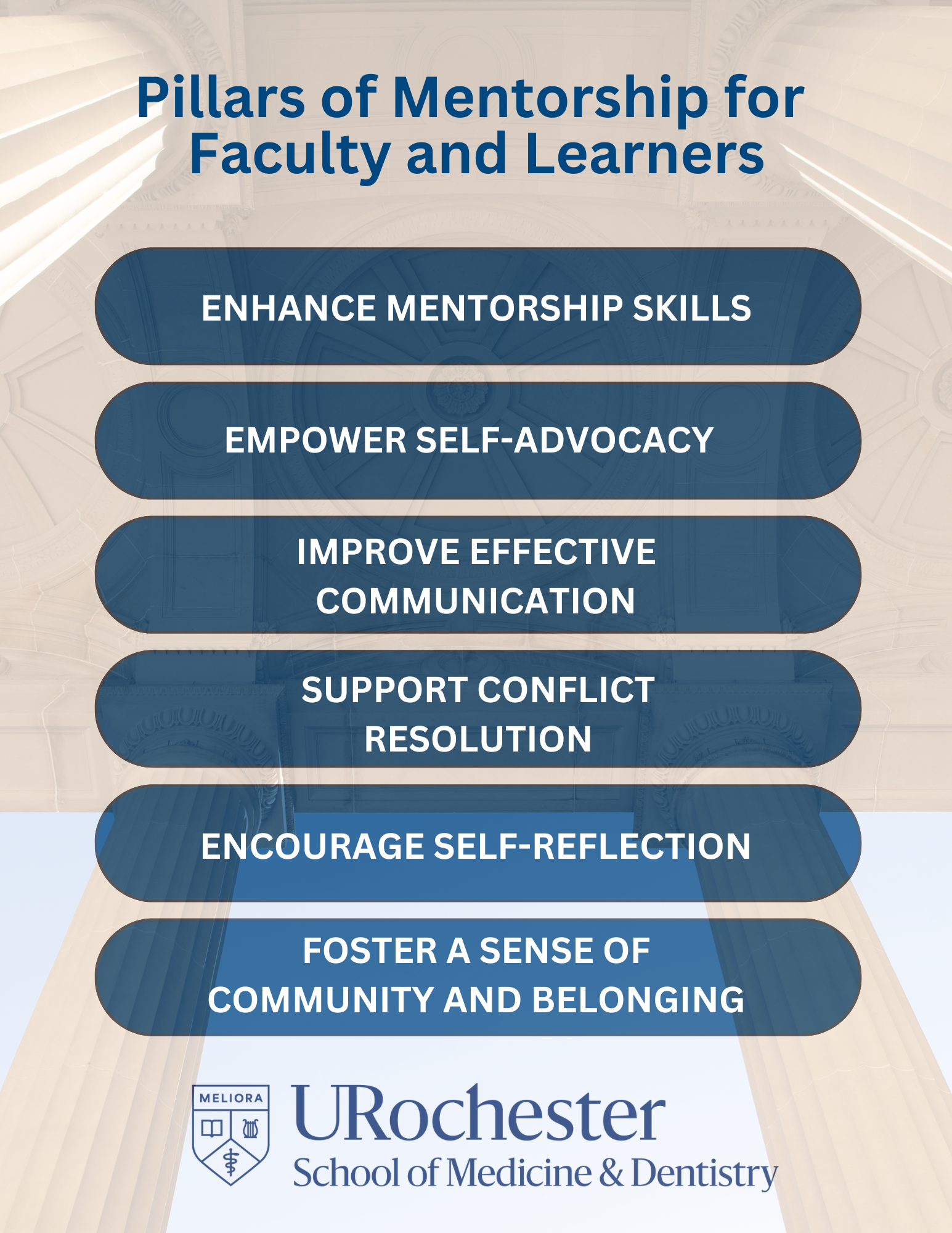
 Pillars of mentorship graphic

1. Mentoring Philosophy

  • Tailor the Mentoring Approach based on the University of Rochester SMD’s 6 Pillars of trainee mentorship:
    • Enhancing mentorship skills
    • Empowering self-advocacy
    • Improving communication
    • Supporting conflict resolution
    • Encouraging self-reflection
    • Fostering community and belonging
  • Provide structured guidance aligned with trainee goals.
  • Use language consistent with the trainee’s Candidate Overall Goals, Preparedness, and Potential section.
  • Highlight your own mentor development activities (courses, seminars, certificates, conferences).

2. Support for Training Activities

  • Identify relevant funding sources (NIH, foundation grants, start-up funds, endowments).
  • Describe support for:
    • Technical skill development, hypothesis formulation, experiment design, and data analysis.
    • Participation in lab meetings, seminars, and conferences.
    • Completion of coursework and manuscript preparation.

If a Co-Sponsor is included:

  • Describe coordination between Sponsor and Co-Sponsor.
  • Provide examples of collaborative mentoring.

1. Mentorship Experience

  • Discuss history of mentoring trainees at various levels (high school to postdoc).
  • Summarize outcomes of former trainees in the Biomedical Research Workforce.
  • Highlight 2–5 examples of successful mentees and career paths.
  • Describe prior collaboration with a Co-Sponsor if applicable.

2. Guidance for New Mentors

  • Describe your plan to be mentored and apply best practices.
  • Include formal and informal mentor training (courses, seminars, NRMN, professional societies).

1. Mentorship Schedule

  • Frequency, duration, and nature of meetings with the trainee.
  • How individualized attention will be maintained.
  • If applicable, define Sponsor/Co-Sponsor time commitment (e.g., 90% / 10%).

2. Research Focus

  • Commitment to ensuring success of trainee’s research plan.
  • Highlight novel approaches and conceptual advances.
  • Describe expertise and collaborative networks supporting the plan.

3. Training Activities

  • Technical skill mastery
  • Conceptual development and independence
  • Professional development and communication opportunities

1. Institutional Environment

  • Interdisciplinary research and training opportunities.
  • Collaboration between labs and shared resources.
  • Graduate Program, departmental/center/institute support.

2. Laboratory and Core Facilities

  • Lab resources for proposed experiments.
  • Access to URMC Core facilities (histology, microscopy, proteomics, behavioral testing, statistics, etc.).

3. Relevant Programs Supporting Career Development

  • Internships, teaching fellowships, leadership roles, outreach opportunities.

4. Personal and Professional Development

  • Courses or certificates (required or elective).
  • Publications, manuscript prep, grant writing.
  • Presentations at conferences and department meetings.
  • Writing: thesis, reviews, science communication opportunities.
  • Mentorship workshops, seminars, and hands-on experience.

1. Background and Motivation

  • Understanding of the trainee’s interests and career goals.
  • Personal characteristics and experiences (curiosity, persistence, resilience).

2. Areas for Development

  • Technical skills: new techniques, quantitative or computational methods.
  • Operational: practices promoting rigor, reproducibility, and responsible research.
  • Professional: management, leadership, communication, teamwork.
  • Conceptual/Critical thinking: experimental design, grant rationale, independent thought.

3. Achievements

  • Scientific contributions and technical skill development.
  • Professional development, honors, and strong science communication.

4. Future Goals

Use the same language as in the trainee’s Candidate Overall Goals, Preparedness, and Potential section, e.g., neurosurgeon-scientist, independent investigator, RNA biologist.