
Department Seminars
If you would like to speak with any of these people during their visit, or need additional information, please contact Stephanie Scoville.
“Financial Aspects of Directing a Research Lab at an Academic Medical Center” - GWIS Seminar
Eric Wagner, PhD; Makaía Papasergi-Scott, PhD - Professor, Department of Biochemistry & Biophysics, University of Rochester, Rochester, NY; Assistant Professor, Department of Biochemistry & Biophysics and Department of Pharmacology & Physiology; Scientific Director, Structural Biology Imaging Resource, Center for Advanced Research Technologies, University of Rochester, Rochester, NY
Dec 03, 2026 @ 3:00 p.m.
Medical Center | Lower Adolph Aud 1-7619
Host: Dr. Lynne Maquat
“Beyond the Consensus Sequence: Thriving on a Non-Linear Career Path in Science” - GWIS Seminar
Isaac Fianu, PhD - Assistant Professor, Department of Biochemistry, Caltech, Pasadena, CA
Nov 19, 2026 @ 3:00 p.m.
Medical Center | Lower Adolph Aud 1-7619
Host: T32 past trainee, MaryClaire Haseley and Dr. Eric Wagner, PI
“The Early Finish: How Premature Transcription Termination Fine-Tunes Gene Expression” - DBB Seminar
Isaac Fianu, PhD - Assistant Professor of Biochemistry, Caltech, Pasadena, CA
Nov 18, 2026 @ 2:00 p.m.
Medical Center | k307 (3-6408)
Host: Grad student MaryClaire Haseley and Dr. Eric Wagner (co-sponsored by Graduates Working in Science (GWIS) and RNA Society & Lexogen
"Defining the roles of 5'UTR length and secondary structure in eukaryotic translation initiation" - Thesis Defense
Tom Ossevoort - PhD Candidate
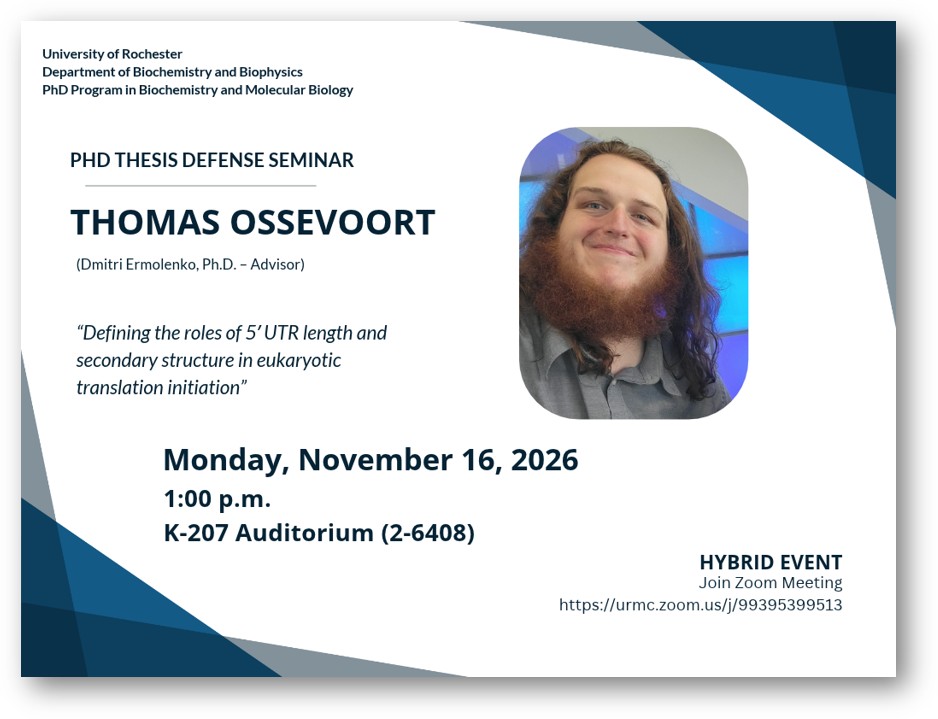
Nov 16, 2026 @ 1:00 p.m.
Medical Center | K207 (2-6408)
Hybrid EventHost: Advisor: Dmitri Ermolenko, PhD
“Biochemical Ecology in Host/Microbiome Interactions” - DBB Seminar
Michael Neugent, PhD - Assistant Professor, Departments of Urology and of Microbiology & Immunology, University of Rochester, Rochester, NY
Nov 11, 2026 @ 2:00 p.m.
Medical Center | K307 (3-6408)
Host: Dr. Josh Munger
"Investigating the Role of HMGN1 in Modulating Inter-nucleosome Interactions Mediated by the Core Histone N-terminal Tail Domains" - Student Seminars
Elizabeth Lucas - Graduate Student
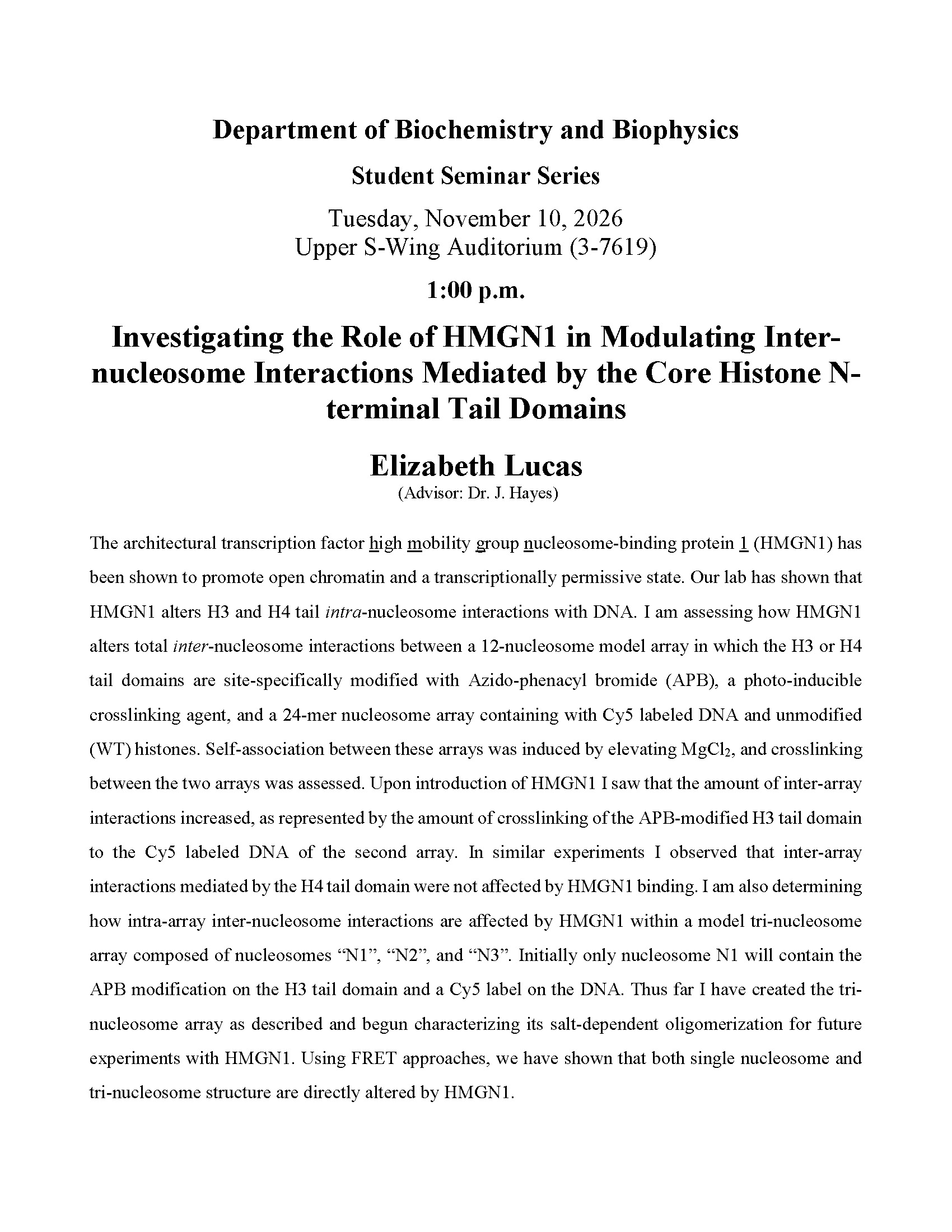
Nov 10, 2026 @ 1:00 p.m.
Medical Center | Upper S-Wing Auditorium (3-7619)
Host: Advisor: Dr. J. Hayes
“A metabolically regulated lncRNA–micropeptide tunes sensory responses to food odors”
Gaëlle Talross, Ph.D. - Assistant Professor, Department of Biochemistry and Biophysics
Center for RNA Biology
Del Monte Institute for Neuroscience
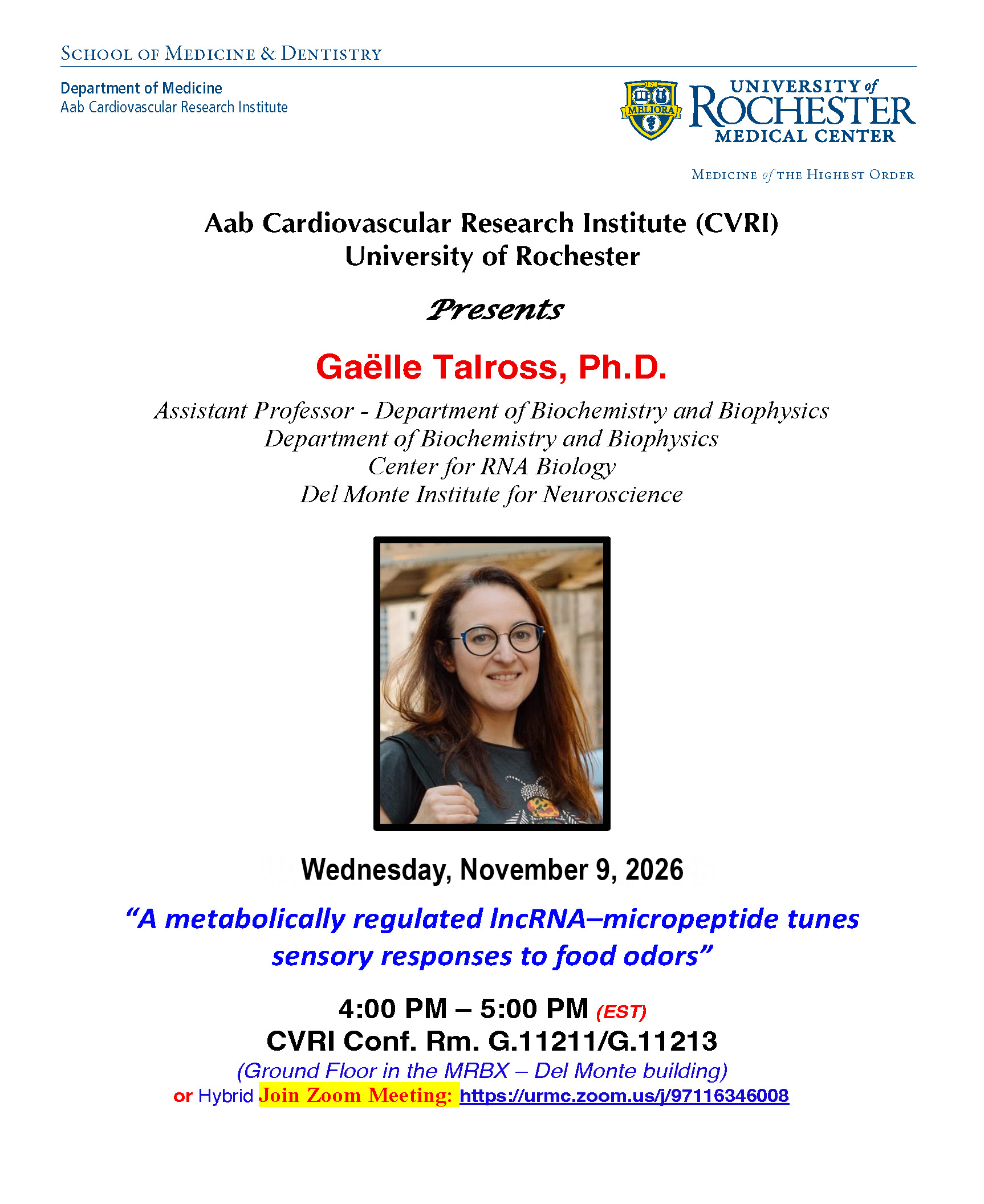
Nov 04, 2026 @ 4:00 p.m.
Medical Center | CVRI Conf. Rm. G.11211/G.11213
Hybrid EventHost: Aab Cardiovascular Research Institute (CVRI)
CANCELLED “Simulating Large-Scale Conformational Dynamics in Biological Assemblies” - DBB Seminar
Paul Whitford, PhD - Professor, Department of Physics, Northeastern University, Boston, MA
Nov 04, 2026 @ 2:00 p.m.
Medical Center | K307 (3-6408)
Host: Dr. Dmitri Ermolenko (co-sponsored by the Bioinformatics Cluster and the Protein Synthesis Cluster)
“Metalloproteins in Action: Coupling Diffraction and Spectroscopy for Structural Studies” - DBB Seminar
Sarah E. J. Bowman, PhD - Associate Professor and Director of the National Crystallization Center, Department of Biochemistry, Jacobs School of Medicine and Biomedical Sciences, University at Buffalo, Buffalo, NY
Oct 28, 2026 @ 2:00 p.m.
Medical Center | k307 (3-6408)
Host: Dr. Joseph Wedekind
"Structural Basis of Translation Regulation by a Class I Type III preQ1 Riboswitch" - Student Seminar
Daniil Kiliushik - Graduate Student
Oct 27, 2026 @ 1:00 p.m.
Medical Center | Lower Adolph Auditorium (1-7919)
Host: Advisor: J. Wedekind
“Optimizing Protein Synthesis with tRNA Modifications” - DBB Seminar
Ute Kothe, PhD - Professor, Department of Chemistry, University of Manitoba, Winnipeg, Manitoba, Canada
Oct 21, 2026 @ 2:00 p.m.
Medical Center | K307 (3-6408)
Host: Dr. Yi-Tao Yu (co-sponsored by the Protein Synthesis Cluster, RNA Society & Lexogen, and the RNA Structure & Function Cluster)
"Identification and characterization of genetic barriers to conjugation in Staphylococcus aureus" - Student Seminar
Keegan Proctor - Graduate Student
Staphylococcus aureus is both a commensal member of the human skin and nasal microbiome as well as a devastating opportunistic pathogen. This difference in outcomes is described in part by the highly plastic genome of S. aureus, where compositions of virulence factors and antibiotic resistance genes vary significantly between individual strains as a result of horizontal gene transfer (HGT). Individual mobile genetic elements such as conjugative plasmids carry significant fitness costs and there is a growing body of literature describing diverse defense systems which protect bacteria against foreign DNA. While defense systems have been characterized in model systems, the role these systems play on HGT within their native hosts remains poorly understood.
Previous work in the lab has demonstrated that a clinically isolated S. aureus conjugative plasmid transfers into different strains of S. aureus at highly variable rates, indicating a sporadic distribution of active defense systems among the tested strains. Using a genome-wide association study to parse out shared genes among the strains most restrictive to conjugation, I have identified a phage-encoded, non-canonical RM system present within a subset of S. aureus clinical strains. To further probe those strains with limited conjugation which lack RM or CRISPR, I have generated transposon libraries in these clinical strains of S. aureus to experimentally screen for novel barriers to HGT. Further understanding of bacterial factors involved in HGT could aid in predicting or potentially controlling the spread of antibiotic resistance as well as rational design of mobile genetic elements as tools.
Oct 20, 2026 @ 1:00 p.m.
Medical Center | Upper S-Wing Auditorium (3-7619)
Host: Advisor: A. Varble
“From Curiosity to Impact: My Journey Through Structural Biology, Drug Discovery, and Leadership” - GWIS Seminar
Ximena Barros Álvarez, PhD - Principal Scientist II, Structural Biology, Schrödinger Therapeutics Group, Boston, MA
Oct 15, 2026 @ 3:00 p.m.
Medical Center | Lower Adolph Aud 1-7619
Host: Dr. Makaía Papasergi-Scott
“Mechanism and Manipulation of Metabotropic Glutamate Receptor 5 Allostery” - DBB Seminar
Kaavya Krishna Kumar, PhD - Assistant Professor, Department of Pharmacology, Weill Cornell Medicine, New York, NY
Oct 14, 2026 @ 2:00 p.m.
Medical Center | K307 (3-6408)
Host: Dr. Mitch O’Connell
"Nuclear Inhibitor of Protein Phosphatase-1 (NIPP1) regulates CDK11-mediated phosphorylation of SF3B1, a cancer relevant pre-mRNA splicing factor" - Student Seminar
Hannah Powell - Graduate Student
SF3B1 is an essential early pre-mRNA splicing factor and is also the most frequently mutated splicing factor in cancer. It is known that SF3B1 is phosphorylated during active splicing by various CDKs, including CDK11. Using RT-PCR, I have shown the importance of SF3B1 phosphorylation in splicing and plan to use this technique to link the effect of SF3B1 phosphorylation to the function of essential splicing factor U2AF2, as part of a rebuttal manuscript1 . Little is known, however, about how the dephosphorylation of SF3B1 is controlled. A protein phosphatase 1 (PP1) subunit called NIPP1 is known to associate with phosphorylated SF3B1, but the binding interface and interaction context is unclear. We hypothesize that NIPP1 acts as a functional counterpart to CDK11 to counterbalance its phosphorylation of SF3B1. I have used X-ray crystallography and isothermal titration calorimetry to reveal a new recognition mode between the phospho-binding domain of NIPP1 and a phosphorylated SF3B1 site. In this period, I used the CDK11 inhibitor OTS 964 and NIPP1 mutants that prevent PP1 and SF3B1 association to show that these conditions affect SF3B1 phosphorylation at sites pT211 and pT313 in cells via Western blotting. Using RNA-sequencing, we have determined that the NIPP1-SF3B1 interface has widespread effects on pre-mRNA splicing across the transcriptome. Going forward, I am preparing samples for mass spectrometry analysis to determine the SF3B1 phosphorylation sites affected by NIPP1 and CDK11. Additionally, I plan to test whether NIPP1 overexpression alters the effects of OTS 964 to support the hypothesis that these proteins act in the same step of splicing. These results show that regulation of SF3B1 phosphorylation by NIPP1 and CDK11 has a functional role in splicing, suggesting a role for these proteins in the broader context of regulating gene expression through a balance of kinase and phosphatase activity.
1. Kirchhoff CL, Powell HR, et al. SF3B1 Phosphorylation Prompts U2AF2 Dissociation for Widespread Control of pre-mRNA Splicing. bioRxiv. Jan 20 2026;doi:10.64898/2026.01.19.700466
Oct 13, 2026 @ 1:00 p.m.
Medical Center | Upper S-Wing Auditorium (3-7619)
Host: Advisor: C. Kielkopf
Annual DBB Retreat
Oct 12, 2026 @ 8:30 a.m.
WoodCliff Hotel & Spa |
CANCELLED “Correction of Disease - Causing Splicing Mutations Using Engineered U1 snRNA” - DBB Seminar
Hua Lou, PhD - Associate Professor, Department of Genetics and Genome Sciences, School of Medicine, Case Western Reserve University, Cleveland, OH
Oct 07, 2026 @ 2:00 p.m.
Medical Center | K307 (3-6408)
Host: Dr. Yi-Tao Yu and Dr. Peng Yao (co-sponsored by the RNA Structure & Function Cluster)
"CRISPR-Cas13b-associated effector Csx27 forms a lipid-gated heptameric membrane pore, which enhances Cas13b antiphage defense" - Student Seminar Series
Seth Jones - PhD Candidate
Oct 06, 2026 @ 1:00 p.m.
Medical Center | Upper S-Wing Auditorium (3-7619)
Host: Advisor: M. O’Connell
“Control of mRNA Translation by RNA Sequences and Structures” - DBB Seminar
Joel McManus, PhD - Associate Professor, Department of Biological Sciences, Carnegie Melon University, Pittsburgh, PA
Sep 30, 2026 @ 2:00 p.m.
Medical Center | K307 (3-6408)
Host: Dr. Dmitri Ermolenko (co-sponsored by the Protein Synthesis Cluster, RNA Society & Lexogen, and the RNA Structure & Function Cluster)
"HEXIM1 Integrates Transcriptional Stress and Cell Cycle Arrest Following Dual Disruption of Integrator and NELF" - Student Seminar
MaryClaire Haseley - PhD Candidate
Transcription by RNA Polymerase II (RNAPII) is tightly regulated at the promoter-proximal pause site, where NELF and DSIF stabilize the paused elongation complex (PEC). Productive elongation requires release of RNAPII through pTEFb-mediated phosphorylation, whereas the Integrator complex (INT) facilitates premature termination when elongation is not engaged. HEXIM1, a canonical regulator of pTEFb, sequesters and inhibits its kinase activity, suggesting that dynamic control of pTEFb is central to transcriptional output. However, how HEXIM1 itself is regulated and interfaces with the paused transcription machinery remains poorly defined.
To address this, we engineered a system enabling rapid and combinatorial depletion of INT or NELF. Using NGS approaches, we find that dual depletion synergistically disrupts promoter-proximal control, producing nearly unregulatable RNAPII complexes. This dysregulation is accompanied by reduced proliferation and cell death. Strikingly, HEXIM1 is massively upregulated (>20-fold at the protein level) under these conditions. Genetic ablation of HEXIM1 partially rescues the proliferation defect, indicating a functional contribution to the stress phenotype. NGS analyses revealed that HEXIM1 is required to fully activate a subset of genes in the absence of INT/NELF. Proteomic interrogation (IP/MS) reveals that HEXIM1 interacts with elongation machinery, supporting a model in which HEXIM1 can facilitate pTEFb delivery to RNAPII under conditions of transcriptional stress. Together, these findings support a model in which disruption of promoter-proximal control triggers HEXIM1 induction, which in turn modulates elongation capacity to buffer transcriptional dysregulation.
Sep 29, 2026 @ 1:00 p.m.
Medical Center | Upper S-Wing (3-7619)
Host: Advisor: E. Wagner
“An Unlikely Scientist: Grit, Risk, and the Road to Academia” - GWIS Seminar
Mary C. Mullins, PhD - Professor, Department of Cell & Developmental Biology, Perelman School of Medicine, University of Pennsylvania, Philadelphia, PA
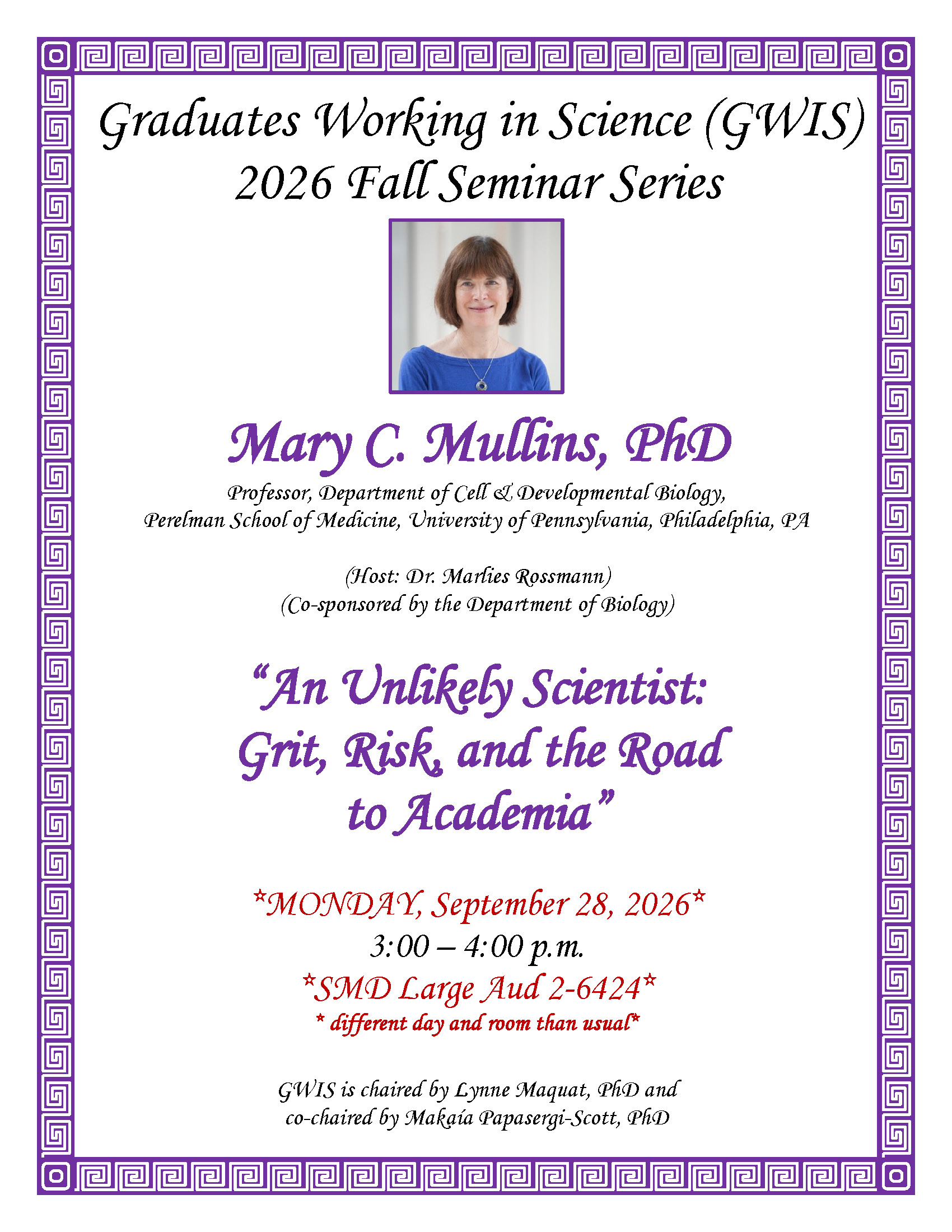

Sep 28, 2026 @ 3:00 p.m.
School of Medicine and Dentistry | SMD Large Aud 2-6424
Host: Dr. Marlies Rossmann, Co-sponsored by the Department of Biology
“Mechanisms of Transcription and Replication Through Chromatin” - DBB Seminar
Lucas Farnung, PhD - HHMI Freeman Hrabowski Scholar; Assistant Professor, Department of Cell Biology, Blavatnik Institute, Harvard Medical School, Boston, MA
Sep 23, 2026 @ 2:00 p.m.
Medical Center | K307 (3-6408)
Host: Dr. Clara Kielkopf
"Developing a 9-dimensional RNA-barcode to characterize RNA structures" - Student Seminar
James T. Seuch - PhD Candidate
Analysis of the RNA backbone conformations in tertiary and quaternary RNA-containing structures can characterize structural features present and evaluate results of molecular dynamics (MD) simulations. To analyze the conformations in a multi-residue molecule the RNA backbone can be organized by the dihedral bond angles in an overlapping sugar-to-sugar structure, termed a ‘suite’, defined by the nine dihedrals bonds δ(i), χ(i), ε(i), ζ(i), α(i+1), β(i+1), γ(i+1), δ(i+1), χ(i+1) of a dinucleotide pair. Given that a far greater collection of representative RNA-containing crystal structures is currently available, the evaluation of an updated dataset will reveal previously uncharacterized RNA conformations. In this work a filtered dataset was generated from crystal structures listed in the ‘Representative Sets of RNA 3D Structures’ database. Dihedral angle statistical potential and MD potential energy profiles organize RNA suites into distinct groups representing specific conformations. These groups are identified using a nine-character barcode that represents the dihedral bonds used. The resulting suite-barcodes can be used to characterize structural elements of interest in RNA molecules, provide a fast search for well characterized structural motifs and evaluate the backbone conformation space utilized in predicted RNA structures. This study will update our understanding of RNA backbone conformations using quality crystal structures of RNA-containing molecules and develop useful tools to critique and characterize tertiary RNA structures based on the backbone conformations.
Sep 22, 2026 @ 1:00 p.m.
Medical Center | Lower Adolph Aud. (1-7619)
Host: Advisor: D. Mathews
“Metabolic Plasticity as a Driver of Development and Disease” - DBB Seminar
Matthew Sieber, PhD - Associate Professor, Department of Physiology, The University of Texas Southwestern Medical Center, Dallas, TX
Sep 16, 2026 @ 2:00 p.m.
Medical Center | K307 (3-6408)
Host: Dr. Gaëlle Talross
Student Seminar Series: "Examining the Functions of the KDM5 Demethylases in Luminal Breast Cancer"
Zachary Smith - Graduate Student
Sep 15, 2026 @ 1:00 p.m.
Medical Center | Upper S-Wing Aud. (3-7619)
Host: Advisor: P. Vertino
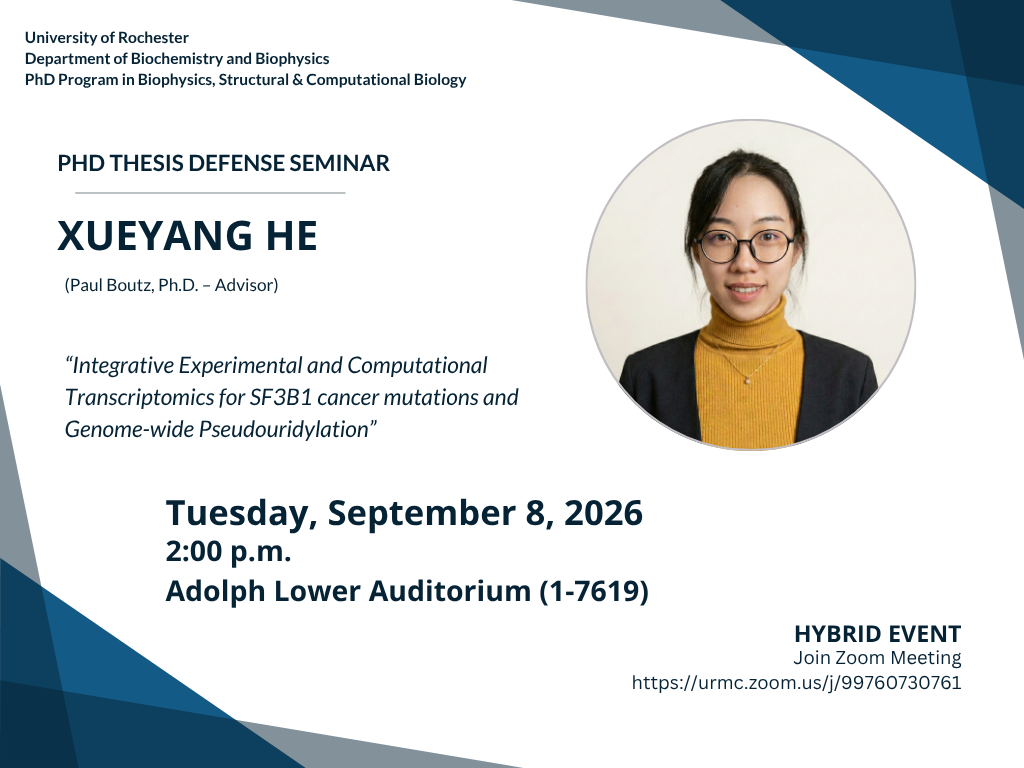
"Integrative Experimental and Computational Transcriptomics for SF3B1 cancer mutations and Genome-wide Pseudouridylation" - Thesis Defense
Student Seminar Series: "SIRT6 K316 drives phase separation and spatial partitioning of DNA and RNA to enable dsDNA break repair"
Eric Hillpot - Graduate Student
Sirtuin6 (SIRT6) is an anti-aging enzyme that silences genes, represses transposable elements, and promotes DNA damage response and repair. In mice, SIRT6 overexpression extends lifespan while SIRT6 KO mice die within 30 days after birth. SIRT6 functions as a chromatin-associated histone deacetylase (HDAc) and a protein mono-ADP-ribosyltransferase (mADPr); yet the dynamics of its interactions with chromatin and other substrates remains unknown. Liquid-Liquid Phase Separation (LLPS), or biomolecular condensation, manifests as membrane-less organelles that allow cells to regulate complex processes spatially and temporally such as in the nucleolus, stress granules, and heterochromatin regions. Due to its flexible C-terminal tail, we hypothesize that SIRT6 undergoes liquid-liquid phase separation (LLPS) to modulate interactions critical for DNA repair, gene expression including LINE1 suppression, stress granule biogenesis, and heterochromatin maintenance. SIRT6 undergoes phase separation with nucleic acids and partitions DNA from RNA in multiphasic condensates. Stimulated emission depletion (STED) super-resolution immunofluorescence microscopy reveals SIRT6 condensates in cells that are sensitive to nucleases. SIRT6 condensates purified from cells analyzed by mass spectrometry reveal chromatin and RNA-related proteins. A screen for SIRT6 phase separation knockout mutants yielded a point mutation, K316A, that can no longer phase separate with RNA, loses its DNA and RNA partitioning function, and has impaired DNA break repair while maintaining LINE1 suppression in cells. Future work includes multiomic comparison of SIRT6 WT to K316A CRISPR cell line
Sep 08, 2026 @ 1:00 p.m.
Medical Center | Upper S-Wing Auditorium (3-7619)
Host: Advisor: V. Gorbunova
“eIF3g binding to GUCG boxes located in mRNA coding regions enhances translation of mild heat shock response genes” - Special Seminar
Katsura Asano, PhD - Professor of Biology, Kansas State University, Manhattan, KS

Jul 31, 2026 @ 1:00 p.m.
Medical Center | Stotz (3-7423) or K307 if needed
Host: Center for RNA Biology
"The Molecular Mechanism of Csx28 Activation by Cas13b in Type VI-B2 CRISPR-Cas Systems" - Thesis Defense
Mert Koka - PhD Candidate
Jul 17, 2026 @ 12:00 p.m.
Medical Center | Upper S. Wing Aud. (3-7619)
Hybrid EventHost: Mitchell O'Connell, PhD - Advisor
"Analysis of Drosophila melanogaster somatic linker histone binding to nucleosomes and its effects on chromatin structure" - Thesis defense
Nicholas Rugelis - PhD Candidate
Jun 30, 2026 @ 10:00 a.m.
Medical Center | Adolph Aud. (1-7619)
Hybrid Event: Meeting ID: 913 6574Host: Advisor - Jeffrey Hayes, PhD
"Targeting Mitochondrial Metabolism to Limit Human Cytomegalovirus Replication" - Thesis Defense
Lucas Simpson - PhD Candidate
Jun 05, 2026 @ 1:00 p.m.
Medical Center | K-207 (2-6408)
Hybrid Zoom Link - Meeting ID: 971 2315 5511Host: Advisor: Joshua Munger, PhD
“Linking Genome Structure with Function: A Journey of Histone Variant Discovery”
David Tremethick, BSc (Hons) (Syd), PhD (Macq) - Professor, Division of Genome Sciences and Cancer, Australian National University, College of Science and Medicine, Canberra, Australia
May 26, 2026 @ 1:00 p.m.
Medical Center | Upper S-Wing Aud (3-7619)
Host: Dr. Jeffrey Hayes
“Ribosome Remodeling to Attend to Cellular Stress”
Katrin Karbstein, PhD - Professor and Vice-Chair, Department of Biochemistry, University, Nashville, TN
May 15, 2026 @ 11:00 a.m.
Medical Center | K307 (3-6408)
Host: Dr. Lynne Maquat (co-sponsored by the Protein Synthesis Cluster)
"Development of a novel cellular antibody affinity-based CRISPR screen and identification of JUNB as an inflammatory antiviral factor" - Thesis defense
Nicole Waild - PhD Candidate, Program in Biochemistry and Molecular Biology
May 04, 2026 @ 1:00 p.m.
Medical Center | Ryan Case Method Room (1-9576)
Hybrid EventHost: Advisor: Joshua Munger, PhD
“Replication and Host Impact of Circular RNAs in Bacteria”
Andrew Varble, PhD - Assistant Professor, Department of Microbiology and Immunology, University of Rochester, Rochester, NY
Apr 29, 2026 @ 3:00 p.m.
Medical Center | K307 (3-6408)
Host: Dr. Mitch O’Connell and Dr. Lynne Maquat
“Cancer-Specific Remodeling of the Transcription Machinery Identifies Targetable Vulnerabilities”
Harri Itkonen, PhD - Associate Professor, Department of Clinical Molecular Biology, EpiGen, Institute of Clinical Medicine, University of Oslo, Oslo, Norway; EpiGen, Medical Division, Akershus University Hospital, Lørenskog, Norway; Department of Biochemistry and Developmental Biology, Faculty of Medicine, University of Helsinki, Helsinki, Finland
Apr 23, 2026 @ 2:00 p.m.
Medical Center | Lower Adolph Aud. (1-7619)
Host: Dr. Paul Boutz
GWIS - "Beyond the Next Experiment: Crafting a Career with a Through-Line"
Seychelle Vos, PhD - Associate Professor of Biology, HHMI Freeman Hrabowski Scholar; Department of Biology, MIT, Cambridge, MA
Apr 16, 2026 @ 3:00 p.m.
Medical Center | Adolph Lower Aud (1-7619)
Host: T32 past trainee, Abby Manning and Dr. Eric Wagner (cosponsored by the NIH NIGMS T32 in CBMS)
“Understanding Transcription in the Context of Genome Organization”
Seychelle Vos, PhD - Associate Professor of Biology, HHMI Freeman Hrabowski Scholar; Department of Biology, MIT, Cambridge, MA
Apr 15, 2026 @ 3:00 p.m.
Medical Center | K307 (3-6408)
Host: T32 past trainee, Abby Manning and Dr. Eric Wagner (co-sponsored by Dr. Lynne Maquat, PI & Dr. Jeffrey Hayes, Co-PI; Graduates Working in Science (GWIS), and the RNA Society & Lexogen)
“Bridging Genome Structure and Function: Linking Chromosome Architecture, Chromatin Modifications, and Gene Expression”
Jill Dowen, PhD - Associate Professor, Department of Biochemistry & Biophysics, and of Biology; Associate Director, Curriculum in Genetics and Molecular Biology (GMB); Member, Integrative Program for Biological & Genome Sciences (iBGS); Lineberger Comprehensive Cancer Center, University of North Carolina, Chapel Hill, NC
Apr 08, 2026 @ 3:00 p.m.
Medical Center | K307 (3-6408)
Host: Dr. Jeffrey Hayes
“The RNA Regulation in Nuclear Bodies”
Ling-Ling Chen, PhD - Professor, and Director, State Key Laboratory of RNA Innovation, Science and Engineering (RISE), Shanghai Institute of Biochemistry and Cell Biology, Chinese Academy of Sciences, China
Apr 06, 2026 @ 3:00 p.m.
Medical Center | Lower Adolph Aud. (1-7619)
Host: Dr. Lynne Maquat (co-sponsored by the RNA Structure & Function Cluster)
GWIS - “Always Looking Forward”
Leemor Joshua-Tor, PhD - HHMI Investigator; W. M. Keck Professor of Structural Biology; Director of Research, Cold Spring Harbor Laboratory, Cold Spring Harbor, NY
Mar 19, 2026 @ 3:00 p.m.
Medical Center | Adolph Lower Aud (1-7619)
Host: Dr. Lynne Maquat (cosponsored by the NIH NIGMS T32 in CBMS)
“Target Release During miRNA Silencing”
Leemor Joshua-Tor, PhD - HHMI Investigator; W. M. Keck Professor of Structural Biology; Director of Research, Cold Spring Harbor Laboratory, Cold Spring Harbor, NY

Mar 18, 2026 @ 1:00 p.m.
School of Medicine and Dentistry | Class of '62 Aud. (G-9425)
Host: Dr. Lynne Maquat and Dr. Jeffrey Hayes (co-sponsored by Graduates Working in Science (GWIS))
2026 Upstate NY RNA Symposium

Mar 15, 2026 @ 9:00 a.m.
Host: The RNA Institute, U. of Albany & Center for RNA Biology, U. Rochester
“Insights into RNA Folding In Vivo by Complementary Top-Down and Bottom-Up Approaches”
Philip Bevilacqua, PhD - Distinguished Professor of Chemistry and of Biochemistry & Molecular Biology, Center for RNA Molecular Biology, Pennsylvania State University, University Park, PA
Mar 11, 2026 @ 3:00 p.m.
Medical Center | K307 (3-6408)
Host: T32 trainee, Olivia Hiltke and Dr. David Mathews (co-sponsored by Dr. Lynne Maquat, PI & Dr. Jeffrey Hayes, Co-PI and by the RNA Structure & Function Cluster)
“Understanding and Targeting NUP98 Fusion Oncoprotein Condensates”
Nicole Michmerhuizen, PhD - Assistant Professor, Department of Pediatrics, Hematology and Oncology, University of Rochester, Rochester, NY
Mar 04, 2026 @ 3:00 p.m.
Medical Center | K307 (3-6408)
Host: Dr. Eric Wagner and Dr. Josh Munger
Student Seminar Series: "A 2.49Å cryo-electron microscopy structure of CRISPR-associated heptameric membrane pore BpyCsx27 reveals important lipid interactions and a hydrophobic gating mechanism"
Seth Jones - Graduate Student
Mar 03, 2026 @ 1:30 p.m.
Medical Center | Upper S-Wing Auditorium (3-7619)
Host: Seth Jones
Student Seminar Series: "The hormesis effect of glycative stress on the heart during ischemia-reperfusion"
Rahiim Lake - Graduate Student
Mar 03, 2026 @ 1:00 p.m.
Medical Center | Upper S-Wing Auditorium (3-7619)
Host: Advisor: P. Brookes)
Student Seminar Series: "Sustainable Degradation of Marine Plastics using Microbial and Enzymatic Engineered Living Materials"
Tiana Rohe - Graduate Student
Biodegradable plastics have been developed to combat plastic pollution on land; however, these plastics typically show exceedingly slow degradation in marine environments. A marine bacteria, Bacillus sp. NRRL B-14911 (Bacillus sp.), is known to natively depolymerize the bioplastic poly(3-hydroxybutyrate) (PHB) and metabolize it as a carbon source. Taking advantage of the PHB degrading properties of Bacillus sp., I am developing synthetic biology solutions for end-of-life and triggerable PHB degradation. 3D bioprinted hydrogels with Bacillus sp., termed biostickers, have previously been shown by our lab to degrade PHB. Using desiccation, I have been able to extend the shelf life of these biostickers for a month. The viability and PHB degradation rates are on par with the non-desiccated biostickers and, excitingly, the mechanical toughness has improved with desiccation. This extended shelf life and toughness will allow biostickers to stay intact when stored on oceanography vesicles, where they can then be used for end-of-life PHB degradation onsite. I am also developing a solid-state Engineering Living Material (ELM) with desiccated Bacillus sp. embedded within PHB. When placed in an ocean-like environment, I have observed up to 20% mass loss in just 7 weeks of incubation. When placed in ocean seawater, a 5-fold increase in the degradation rate was observed. This novel solid-state ELM technology is the first of its kind for marine bioplastics and allows for embedded cells to survive and be specifically triggered when placed in an ocean environment, decreasing the lifespan of plastic in our fragile ocean ecosystems.
Feb 24, 2026 @ 1:30 p.m.
Medical Center | Lower Adolph Auditorium (1-7619)
Host: Advisor: A. Meyer
Student Seminar Series: "Characterization and function of a novel Integrator-associated complex"
Abby Manning - Graduate Student
The Integrator complex (INT), a substantial 17-subunit, modular assembly, plays a pivotal role in the transcription of all RNA Polymerase II (RNAPII) genes. Its functions are well-established in two key areas: 3′ end processing at small nuclear RNA (snRNA) genes and the orchestration of premature termination at the promoter-proximal pause of protein-coding genes. A key unanswered question is whether unique subcomplexes of INT subunits occupy the promoters of different RNAPII biotypes. While the Little Elongation Complex (LEC) is known to associate with RNAPII at snRNA genes to facilitate transcription and recruit Integrator—enabling INTS11 to mediate 3′-end cleavage—the precise structural and mechanistic basis of this recruitment remains unclear. Through co-immunoprecipitation experiments, we have found that the LEC subunit ICE2 forms a previously uncharacterized complex with the INT Tail module, which we term the ‘ICE Tail’ complex.
AlphaFold modeling and comparison with existing cryo-EM structures reveal that the INT Tail module adopts a distinct conformation when bound to ICE2, forming the ICE-Tail complex. This complex appears structurally distinct from and mutually exclusive with the canonical full INT and LEC complexes, suggesting that ICE-Tail may function as a transient intermediate required for snRNA biogenesis. My preliminary data show that ICE2 interacts robustly with the INT Tail module. To define the constituency of the ICE-Tail complex, I will use an established auxin-inducible degron (AID) system, which also enables probing of transcriptional changes upon targeted depletion of ICE-Tail members. Structural characterization of ICE-Tail involves cryo-EM and mutational co-immunoprecipitation analysis. This work will fill critical knowledge gaps by identifying functionally essential interactions and generating novel structural models of this intermediate assembly. It also provides a key first insight into how INT may assemble and function differently across distinct RNA biotypes, suggesting that transcriptional machinery may customize its composition to regulate coding versus noncoding loci
Feb 24, 2026 @ 1:00 p.m.
Medical Center | Lower Adolph Auditorium (1-7619)
Host: Advisor: E. Wagner
GWIS - “Responsible Conduct of Research with AI”
Jonathan Herington, PhD - Assistant Professor, Departments of Health Humanities and Bioethics, and of Philosophy, University of Rochester
Feb 19, 2026 @ 3:00 p.m.
Medical Center | Adolph Lower Aud (1-7619)
Host: Dr. Lynne Maquat
“RNA Methylation in Gene Expression Regulation”
Chuan He, PhD - John T. Wilson Distinguished Service Professor, Department of Chemistry, Department of Biochemistry and Molecular Biology, Howard Hughes Medical Institute, The University of Chicago, Chicago, IL
Feb 18, 2026 @ 3:00 p.m.
Medical Center | K307 (3-6408)
Host: Dr. Lynne Maquat (co-sponsored by RNA Society & Lexogen and the RNA Structure & Function Cluster)
Student Seminar Series: "Calculating the Local pKa of Ionizable Lipids in Membranes with Alchemical Free Energy Perturbation Simulations"
Akshara Sharma - Graduate Student
Lipid nanoparticles (LNPs) are a leading drug delivery platform for mRNA or other nucleic-acid based therapeutics. LNP platforms like those used in the COVID-19 vaccines from Moderna and Pfizer/BioNTech are typically composed of ionizable aminolipids, phospholipids, sterols, and PEG lipids. These ionizable aminolipids are typically protonated at low pH, allowing them to encapsulate negatively charged mRNA. The pHs used during the different stages of LNP formulation strongly regulate how efficiently the mRNA is encapsulated in a composition-dependent manner. This makes understanding the pKa of aminolipids in the context of an LNP or membrane crucial to rational refinement of the encapsulation process. In this study, we use molecular dynamics (MD) simulations with alchemical free energy perturbation to calculate the free energy to deprotonate an ionizable aminolipid in an LNP-like membrane bilayer, allowing us to calculate the apparent pKa of the system. We do this for membranes of aminolipid compositions ranging from 10% to 45% ionizable lipid and represent various pH environments by varying the fraction of charged aminolipids from 20-80% to quantify the apparent pKa of the system over a wide range of physiological conditions. We calculate the pKa shifts, study the electrostatic environment of the various systems, and derive insights into the structural properties of the membranes at different compositions
Feb 17, 2026 @ 1:30 p.m.
Medical Center | Lower Adolph Auditorium (1-7619)
Host: Advisor: A. Grossfield
Student Seminar Series: "Structure and function analysis of a polyamine riboswitch..."
Matthew Law - Graduate Student
Feb 10, 2026 @ 1:30 p.m.
School of Medicine and Dentistry | SMD Large Auditorium (2-6424)
Host: Advisor: J. Wedekind
Student Seminar Series: "RNAProbClust: A tool for clustering aptamer sequences from SELEX experiments"
Megan Miaro - Graduate Student
Feb 10, 2026 @ 1:00 p.m.
School of Medicine and Dentistry | SMD Large Auditorium (2-6424)
Host: Advisor: D. Mathews
Student Seminar Series: "Defining the Roles of 5’UTR Length and Secondary Structure in Eukaryotic Translation Initiation"
Thomas Ossevoort - Graduate Student
The 5ʹ untranslated region (UTR) of mRNA is known to be a key contributor to translational
regulation. However, many of the mechanisms by which the 5ʹUTR regulates translation are poorly
understood. To delineate contributions of UTR length and secondary structure, we use non-repetitive
unstructured sequences (NUSs) designed by the Mathews lab. We show that variation in 5ʹUTR length
has a modest impact on cap-dependent translation in plant and human cellular extracts, indicating that
scanning of the 5ʹUTR by the 40S in search of the start codon is not rate limiting. Inhibition of the
main translational RNA helicase eIF4A by hippuristanol equally decreases cap-dependent translation
of mRNAs with unstructured 5ʹUTRs of various lengths in WGE. Therefore, our data suggests that 40S
scanning is a helicase-independent, diffusion-driven process. In collaboration with the Mathews lab,
we also explored conserved elements of 5ʹUTR secondary structure that regulate translation initiation
in human cells. We focus our studies on a non-canonical cyclin, CCNI, and demonstrate that the
computationally identified, evolutionary conserved stem-loop of CCNI 5ʹUTR is involved in
translation mediated by a non-canonical initiation factor eIF4G2. The removal of upstream Open
Reading Frames (uORFs) combined with the deletion of the stem-loop completely abrogates
dependence of CCNI mRNA translation on eIF4G2. Our data is consistent with a model suggesting
that the presence of uORFs and elements of secondary structure in the 5ʹUTR enables eIF4G2-
mediated translation. Taken together, our studies reveal new roles of 5ʹUTR length and secondary
structure in translational control.
Feb 03, 2026 @ 1:00 p.m.
Medical Center | Upper S-Wing Auditorium (3-7619)
Host: Advisor: D. Ermolenko
Student Seminar Series: "Experimental identification of genetic barriers to horizontal gene transfer in Staphylococcus aureus"
Keegan Proctor - Graduate Student
Staphylococcus aureus permanently and asymptomatically colonizes ~30% of the human population and acts as a commensal member of the human skin and nasal microbiome. However, S. aureus is also an opportunistic pathogen and a leading cause of serious hospital acquired infections. The ability of S. aureus to overcome host barriers and successfully infect their host relies on a diverse array of virulence factors, many of which are present on mobile genetic elements. Horizontal gene transfer (HGT) of these mobile elements is therefore a major driver of S. aureus pathogenicity, and my project seeks to better understand the factors which influence the transmission of mobile genetic elements.
Conjugation and mobilization of plasmids is a widespread mechanism of HGT in S. aureus, and these plasmids encode numerous virulence factors which benefit S. aureus during infection. However, Transfer of a representative conjugative plasmid into a collection of clinically isolated S. aureus samples revealed highly varied rates between different strains. Using a bioinformatic approach to identify potential determinants of this difference in conjugation rate identified a narrow range of canonical and noncanonical RM systems which impact conjugation in the impacted clinical strains. Given this small subset of factors which inhibit conjugation, further work seeks to develop methods to overcome these barriers in order to leverage conjugation as a genetic tool for manipulating the otherwise experimentally intractable clinical strains of S. aureus. Further understanding of bacterial factors involved in HGT could aid in predicting or potentially controlling the spread of antibiotic resistance as well as rational design of mobile genetic elements as tools.
Jan 27, 2026 @ 1:00 p.m.
Medical Center | Upper S-Wing Aud. (3-7619)
Host: A. Varble - Advisor
GWIS - “GWIS 25 Years Later: Discussion of Memoir ‘Mommy, Can Boys Also Be Doctors?’”
Marlene Belfort, PhD - Distinguished Professor, Department of Biological Sciences; Senior Advisor, The RNA Institute, SUNY University at Albany, NY
Jan 22, 2026 @ 3:00 p.m.
Medical Center | Adolph Lower Aud (1-7619)
Host: Dr. Lynne Maquat
DBB Student Seminar: "Development of Tools and tRNA-based Therapeutics for Rescue of PTC-derived Disease and Elongation Efficiency of CFTR"
Jeff Gabell - PhD Candidate
Cystic fibrosis (CF) is a monogenic autosomal recessive disorder caused by loss-of-function mutations in the Cystic Fibrosis Transmembrane Conductance Regulator (CFTR) gene. Several classes of the disease exist with various susceptibility to therapeutic intervention. The Lueck Lab explores how tRNAs can be harnessed as a therapeutic tool to target nonsense readthrough or to manipulate elongation efficiency of translation. Class I CFTR mutations, which result from nonsense mutations, account for ~10% of CF cases and are associated with severe CF phenotypes. Previous work has demonstrated that Anti-Codon Edited (ACE-) tRNAs are a promising therapeutic for nonsense diseases. Here, we demonstrate an in vivo reporter mouse for premature termination codon (PTC) readthrough we call Stop-Go-Glow. This model allows for fluorescent and luminescent quantification of PTC readthrough that can be used to evaluate the efficacy, durability, and delivery efficiency of ACE-tRNA technologies in a disease-agnostic manner. Additionally, tRNA pools are a major determinant in translation elongation rates, yet they are highly variable between cell types and are often not considered in available algorithms that determine codon optimality. We have developed screening reporter(s) for identifying specific codon usage within a gene of interest to determine which specific tRNA isodecoders are limiting translation elongation. The goal is to explore the efficacy of natural and non-natural tRNA supplementation targeting elongation bottlenecks and to inform the creation of a ‘functionally optimized’ CFTR transcript by identifying specific codons susceptible to optimization. From these screens, we have determined a list of tRNAs and codons in the CFTR transcript that are promising targets, which we are currently evaluating through functional assays. Importantly, what we learn here can be adapted to other transcripts for generations of therapeutics.
Jan 20, 2026 @ 1:00 p.m.
Medical Center | Upper S-Wing Auditorium (3-7619)
Host: J. Lueck - Advisor
Student Seminar Series: "Development of Tools and tRNA-based Therapeutics for Rescue of PTC-derived Disease and Elongation Efficiency of CFTR"
Jeff Gabell - Graduate Student
Cystic fibrosis (CF) is a monogenic autosomal recessive disorder caused by loss-of-function mutations in the Cystic Fibrosis Transmembrane Conductance Regulator (CFTR) gene. Several classes of the disease exist with various susceptibility to therapeutic intervention. The Lueck Lab explores how tRNAs can be harnessed as a therapeutic tool to target nonsense readthrough or to manipulate elongation efficiency of translation. Class I CFTR mutations, which result from nonsense mutations, account for ~10% of CF cases and are associated with severe CF phenotypes. Previous work has demonstrated that Anti-Codon Edited (ACE-) tRNAs are a promising therapeutic for nonsense diseases. Here, we demonstrate an in vivo reporter mouse for premature termination codon (PTC) readthrough we call Stop-Go-Glow. This model allows for fluorescent and luminescent quantification of PTC readthrough that can be used to evaluate the efficacy, durability, and delivery efficiency of ACE-tRNA technologies in a disease-agnostic manner. Additionally, tRNA pools are a major determinant in translation elongation rates, yet they are highly variable between cell types and are often not considered in available algorithms that determine codon optimality. We have developed screening reporter(s) for identifying specific codon usage within a gene of interest to determine which specific tRNA isodecoders are limiting translation elongation. The goal is to explore the efficacy of natural and non-natural tRNA supplementation targeting elongation bottlenecks and to inform the creation of a ‘functionally optimized’ CFTR transcript by identifying specific codons susceptible to optimization. From these screens, we have determined a list of tRNAs and codons in the CFTR transcript that are promising targets, which we are currently evaluating through functional assays. Importantly, what we learn here can be adapted to other transcripts for generations of therapeutics.
Jan 20, 2026 @ 1:00 p.m.
Medical Center | Upper S-Wing Aud. (3-7619)
Host: Advisor: J. Lueck
“Health Humanities: The Other Basic Science at UR School of Medicine and Dentistry”
Lainie Friedman Ross, MD, PhD - Mark and Lois Taubman Distinguished Professor and Chair, Dept of Health Humanities and Bioethics, University of Rochester School of Medicine and Dentistry; and Director, Paul M Schyve MD Center for Bioethics, University of Rochester
Jan 15, 2026 @ 3:00 p.m.
School of Medicine and Dentistry | Adolph Lower Aud. (1-7619)
Host: Dr. Lynne Maquat