
Thesis/Defense Presentations
Thesis/Defense Presentations
"The role of prefrontal μ-opioid receptors in the rapid antidepressant actions of ketamine" - Thesis Proposal
Gavin Magill - PhD Candidate, Neuroscience Graduate Program
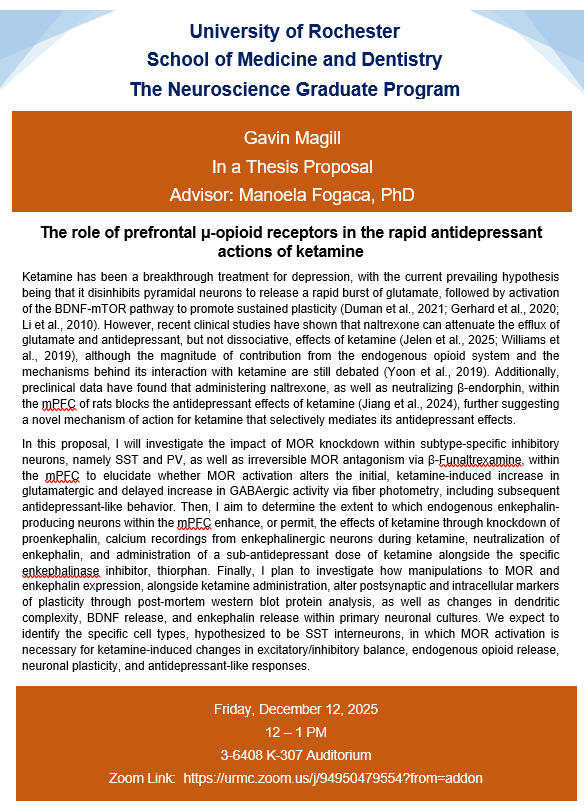
Dec 12, 2025 @ 12:00 p.m.
Medical Center | K-307 (3-6408)
Hybrid EventHost: Advisor: Manoela Fogaca, PhD
"Microglial and Dopaminergic Mechanisms of Psychosocial Stress in the Anterior Insular Cortex" - Thesis Proposal
Staci Rocco - PhD Candidate, Neuroscience Graduate Program
Early-life stress is a significant risk factor for neuropsychiatric disorders. Microglia, the brain’s resident immune cells, regulate neuroimmune signaling and are increasingly implicated in stress-related neuropathology. Prior work has proposed an intriguing model of microglial priming, in which an initial stressor induces lasting changes that render microglia hypersensitive to subsequent inflammatory insults. However, it is not yet known whether early-life psychosocial stressors also produce a primed microglial state that alters later psychological stress responses, nor are the neurobiological consequences of such priming well defined. The overall objective of this project is to investigate microglial mechanisms that may link early-life psychosocial stress to enduring stress vulnerability in brain circuits. Our lab previously demonstrated that microglia dynamically interact with dopaminergic axons in the medial frontal cortex, contributing to dopamine-dependent adolescent plasticity and cognitive functions. The anterior insular cortex (aIC), which also receives dense dopaminergic innervation and plays a key role in interoceptive and social-affective processing, represents a compelling region to examine stress-related priming mechanisms. Our preliminary data support this direction: juvenile social isolation in mice reduces dopamine release in the aIC, while transcriptomic analysis of adult-isolated mice reveals downregulation of microglial homeostatic genes. Building on these findings, we hypothesize that juvenile social isolation primes microglia and disrupts microglia–dopamine interactions in the aIC. Aim 1 will employ a two-hit psychological stress paradigm—juvenile social isolation (JSI) followed by adult restraint stress—to determine whether JSI establishes a primed microglial state in the aIC. Noninvasive in vivo two-photon imaging of microglial morphology and dynamics, paired with pharmacological manipulations and molecular and histological profiling, will identify mechanisms driving microglia priming. Aim 2 will probe how JSI alters microglia–dopamine interactions by integrating simultaneous in vivo imaging of microglia and dopamine axons with targeted pharmacological manipulations to assess circuit-level consequences and microglial contributions. Together, these studies will provide critical insight into how early-life psychosocial stress shapes neuroimmune and dopaminergic function in the aIC, advancing our understanding of the cellular mechanisms that confer vulnerability to stress-related neuropsychiatric disorders.
Dec 02, 2025 @ 12:00 p.m.
School of Medicine and Dentistry | Ryan Case Method Room (1-9576)
Hybrid EventHost: Advisor: Kuan Hong Wang, PhD
"Neuroinflammatory priming in astrocytes by diet-induced maternal immune activation reduces resilience in a second hit model of postoperative delirium" - Thesis Proposal
Erica Squire - PhD Candidate, Neuroscience Graduate Program
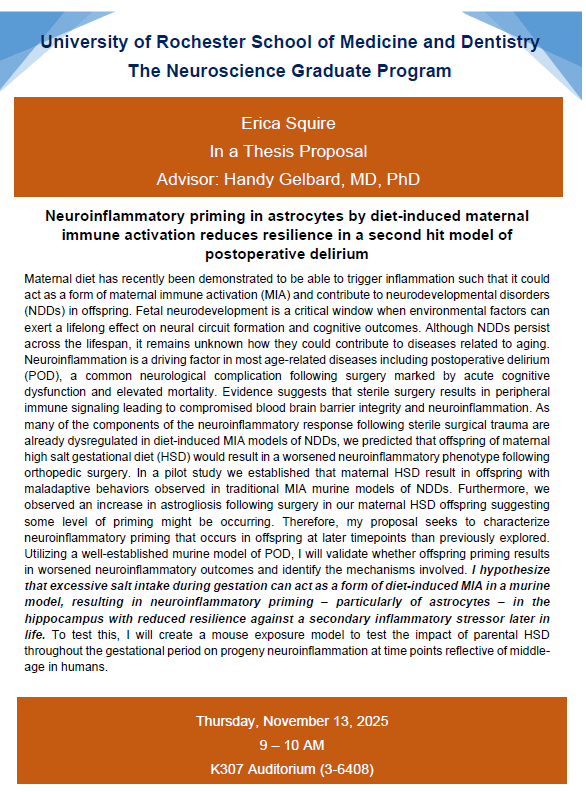
Nov 13, 2025 @ 9:00 a.m.
Medical Center | K307 (3-6408)
Host: Advisor: Handy Gelbard, MD, PhD
"Characterization of mitochondrial intermembrane space protein Mix23 in neurological disease" - Thesis Proposal
Leah Sheppard - PhD Candidate
Mitochondria maintain their function through a protein quality control system that facilitates protein folding, complex assembly, and targeted protein degradation. Disruptions in PQC are implicated in neurodegenerative disorders, mitochondrial diseases, and age-related pathologies. AFG3L2, the inner mitochondrial membrane metalloprotease, plays a crucial role in selectively degrading proteins and maintaining mitochondrial homeostasis. Notably, it regulates the turnover of the respiratory chain complexes, ensuring their functionality. AFG3L2 interacts with Prohibitins (PHBs), scaffolding proteins that chaperone and stabilize inner membrane proteins, including respiratory chain components, by modulating AFG3L2’s access to substrates. Together, the PHB/AFG3L2 complex controls inner membrane proteostasis, contributing to mitochondrial integrity. However, the molecular mechanism by which PHB regulates AFG3L2 and maintains mitochondrial homeostasis is unclear. Here, we propose that Mix23, together with PHB/AFG3L2, form a regulatory axis to maintain inner membrane proteostasis. Mix23 is a small mitochondrial intermembrane space (IMS) protein. While limited information exists on Mix23’s function, proteomic studies have identified that Mix23 and its close binding partner SMIM12 interact with the PHB/AFG3L2 complex and respiratory chain proteins. Preliminary Seahorse data also show that loss of Mix23 disrupts respiratory chain oxygen consumption rates. Based on these findings, we propose that Mix23/SMIM12 interacts with Prohibitin/AFG3L2 complex to regulate the chaperoning and degradation of respiratory chain complexes and assembly factors. To address this hypothesis, we will explore the neurological consequences of Mix23 loss. We generated Mix23 mutant mice to investigate their behavior and pathology. Behavioral testing revealed that Mix23 mutant mice display significant hindlimb motor impairment compared to wild-type controls. This phenotype is consistent with human whole-exome sequencing data that links Mix23 mutations to motor impairment. In Aim 1, we will investigate how Mix23/SMIM12 interacts with PHB/AFG3L2 to mediate respiratory chain assembly in vitro. We will also examine how this mechanism impacts mitochondrial bioenergetics and cellular function. Aim 2 will investigate the neuropathology underlying this phenotype by examining signs of neurodegeneration, neuroinflammation, and mitochondrial stress in the cerebellum and spinal cord. Collectively, these studies will provide insight into how PHB/AFG3L2 maintains respiratory chain stability and define Mix23/SMIM12’s role in mitochondrial function and neurological disease.
Oct 16, 2025 @ 10:30 a.m.
Medical Center | Ryan Case Method Rm. (1-9576)
Host: Advisor: Jennetta Hammond, PhD
"Linking Secondary Insults to Neurological Vulnerability in the Rare Disease Ataxia Telangiectasia" - Thesis Defense
Maleelo Shamambo, MS - PhD Candidate
Ataxia Telangiectasia (AT) is a rare genetic disorder that causes progressively worsening motor decline, immune dysfunction, and frequent respiratory infections. While lung infections are a leading cause of illness and death in AT patients, their contribution to neurological worsening has not been established.
To investigate this, we used an Atm-null mouse model to test how different non-genetic stressors impact the brain. First, we used the cuprizone model of oxidative stress, which revealed that loss of Atm impairs neurological recovery with motor defects, as well as abnormal myelin structure and glial reactivity patterns. Next, we turned to lung-targeted insults, using a bacterial endotoxin (LPS) and viral infection with influenza A, to mimic the clinical immune challenges faced by patients. We found that even without direct brain infection, both insults triggered enhanced neuroinflammatory responses in the cerebellum of ATM-deficient mice, with influenza causing the strongest effects on morbidity and mortality. These brain changes were accompanied by motor deficits, particularly in gait adaptation.
Together, our findings suggest that ATM loss sensitizes the brain to both systemic oxidative and immune stress, and that lung infections in particular can act as drivers of cerebellar inflammation and motor dysfunction. By connecting genetic experimental models with patient-relevant insults, this work highlights the importance of integrating genetic and environmental factors in AT research and points toward new therapeutic strategies.
Oct 16, 2025 @ 10:00 a.m.
Medical Center | K307 (3-6408)
Host: Advisor: Margot Mayer-Proschel, PhD
Auditory Neurophysiological and Neuropathological Deficits in the Cln3-/- Mouse Model of Batten Disease - Thesis Defense
Yanya Ding, MS - PhD Candidate
CLN3 disease, also known as Juvenile Batten Disease, is a recessively inherited neurodevelopmental disorder caused by mutations in the CLN3 gene. It represents the most common form of Neuronal Ceroid Lipofuscinoses (NCLs), a group of Lysosomal Storage Disorders (LSDs) marked by accumulation of storage material. Clinical features include progressive vision loss, cognitive decline and language impairment. The early onset of visual deficits complicates the neurological assessment of cognitive dysfunction, while the rarity of CLN3 cases limits the study of sex-specific disease trajectories in humans. Therefore, there is a critical need for objective, translational biomarkers to monitor disease progression and support therapeutic development in preclinical animal models. Although language impairment has been documented in CLN3 disease, auditory processing dysfunctions that underlie it remain unexplored, highlighting another gap in understanding disease mechanisms.
Building on our prior studies in CLN3 patients, electroencephalography (EEG) with a duration-based mismatch negativity (MMN) paradigm was used in the Cln3-/- mouse model to examine auditory neurophysiological changes. It evaluates automatic detection of auditory pattern changes in male and female mice between 3 and 9 months of age. Wild-type (WT) mice of both sexes showed robust and stable duration MMN responses across this age range. In contrast, Cln3-/- mice showed sex- and age-dependent deficits. Female mutants displayed persistent MMN deficits, whereas male mutants exhibited early MMN abnormalities that restored at later ages. Auditory brainstem responses (ABRs) confirmed intact peripheral hearing in Cln3-/- mice, indicating a central origin for the observed abnormalities. Further analyses revealed age- and sex-specific alterations in auditory evoked potentials (AEPs) to both standard and deviant stimuli.
Immunostaining and imaging of the Subunit C of Mitochondrial ATP Synthase (SCMAS), a common histological marker for NCLs, were performed to examine auditory neuropathological changes in the Cln3-/- mouse model. WT mice of both sexes showed no pathological accumulation, whereas Cln3-/- mice exhibited progressive increase in SCMAS expression between 1 to 9 months of age. Female mutants displayed higher expression of SCMAS than male mutants in the medial geniculate nucleus (MGN) at 1- and 3-month-old. They also showed elevated SCMAS expression in the auditory thalamic reticular nucleus (TRN) and primary auditory cortex (A1) at 9 months of age. Cell-type susceptibility of neuropathology was next examined. In the auditory TRN, there was high co-localization of SCMAS with parvalbumin (PV) in Cln3-/- mice between 1 to 9 months of age, indicating PV+ interneuron as a susceptible cell type.
Overall, Cln3-/- mice showed sex- and age-dependent neurophysiological and neuropathological deficits of central auditory processing. These findings unravel central auditory dysfunctions in CLN3 disease and validate auditory duration MMN as a translational biomarker. They also provide foundations to uncover underlying mechanisms and develop therapeutic strategies.
Sep 30, 2025 @ 1:00 p.m.
Medical Center | K307 (3-6408)
Host: Advisors: Kuan Hong Wang, PhD, John Foxe, PhD and Edward Freedman, PhD
Alpha 1 noradrenergic signaling modulates Ca2+-mediated microglial process motility via release of astrocytic ATP - Thesis Proposal
Siddharth Chittaranjan - PhD Candidate
Sep 30, 2025 @ 9:15 a.m.
School of Medicine and Dentistry | Large Auditorium (2-6424)
Host: Advisor: Nathan A. Smith, PhD
Investigating maladaptive callosal myelination in Houge-Janssens Syndrome 1 mouse models - Thesis Proposal
Stacey Pedraza - PhD Candidate
Houge-Janssens syndrome-1 (HJS1), also called Jordan’s syndrome, is a rare neurodevelopmental disorder resulting from de novo mutations in the PPP2R5D gene. This gene encodes one of the many regulatory B subunits of protein phosphatase 2A (PP2A). PP2A is a critical heterotrimeric holoenzyme, responsible for more than 40% of all serine/threonine-specific dephosphorylations in the central nervous system (CNS). HJS1 mutations (E198K and E420K) lead to severe intellectual disability disorder (IDD), autism, seizures, and other pathological phenotypes such as aberrant white matter brain structure. Alterations in brain structure and function suggest the imbalance of excitatory and inhibitory (E/I) neural activity, which may result in defective neuroplasticity. Previous studies have demonstrated that neuronal activity regulates callosal myelination, a critical process for the rapid propagation of action potentials and modulation of neuroplasticity. Aberrant neuronal activity, such as the imbalance of E/I, may alter activity-regulated myelination. Consistently, we found that HJS1 mouse models exhibit increased neuronal excitability and callosal myelination, suggesting altered brain structure and function. However, the underlying molecular mechanisms involved in HJS1 mutations regulating myelination remain poorly understood. This study will test the hypothesis that severe HJS1 mutations trigger activity-dependent myelination to promote maladaptive myelination of axons in the corpus callosum via the BDNF (neuron) – TrkB (OPC/OL) signaling pathway. We will use heterozygous knock-in mouse models of severe HJS1 mutations that mimic the human disease state and exhibit aberrant neuronal activity to address how HJS1 mutations translate to increased callosal myelination. In Aim 1, I will test our hypothesis that severe HJS1 mutations increase callosal axon myelin sheath thickness. In Aim 2, I will test the prediction that increased neuronal excitability in HJS1 mouse models contributes to the enhanced callosal myelination. Furthermore, I will determine whether BDNF (neuron) – TrkB (OPC/OL) signaling mediates HJS1’s effect on promoting callosal myelination. This study will help define the cellular signaling pathways disrupted in HJS1 that contribute to the pathophysiology and provide valuable insight for understanding the underlying molecular mechanisms involved in activity-regulated myelination in normal and disease states, such as IDD and seizures.
Sep 25, 2025 @ 1:00 p.m.
Medical Center | K307 (3-6408)
Host: Advisor: Houhui Xia, PhD
KCC2 dysfunction in PPP2R5D-related intellectual development and autism spectrum disorders - Thesis Proposal
Thomas Scudder - PhD Candidate
Protein Phosphatase 2A (PP2A) is directly responsible for over 40% of serine/threonine dephosphorylation events in mammalian cells. Though it lacks intrinsic substrate specificity, PP2A achieves precise spatiotemporal regulation through assembly with diverse regulatory adaptor subunits. The canonical holoenzyme comprises a catalytic C-subunit (PPP2C), a scaffolding A-subunit (PPP2R1), and a substratetargeting B-subunit. PPP2R5D (B56δ) is one such adaptor, critical for intracellular localization and activity, yet its full repertoire of targets and mechanisms remains undefined. The human de novo E420K and E198K mutations in PPP2R5D produce neurological symptoms, including intellectual disability, seizures, and autism spectrum disorder (collectively termed Jordan’s Syndrome), with underlying molecular mechanisms that are largely unknown. K+/Cl- co-transporter 2 (KCC2) is neuron-specific, and its activity, surface expression, and localization are tightly regulated through multiple mechanisms, notably phosphorylation at several sites including Serine 940 (S940). KCC2 S940 is phosphorylated by PKC and canonically dephosphorylated by PP1 via scaffolding by LMTK3. Through this regulation, KCC2 maintains intracellular [Cl-] homeostasis, and its dysregulation results in aberrant neuronal activity, including impaired GABAergic inhibition, causing pathogenic hyperexcitability and behavioral deficits that parallel symptoms seen in patients with the de novo PPP2R5D mutations that result in Jordan’s Syndrome. This project aims to determine if human de novo mutation variants of the PPP2R5D-PP2A holoenzyme exhibit rogue activity on KCC2-pS940, resulting in hyperexcitability and reduction or reversal of normal GABAA receptor inhibitory function. To model these effects, I will employ PPP2R5D knockout (+/- and -/-) and heterozygous knock-in (E198K/+ and E420K/+) mice. Using these models, I will determine if PPP2R5D mutations directly alter KCC2-pS940 levels in neurons, investigate whether PPP2R5D mutations cause hyperexcitability via disrupted [Cl-] homeostasis, and test whether a KCC2 activator rescues the neuronal hyperexcitability, cognition, and social interaction deficits seen in mouse models. These studies will advance understanding of PPP2R5D function, how its mutations affect PP2A activity and neuronal signaling, and inform therapeutic development for PPP2R5Drelated intellectual disability.
Sep 19, 2025 @ 1:00 p.m.
Medical Center | K307 (3-6408)
Host: Advisor: Houhui Xia, PhD
FutureCasting: Investigating the deployment of temporal attention to long timescales in naturalistic narratives - Thesis Proposal
Aishwarya Jayan - PhD Candicate
Knowing when and where to direct our visual attention is critical to functioning in a complex world. For example, if we attend exactly at the moment when a tennis ball will be in an ideal location, we can better achieve our ideal outcome of hitting it with our racket. Spatial attention (where to attend) has been studied extensively, including in naturalistic contexts. However, temporal attention (when to attend) has primarily been studied in the context of low-level visual discrimination tasks, such as distinguishing between gratings of different orientations, and with attentional deployment limited to only a couple of seconds into the future. This leaves unexplored the crucial gap between prior work on temporal attention and the reality of how naturalistic temporal attention works, whether that means hitting the tennis ball at the right moment or paying attention to important moments during conversations in our daily lives. To address this problem, I propose to study the behavioral (psychophysics) and neural (functional magnetic resonance imaging, fMRI) mechanisms of voluntary temporal attention on ecologically relevant timescales (ranging from seconds to minutes) and as it applies to a variety of stimuli, ranging from gratings, to objects, scenes, and faces, and to naturalistic audiovisual stories. I hypothesize that (1) temporal attention can be cued on a longer timescale than previously shown (~1.5 sec); and that (2) temporal attention can be cued across highly complex stimuli, such as objects, scenes, faces, and naturalistic narratives. Furthermore, for naturalistic narratives, I predict that successful deployment of temporal attention for a specific story moment will result in improved perception and in memory facilitation not just for the cued moment, but also for the entire encompassing event (tens of seconds to minutes) that the key moment is a part of in the broader narrative. The feasibility of my paradigm is supported by foundational prior work on temporal attention, which provides evidence for improved visual perception due to temporal attention cueing. Further, prior work on event perception and episodic memory for narratives has shown that timing and predictability are crucial elements to both processes, and I expand upon and manipulate these aspects of the stimuli in my study. In Aim 1, I will determine the timescale limitations of temporal attention using a visual discrimination task with gratings. In Aim 2, I will explore the effects of deploying temporal attention at multiple timescales in the context of complex visual stimuli, including faces, objects, and scenes. Finally, in Aim 3, I will examine how deploying temporal attention to specific moments of complex audiovisual naturalistic narratives (e.g., a plot point of a TV show episode) affects perception and memory for those moments and for other high-level components of those narratives, such as characters, plots, and events. Successful completion of these aims will help shed light not only on the behavioral and neural mechanisms of temporal attention for complex stimuli and ecologically relevant timescales but will also offer a new approach for examining the effects of attentional cueing on naturalistic event perception and memory. In sum, our proposed study seeks to bring us closer to understanding the real-world implications of temporal attentional deployment.
Sep 17, 2025 @ 2:00 p.m.
Medical Center | 1-7619 Lower Adolph Aud.
Hybrid EventHost: Advisor: Coraline Rinn Iordan, PhD
Phospho-regulation of liprin-alpha1 via the PPP2R5D-PP2A holoenzyme - Thesis Defense
Abigail Mayer, MS - PhD Candidate
Sep 12, 2025 @ 1:00 p.m.
Medical Center | K307 (3-6408)
Host: Advisor: Houhui Xia, PhD
Variability in early visual cortex damage from stroke: impact on perception, metacognition, and training outcomes - Thesis Proposal
Niki Lam - PhD Candidate
Cortically-induced blindness (CB) occurs from postchiasmatic brain damage, primarily due to occipital stroke. This produces homonymous visual field defects, in which perception in the visual field on the same side of each eye is affected to varying degrees for different abilities1,2. Perceptual training appears beneficial in improving perceptual deficits in CB patients3-5. However, there is significant variability in both residual blind-field perception post-stroke and training outcomes across patients5-7. An important gap in the field is understanding why there is variability from occipital stroke damage both for residual perception in the blindfield and training outcomes. For instance, residual motion abilities5, 36 appear to be more prevalent than residual orientation abilities5 in the blind-field. This could be due to the sparing of the motion-sensitive area hMT+ by the stroke, and the existence of pathways that bypass V1, sending direct projections from the LGN to hMT+15, 37, 38. In contrast, residual perception for static orientation may be less common because it critically relies on orientation-selective V1 neurons41, and in rare cases when it is preserved, this could be due to unaffected extrastriate areas that contain orientation-tuned neurons42, 43. The variable sparing of extrastriate visual areas could also contribute to variability in the efficacy of training for recovering static orientation discrimination, as some CB patients show more improvement than others5, 16, 44. The present proposal will test the hypothesis that the particular combination of damage to early visual cortical areas and/or hMT+ accounts for the observed variability in residual perception and training outcomes across CB patients. Another possible source of variability affecting perception in CB fields is metacognitive state, or the ability to reflect on one’s own perception, and adjust performance accordingly24,49. Intact metacognition likely reflects a process whereby higher-level cognitive areas evaluate processing in lower-level sensory areas, with increased metacognitive accuracy functioning as positive feedback for future task performance50,53. One visual area thought to
contribute to metacognition for low-level visual features such as orientation is V121. Despite the extensive literature on blindsight (above-chance task performance despite no subjective awareness)19, 20, 33, preliminary data from our lab suggests that many CB patients have intact metacognition. This highlights another gap in the field: the lack of systematic assessment of metacognitive ability in CB patients and its neural substrates. Our proposed experiments ask if the extent of damage to early visual cortex determines metacognitive ability of CB patients, and for the first time, we will explore whether metacognition can be recruited during training to enhance rehabilitative outcomes in this condition. Aim 1 seeks to understand the effects of damage to early visual areas on perception and metacognition in the blind field of CB patients before training. I will use probabilistic brain atlases to characterize damage to visual cortical areas and correlate this with psychophysical measures of performance and metacognition. Aim 2 will then examine the relationship between damage to early visual areas, metacognitive ability and training outcomes, asking the additional question: can training that taps into metacognition enhance recovery. Two cohorts of CB patients will be trained on a fine orientation task with or without confidence ratings. Aim 1 psychophysical measures will be repeated posttraining. Finally, in Aim 3, to understand which visual cortical areas are necessary for metacognition and perception pre- and posttraining, we will use transcranial magnetic stimulation (TMS) to temporarily inactivate either spared early visual areas or hMT+ in CB patients. Overall, the proposed experiments will explore a potential explanation for observed variability in blind-field perception and metacognition, and their interaction with training outcomes in adult CB patients. This understanding is key for optimizing individually-targeted vision restoration protocols for this patient population.
Sep 09, 2025 @ 1:00 p.m.
Medical Center | Adolph Lower Aud. (1-7619)
Host: Advisor: Krystel R. Huxlin, PhD
Anatomical characterization of the mouse retinal vasculature under healthy and hyperglycemic conditions - Thesis Defense
Fei Shang, MS - PhD Candidate
The retinal circulation is a critical blood supply which provides oxygen and nutrients to the highly metabolically active retinal tissue. Neurovascular coupling (NVC) describes the mechanisms by which phenomenon such as functional hyperemia, in which elevated neural activity corresponds with localized increased blood flow, occur. Here, the vascular side of NVC was investigated to elucidate the anatomical properties of microvessels under healthy and hyperglycemic conditions.
This work addresses three main goals:
- anatomical characterization of the retinal circulation
- analysis of the distribution and patterning of the contractile protein alpha smooth muscle actin (α-SMA)
- evaluation of the impact of prolonged elevated blood glucose on the retinal vasculature.
To achieve these goals, five different types of transgenic mice were studied with a combination of ex vivo confocal microscopy and in vivo adaptive optics scanning light ophthalmoscopy (AOSLO). Together these methods allowed for quantification of even the smallest microvessels, including the understudied axial vessel population that connect the vascular layers. It also allowed direct comparison between in vivo and ex vivo measurements. It was found that the mouse retinal vasculature was highly stable across age and eccentricity with two populations of α-SMA+ vessels. And after prolonged hyperglycemia of up to one-year, no overt alterations in the retinal circulation at the network level were discovered.
Sep 05, 2025 @ 1:00 p.m.
Medical Center | K207 (2-6408)
Host: Advisor: Jesse Schallek, PhD
The Role of Occupational Mixed Metal Oxide Exposure on Astrocytic Senescence and Neurodegeneration - Thesis Proposal
Aiesha Anchan - PhD Candidate
Approximately 50 million people worldwide are affected by neurodegenerative diseases (NDD), with this number predicted to double in the next 50 years. Metal imbalance is a key characteristic of many of these NDDs, which may potentially be driven by environmental metal exposures. Epidemiological studies have implicated metals such as iron (Fe) and manganese (Mn), in NDD pathophysiology. However, human exposures to metals are rarely singular, rather, people are exposed to complex metal mixtures. The role of metal mixture in driving NDDs is underexplored. Astrocytes have been repeatedly associated with metal exposure-associated NDDs. These cells play a key role in metal homeostasis in the brain, but metal overexposure can push astrocytes from homeostatic to a pathological state. In a pathological state, astrocytes can damage surrounding neurons, a key feature of many NDDs. This astrocyte reactivity has been highlighted in traditional models of metal exposure, which utilize individual soluble metal exposure, such as MnCl2 and FeCl2 (i.e., metal chlorides). However, human metal exposure has been characterized as metal oxides, which are insoluble and potentially participate in different interactions between astrocytes and biochemical processes. Additionally, these studies have rarely considered the implications of metal mixtures, further limiting our understanding of the role of mixed metal oxide exposures in neurodegeneration. Our preliminary in vitro findings demonstrate a unique astrocytic response to metal oxides versus metal chloride exposures. Exposure to metal oxide mixtures resulted in increased mitochondrial deficits and inflammatory markers in comparison to the metal chloride mixture exposure. This highlights the importance of replicating human exposures by matching both the chemical species and mixture composition, as these factors seem to modify astrocytic responses. The central hypothesis of this work is that complex metal oxide exposure can induce astrocytic senescence, a cellular state of irreversible cell cycle arrest, in mice, which produces a neurodegenerative phenotype similar to what is seen in the human population. The mechanisms by which this complex metal fume is capable of causing astrocytic senescence will provide substantial insight into the mechanism of welding-associated NDDs. To understand the specific neurological consequences of mixed metal oxide inhalation exposure, we are basing our exposures on welding exposures, a well-documented inhalation hazard with a substantial history of associations with NDDs such as Parkinson’s Disease. We developed a sub-acute exposure model utilizing commonly used welding wires to expose C57BL/6 mice to complex welding fumes. In Aim 1, we will characterize the different responses of astrocytes to metal exposures of different solubilities. We will expose the U373 astrocyte cell line to Mn and Fe chlorides individually and in a mixture, at a ratio comparable to a welding fume exposure. After 24-hour exposure, we will conduct biochemical assays and immunocytochemistry to characterize metabolic and pathological changes. We will further characterize the astrocytic secretome and gene expression changes using qPCR. These experiments will be replicated in hiPSC-derived astrocytes, to characterize the effects of these exposure in human cells. In Aim 2, we will be conducting a sub-chronic fume exposure paradigm (25 days for 4 hrs every day) with adult C57BL/6 mice to quantify behavioral, biochemical, and neuroanatomical changes. Following this exposure, we will utilize the small animal 9.4T MRI to characterize the anatomical changes that occur in the mouse brain post-welding fume exposure. We aim to visualize the gross anatomical changes seen in the MRI and whether this may correspond to changes on a cellular level, characterized using immunohistochemistry. Additionally, we predict that these regions of change will be functionally associated with the behavioral alterations we have characterized. This project is an important step in promoting the study of the neurodegenerative consequences of complex mixtures, as well as the consideration of chemical speciation in astrocytic metal handling and senescence. These are essential questions in developing translationally relevant models and furthering our understanding of the role of environmental metals in neurodegenerative diseases and aging.
Sep 02, 2025 @ 2:00 p.m.
Medical Center | K207 (2-6408)
Host: Advisors: Souvarish Sarkar, PhD and Marissa Sobelewski-Terry, PhD
Investigating the role of viral latency protein U94A in Alzheimer’s disease - Thesis Proposal
Amelia Hines - PhD Candidate, Neuroscience Graduate Program
Alzheimer’s disease (AD) is a progressive neurodegenerative disease characterized clinically by cognitive decline, memory loss, pathological accumulation of amyloid beta (aβ) and formation of neurofibrillary tau tangles (NFTs). The majority AD cases have no clear underlying genetic cause, and emerging evidence indicates a role of viruses in the pathogenesis of AD. In this study, we are investigating the role of the viral latency protein U94A from the human herpesvirus 6A (HHV-6A), which has been found at higher prevalence in the postmortem brains of human AD subject. We crossed our transgenic mice that express U94A with the well-defined APPNL-G-F (APP) knock-in mouse that expresses human amyloid-beta at physiological levels to create a double hit model of AD. Behavioral testing using contextual discrimination, reveals significant deficits in the memory of APP+U94A expressing male mice compared to APP alone at both 5 and 7.5 months of age. Histological analysis demonstrates a region-specific change in amyloid β plaque morphology, with an increased percentage of diffuse plaques in the CA3 and dentate gyrus regions of the hippocampus. Analysis of glial cells suggests a disrupted inflammatory response in the APP+U94A expressing mice compared to activation of astrocytes in U94A and APP expressing brains. Future experiments we will further quantify region-specific plaque load, plaque morphology and inflammation in both sexes. To begin to understand the mechanisms that could drive these changes, we performed proteomics and protein vicinity labeling of U94A expressing cells using BioID. Preliminary analyses suggest a role of the protein BAG3, which is involved in autophagy and clearance of misfolded proteins. Additional in vitro experiments will be performed to verify these preliminary studies, and to determine the potential cell specific role of U94A on Bag expression and function. Collectively, our findings support the potential role of U94A in exacerbating AD pathology in mice thus providing a potential link between latent viruses and AD.
Aug 21, 2025 @ 2:00 p.m.
Medical Center | K307 (3-6408)
Host: Advisor: Margot Mayer-Proschel, PhD
Disentangling the Effects of Repetitive Mild Traumatic Brain Injury and Olfactory Loss: A Longitudinal Mouse Model of Chemosensory Behavior and Neuroinflammation - Thesis Defense
Anthony Bryan Crum, MS - PhD Candidate, Neuroscience Graduate Program
Mild traumatic brain injury (mTBI) accounts for approximately 75% of the 2.5 million TBIs reported annually in the United States, disproportionately affecting adolescents and young adults. These individuals are at elevated risk for experiencing multiple injuries across their lifetime—repetitive mild TBI (rmTBI)—a condition linked to chronic behavioral and sensory dysfunctions. Olfactory dysfunction (OD) is one of the most common sensory consequences of TBI and is itself associated with mood disorders and neurodegenerative vulnerability. Yet, the combined effects of rmTBI and OD remain poorly understood.
This dissertation addresses that gap by developing a longitudinal mouse model incorporating rmTBI and zinc sulfate-induced anosmia. Using a modified weight-drop apparatus to deliver repeat concussive impacts, comprised of both linear and angular acceleration, and zinc sulfate nasal lavage to induce olfactory loss, I evaluated four treatment groups: control, rmTBI-only, anosmia-only, and combination rmTBI+anosmia. Behavior was tracked over time using DeepLabCut and Keypoint MoSeq, integrating pose estimation with unsupervised behavioral segmentation.
Animals in the rmTBI and combination groups exhibited persistent reductions in behavioral entropy, altered transition dynamics, and diminished odor-guided foraging. The results revealed both distinct and interactive effects of rmTBI and anosmia on behavioral flexibility.
To confirm the neurobiological impact of the rmTBI protocol, immunohistochemistry was conducted on a separate validation cohort comparing rmTBI and control animals. Microglial activation was elevated in the main olfactory bulb and anterior olfactory nucleus, with significantly increased CD68 expression observed in the corpus callosum of rmTBI mice—indicating diffuse neuroinflammatory responses following injury.
Together, these findings provide a robust framework for studying the distinct and overlapping consequences of rmTBI and olfactory dysfunction. This model offers new insight into behavioral and neuroimmune outcomes with translational relevance for mild brain injury and sensory loss.
Aug 08, 2025 @ 11:00 a.m.
Medical Center | K207 (2-6408)
Hybrid EventHost: Advisor: Julian Meeks, PhD
Physiological and Computational-Modeling Studies of Timbre Encoding in the Inferior Colliculus - Thesis Defense
Johanna Fritzinger, MS - PhD Candidate, Neuroscience Graduate Program
Timbre is the quality of sound that allows listeners to distinguish instruments playing the same note and is a critical aspect of music enjoyment and speech communication. Timbre perception is impacted by spectral properties of a sound, for example, the center of mass of a spectrum changes the brightness percept. Despite its importance, how timbre is represented in the auditory system is unclear. This thesis examines whether two mechanisms, neural fluctuation (NF) sensitivity and amplitude-modulation (AM) tuned broad inhibition, contribute to timbre encoding in the inferior colliculus (IC). The IC is a ‘hub’ in the subcortical auditory system where signals converge and is an important area of study.
NF sensitivity and AM-tuned broad inhibition mechanisms were investigated by recording IC extracellular responses to tones in narrowband or wideband noise. Results revealed that tones in narrowband noise were encoded through NF sensitivity, but responses to tones in wideband noise were consistent with AM-tuned broad inhibition. To test these mechanisms further, an IC computational model that replicates NF sensitivity was modified to include AM-tuned broad inhibition. The modified model predicted IC responses to AM, tones in narrowband and wideband noise.
Next, responses were recorded to a harmonic tone complex with a triangular spectral envelope, representing a controlled musical stimulus, to test if these mechanisms encoded spectral peaks related to timbre. Spectral peaks were encoded in rate responses and results were consistent with AM-tuned broad-inhibition predictions. The modified computational model more accurately predicted these responses than the previous model. Additionally, many neurons had stable rate responses across suprathreshold levels, and neural discrimination thresholds were similar to psychophysical thresholds in humans.
Lastly, IC responses to natural musical sounds were recorded to investigate how IC neurons encode timbre and pitch (fundamental frequency, F0) in natural sounds. Decoding models were used to investigate information present in IC responses. Timbre and F0 were robustly represented in a population of rate responses. Temporal information in a population could also be used to decode instrument and F0, but decoding accuracy decreased at higher F0s. Additionally, both timbre and F0 information could be decoded at the same time, again using the rate population.
Results from these projects have advanced our understanding of mechanisms in the IC that encode complex sounds. Spectral peaks in musical sounds, related to the percept of brightness, were encoded in the IC. The modified computational IC model predicted responses to synthetic stimuli, but improvements will be necessary to predict responses to natural sounds. Hearing aids and cochlear implants are not currently designed for timbre perception, and these results could lead to novel strategies for restoring music enjoyment in listeners with hearing loss.
Aug 07, 2025 @ 12:00 p.m.
Medical Center | K307 (3-6408)
Hybrid EventHost: Advisor: Laurel Carney, PhD