
Del Monte Institute for Neuroscience Speaker Series
Del Monte Institute for Neuroscience Speaker Series
Required Attendance
attendance will be taken
Doty Lecture: “Prefrontal-amygdala interactions in social cognition and decision making”
Elisabeth A. Murray, PhD - Chief, Section on the Neurobiology of Learning & Memory, Laboratory of Neuropsychology
National Institute of Mental Health, NIH
Jan 22, 2026 @ 3:00 p.m.

ABSTRACT
The adaptive capabilities of animals and humans are remarkable. Some of our most astonishing abilities appear to stem from contributions of the prefrontal cortex (PFC), yet there are few well defined and experimentally verified specializations within PFC. To address this shortcoming, our laboratory investigates the causal contributions of the ventral and medial prefrontal cortex to learning and decision making in macaques. For example, studies using permanent, selective lesions have contrasted the causal contributions of orbitofrontal cortex (OFC) and the neighboring ventrolateral prefrontal cortex (VLPFC) to decision making. We found that OFC and VLPFC play complementary roles in tracking changes in value and—by extension—decision making. The former depends on dynamic internal states; the latter depends on dynamic external contingencies (Murray and Rudebeck, 2018). Other studies have examined the PFC contributions to social cognition. We found that medial frontal cortex (MFC) but not OFC is essential for aspects of social valuation, in part through interactions with the amygdala (Pujara et al., 2022).
Conclusions: In macaques, MFC and OFC contribute to social cognition and value-based decision-making, respectively, in part through interactions with the amygdala. Thus, specialized prefrontal areas contribute to choices relating to conspecifics or choices independent of others.
Zoom Link: TBAPossibilities of quantitative in vivo neurochemical profiling in neuroscience research
Ivan Tkac, PhD - Assistant Professor of Radiology, Center for Magnetic Resonance Research, University of Minnesota
Feb 11, 2026 @ 10:00 a.m.
Localized proton (1H) MR spectroscopy (MRS) has made notable progress over the last 25 years by increasing the range of detectable brain metabolites in living organisms and by improving the precision and reliability of their quantification. The major advantage of MRS is the in vivo nature, which allows to monitor the progression of neurological diseases, as well as the response to treatments. In the beginning of my talk, I will outline the basic principles of the MRS technique, explain the benefits of ultra-high magnetic fields for in vivo neurochemical quantification and discuss the possibilities and challenges in wider research and clinical applications. In the second part, I will show examples of in vivo MRS applications in animal models (brain development, neurodegenerative diseases) and in humans (neurodegeneration, brain activation)
Medical Center | 2-7520
Host: Del Monte Institute for Neuroscience Seminar Speaker Series
Mary Notter Lectureship - “A neural population journey from MT to the clinic”
Marlene Cohen, PhD - Professor of Neurobiology, The University of Chicago
Feb 18, 2026 @ 10:00 a.m.

School of Medicine and Dentistry | 2-6424 SMD Large Auditorium
Host: Faculty Hosts: Ian Fiebelkorn and Manuel Gomez-Ramirez
Student Host: Alesandra Martin
“Signals controlling mosquito blood feeding and reproduction”
Laura Duvall, PhD - Assistant Professor, Department of Biological Science, Columbia University
Mar 11, 2026 @ 10:00 a.m.

Medical Center | K307 (3-6804)
Host: Del Monte Institute for Neuroscience Seminar Speaker Series
"Translational Approaches to Monitoring and Modulating Neuronal Circuit Dysfunction in Neuropathic Pain and Batten Disease" - Promotion Lecture
Jingyu Feng, PhD - Staff Scientist, University of Rochester
Mar 11, 2026 @ 1:00 p.m.

Medical Center | 1-9575 Ryan Case Method Room
“Pollution’s Fingerprint on Neuroimaging Architecture: Evidence from the ABCD Study”
Megan Herting, PhD - Associate Professor, Department of Population and Public Health Sciences and Pediatrics, University of Southern California
May 06, 2026 @ 10:00 a.m.
Environmental pollutants that we encounter every day can have a significant impact on our health, including brain health. Of particular concern, outdoor air pollution is a prominent neurotoxicant. Ongoing brain development renders children and adolescents particularly vulnerable. In this talk, I will highlight emerging neuroimaging research showing that even relatively 'safe' levels of air pollution exposure are associated with differences in brain development. This will include findings from my research team linking geospatial air quality estimates to brain structure and function in the nationwide Adolescent Brain Cognitive Development (ABCD) Study cohort. Building upon strong existing animal toxicology evidence, these findings demonstrate how neuroimaging can help to address pressing questions in environmental neuroscience and inform policy makers to improve public health.
Medical Center | K307 (3-6408)
"Dopaminergic signaling regulates microglia surveillance and adolescent plasticity in the frontal lobe" - Faculty Candidate Talk
Rianne Stowell, PhD - Research Assistant Professor
Jul 21, 2026 @ 11:00 a.m.
School of Medicine and Dentistry | Ryan Case Method Rm. (1-9576)
"Integration of Progenitor Cells from the Adult Brain into Mature Hippocampal Circuits"
Hwai-Jong Cheng, MD, PhD - Distinguished Research Fellow at the Institute of Molecular Biology, Academia Sinica, Taipei, Taiwan
Nov 13, 2026 @ 11:00 a.m.
Dr. Cheng is a developmental neurobiologist whose work focuses on axon guidance and circuit refinement. He served as Director of Academia Sinica’s Institute of Molecular Biology from 2020 to 2026 and is Professor Emeritus at UC Davis.
After receiving his MD from National Taiwan University, he earned his PhD at Harvard with John Flanagan. There he identified and cloned ELF-1 (ephrin-A2) and showed complementary ligand-receptor gradients in the retinotectal system, providing direct molecular evidence for complementary gradients in topographic mapping. As an HHMI Physician Postdoctoral Fellow with Marc Tessier-Lavigne at UCSF and Stanford, he co-led work showing that Plexin-A3 mediates semaphorin signaling in hippocampal development and helped show that semaphorins trigger stereotyped axon pruning.
From 2002 to 2020 his lab at the UC Davis Center for Neuroscience studied plexin-dependent pruning and synapse elimination, netrin-mediated axon repulsion, and activity-dependent refinement of visual circuits. Most relevant to this talk, his group contributed to work showing that DISC1 regulates the integration of newborn neurons in the adult hippocampus (Cell, 2007) and characterized how adult-born granule cells form mossy fiber synaptic outputs (PNAS, 2008). His current work at Academia Sinica focuses on axonal connectivity, the hippocampus, and aging.
His honors include the Pharmacia Biotech & Science Prize for Young Scientists and Whitehall, Sloan, and Klingenstein fellowships, along with awards for excellence in advising and mentoring.
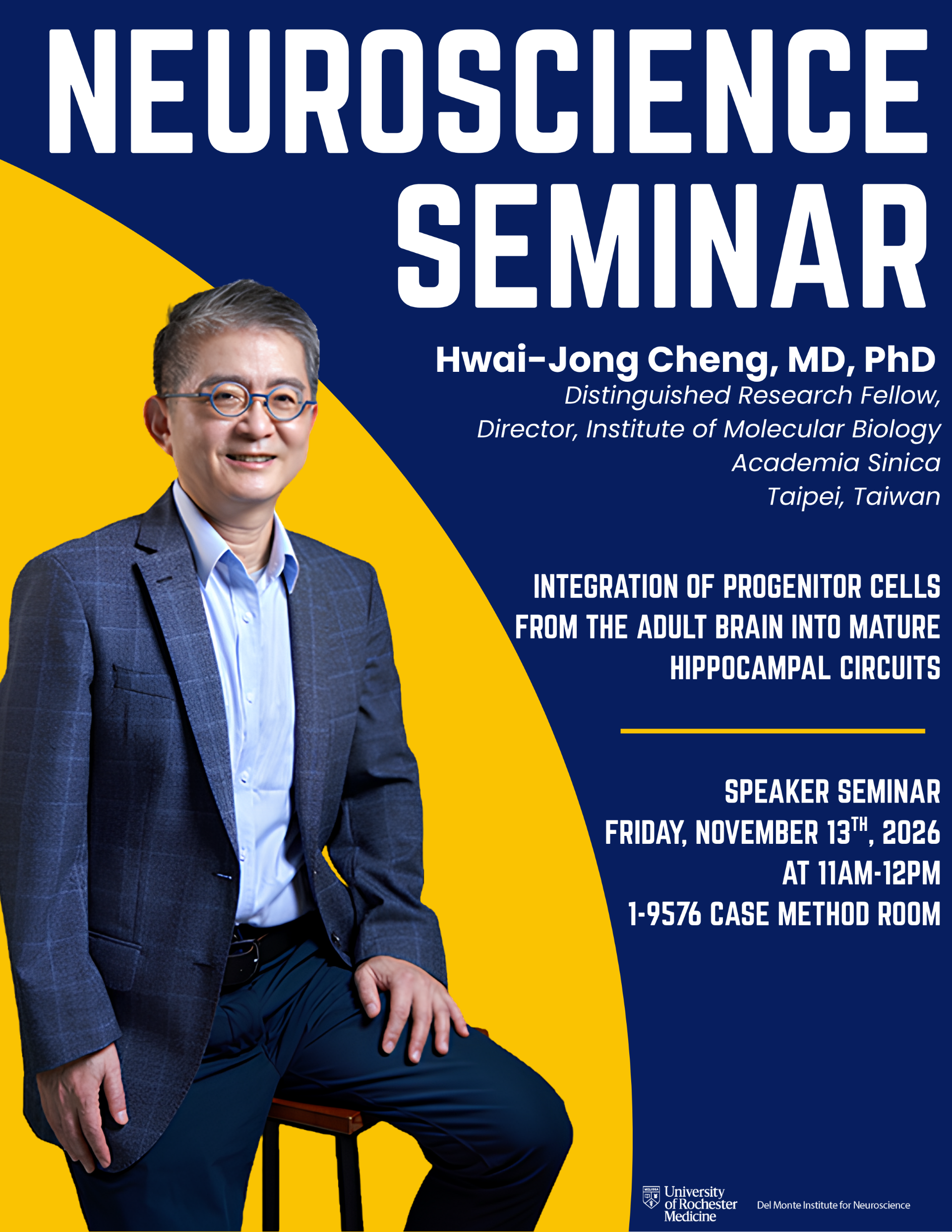
Medical Center | 1-9576 Case Method Room
“From song to synapse: how experience becomes lasting skill” - NeURoYES Speaker
Drew Schreiner, PhD - Postdoctoral Scholar, Duke Neurobiology at Duke University School of Medicine
Dec 10, 2026 @ 10:00 a.m.
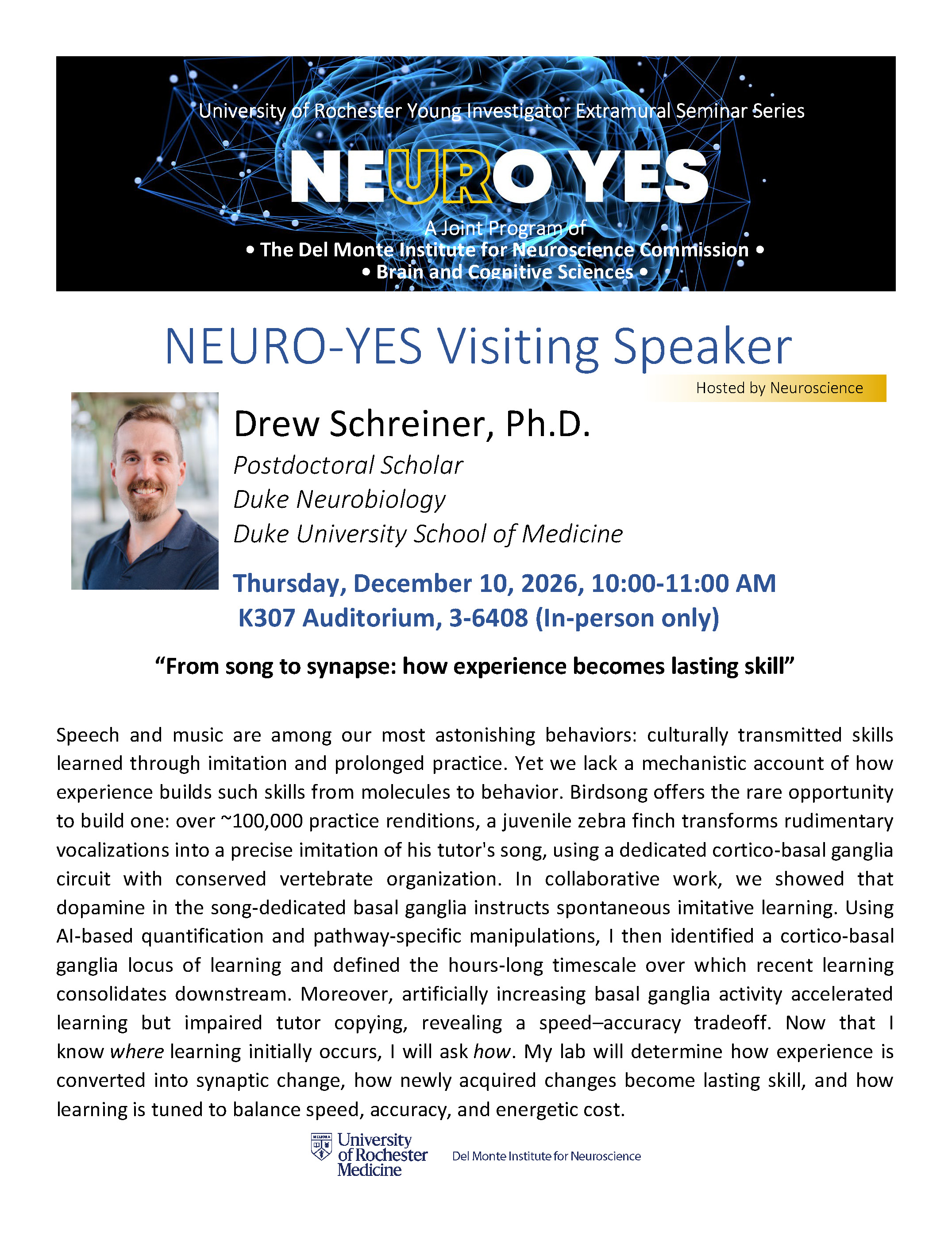
Medical Center | K307 (3-6408)
Host: Del Monte Institute for Neuroscience Commission, Department of Neuroscience, and Brain and Cognitive Sciences