

TEAMS:
Leadership Training for the Next Generation of Biomedical Researchers
TEAMS: Together Everyone Achieves More in Science
TEAMS: Together Everyone Achieves More in Science
Why Apply?
- Build advanced leadership and mentorship skills
- Strengthen your capacity to lead collaborative teams
- Learn evidence-based strategies for team science
- Join a national network of rising biomedical research leaders
If you are ready to move beyond leading projects to also leading people – this program is for you.
Applications are closed.
The University of Rochester, Children’s National Research Institute and the George Washington University are proud to announce the launch of the NIH-funded TEAMS Program (Together Everyone Achieves More in Science) — a national training initiative designed to help early-career biomedical researchers become exceptional team leaders, mentors, and collaborators.
Co-led by Dr. Beth Tarini (Children’s National Research Institute), Dr. Margaret Ormiston (Associate Professor, The George Washington University School of Business), and Dr. Nathan Smith (Associate Dean for Research Mentorship, University of Rochester), TEAMS prepares scientists to lead high-performing research teams that drive discovery.
About the Program
Modern biomedical discoveries are made through collaboration. The TEAMS program helps early-career investigators develop the leadership, mentorship, and communication skills essential for success in today’s team-based research environments.
Over a ten-month training period, participants engage in structured coursework, peer mentorship, and experiential learning designed to enhance their ability to build, lead, and sustain high-performing, multidisciplinary research teams. TEAMS is a research training program supported by the National Institute Of General Medical Sciences of the National Institutes of Health under Award Number R25GM155484.
Key Components
Cohort-Based Design
- Each TEAMS cohort trains together combining virtual coursework and peer mentorship to foster connection, collaboration, and trust.
- Participants also build relationships with alumni from prior cohorts, forming a growing national network that offers ongoing mentorship, support, and professional development.
Peer Mentorship
- Participants join a peer group of 4–6 colleagues
- Rotating leadership roles (facilitator, recorder, timekeeper)
- Structured feedback, accountability, and professional support
Team Leadership Coursework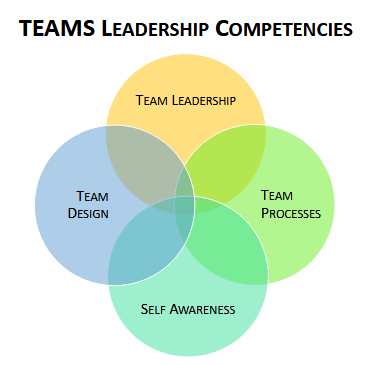
Grounded in leadership and team science research, the TEAMS curriculum is delivered virtually using a flipped-classroom model that emphasizes reflection and experiential learning.
- Building effective research teams
- Leading through collaboration and feedback
- Conflict resolution and shared decision-making
- Sustaining mentorship and team culture