


Homework in Psychotherapy: Do I Really Need to Do it?
By J. MacLaren Kelly, MAPP, PhD
Imagine this: You attend your therapy appointment, you and your therapist identify a piece of homework to try during the week, and you leave the session intending to do it. Then life happens. You juggle work, responsibilities, and everything else on your plate. Before you know it, your next appointment arrives and you realize you didn’t complete the homework. Does this sound familiar?
Enrolling in psychotherapy is a hard first step. It’s easy to assume that simply attending psychotherapy once a week will naturally lead to growth—greater confidence, self‑compassion, stronger relationships, and improved coping.
While growth could happen without doing homework, lasting progress is far more likely when your work in psychotherapy extends beyond the therapy room and into your everyday life. This may not come as a surprise to you when you compare your time in session versus your time not in session.
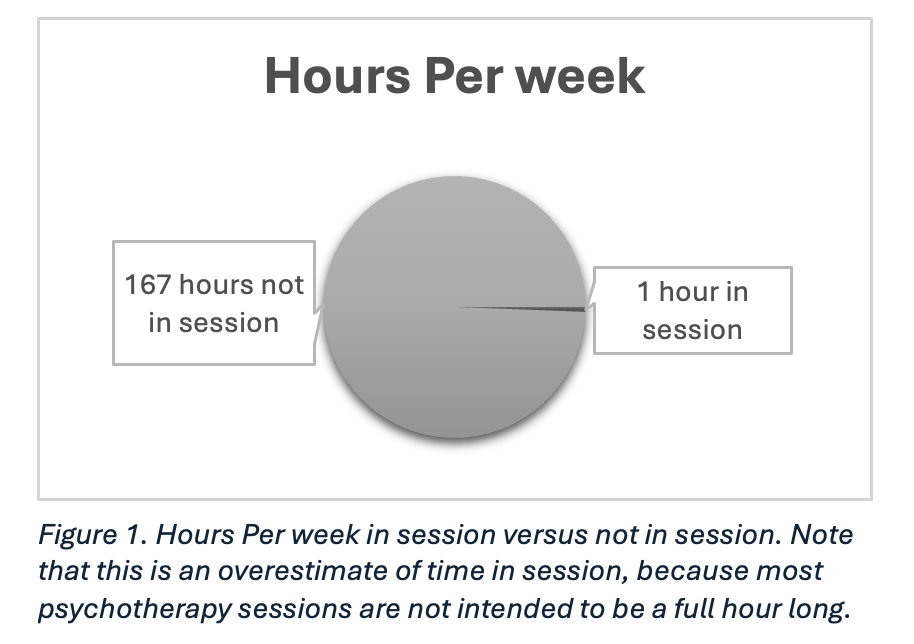
That comparison can be seen in the above unnecessary pie chart, because who doesn’t like pie? If you meet for sessions once weekly for an hour, you have 167 hours in the rest of your week. That amounts to less than 1% of your time in session and over 99% of your time not in session. Over a month, this translates to 4 hours in a session and about 740 hours not in a session. Your time spent in a psychotherapy session is a very small portion of your time overall.
What homework is and why it is assigned
Homework, “between-session practice,” or “action plan” (Beck, 2020), as it is sometimes called, has a long history. In some form, homework has been explicitly incorporated into psychotherapy since the 1960s, with the rise of behavior therapy, and then later with the development cognitive therapy. (Kazantzis and Miller, 2022). Homework refers to “a specific task or tasks that are to be completed between sessions and that are collaboratively determined by the [client] and therapist to have clear hypotheses, and are designed to produce measurable results, in support of treatment processes that meaningfully advance the [client]’s therapeutic goals (Kazantzis and Miller, 2022, p. 248).
There are several reasons why homework is incorporated into psychotherapy.[1]
Homework fits a key concept of CBT known as “collaborative empiricism” (Beck, Rush, Shaw, & Emery, 1979). This fancy term refers to the therapist and client working together as a team to decide on what therapy techniques to try during their session and outside of their session. It also refers to the therapist and client investigating and trying out different ideas, perspectives, beliefs, and behaviors to understand more about the client’s experiences. It’s a chance for you and your psychotherapist to collaboratively discuss what to self-monitor, pay attention to, and test out. Once you together identify what to try out, it is expected that you do so outside of session and then report back on how it went during the following session. Oftentimes, it’s useful to select homework that relates to some of the key takeaways from the session, as this supports outside of session (Jensen et al., 2020).
Modern Cognitive-Behavioral Therapy (CBT) is designed as an active psychotherapy, where clients and therapists are both active participants in the process of change (Beck, 2020). As clients apply what they learn in sessions to their time outside of sessions, their fluency increases. Over time, they learn to become their own CBT therapists.
Beyond theoretical reasons, research on homework has consistently found that it’s important to incorporate it into therapy. Greater homework compliance is associated with better treatment outcomes (Kazantzis et al., 2000; Kazantzis, Whittington, & Dattilio, 2010; Lebeau, Davies, Culver, & Craske, 2013;
Mausbach, et al., 2010). The quantity ─ how often you do the homework─ and the quality ─ how engaged you are when you do the homework─ both play a role in how much homework contributes to your therapy progress (Kazantzis et al., 2016).
What homework might look like?
Homework can look many ways. Sometimes, homework can involve keeping a detailed self-monitoring log of what you think, feel, and do.
Two very common examples are:
- Thought records: When you notice yourself responding to a situation with a strong emotional response, write down the situation, automatic thought(s), evidence for/against the thought, and possible balanced/alternative perspective.
- Activity scheduling/monitoring record: Writing down your mood before and after a planned activity, along with how much enjoyment or accomplishment you feel in order to explore how activities relate to your mood.
When homework is part of exposure therapy, it includes regular self-directed activities that bring someone in contact with what they tend to avoid, building confidence to face the feared object/situation in the future and more importantly to focus more on what is important to them in their lives. Homework does not have to be as detailed as the above examples. It might be as simple as:
- “write in your journal each day”, or
- “try going for a brief walk during part of your lunch break” or
- “practice putting your car keys on a wall hook by the door each day when you arrive home.”
Tips for completing homework:
- Clarify your homework before leaving your appointment. If you don’t understand some part of the homework, then ask questions.
- Schedule time on your calendar and use a reminder if needed. Recurring reminders on your phone can be useful.
- If you miss a day, resume the next day rather than viewing your efforts as a failure.
- Be ready to discuss your experience at your next appointment. If you didn’t complete it, talk openly about what got it the way and make a plan for trying it out again later.
- Wait to decide whether it’s helpful until you’ve tried it a number of times consistently instead of after trying it only a few times.
Homework is one of best ways to reach your treatment goals, yet it’s arguably also one of the most underemphasized features of psychotherapy. Psychotherapy is a process that takes time, consistency, practice, and active participation on your part. If you’re interested in receiving mental health support, Behavioral Health Partners may be a good fit. Behavioral Health Partners is brought to you by Well‑U, offering eligible individuals mental health services for stress, anxiety, depression, and ADHD. To schedule an intake appointment, call (585) 276‑6900.
References
Beck, A. T., Rush, A., Shaw, B., & Emery, G. (1979). Cognitive Therapy of Depression. New York: The Guilford Press.
Beck, J. S. (2020). Cognitive behavior therapy: Basics and beyond. Guilford Publications.
Blagys, M. D., & Hilsenroth, M. J. (2002). Distinctive activities of cognitive-behavioral therapy A review of the comparative psychotherapy process literature. Clinical Psychology Review, 22, 671–706. doi:10.1016/s0272-7358(01)00117-9
Jensen, A., Fee, C., Miles, A. L., Beckner, V. L., Owen, D., & Persons, J. B. (2020). Congruence of patient takeaways and homework assignment content predicts homework compliance in psychotherapy. Behavior Therapy, 51(3), 424–433. doi:10.1016/j.beth.2019.07.005
Kazantzis, N., Deane, F. P., & Ronan, K. R. (2000). Homework assignments in cognitive and behavioral therapy: A meta-analysis. Clinical Psychology: Science and Practice, 7(2), 189.
Kazantzis, N., Whittington, C., & Dattilio, F. (2010). Meta-analysis of homework effects in cognitive and behavioral therapy: A replication and extension. Clinical Psychology: Science and Practice, 17(2), 144.
Kazantzis, N. and Miller, A. R. (2022). A comprehensive model of homework in cognitive behavior therapy. Cognitive Therapy and Research, 46, 247-257. doi: 10.1007/s10608-021-10247-z
Kazantzis, N., Whittington, C., Zelencich, L., Kyrios, M., Norton, P. J., & Hofmann, S. G. (2016). Quantity and quality of homework compliance: A meta-analysis of relations with outcome in cognitive behavior therapy. Behavior Therapy, 47(5), 755–772. doi:10.1016/j.beth.2016.05.002
Lebeau, R. T., Davies, C. D., Culver, N. C., & Craske, M. G. (2013). Homework compliance counts in cognitive-behavioral therapy. Cognitive Behaviour Therapy, 42(3), 171–179. doi:10.1080/16506073.2013.763286
Mausbach, B. T., Moore, R., Roesch, S., Cardenas, V., & Patterson, T. L. (2010). The relationship between homework compliance and therapy outcomes: An updated meta-analysis Springer Science and Business Media LLC. doi:10.1007/s10608-010-9297-z
[1] Not all psychotherapy involves between-session homework; it is most commonly found in cognitive-behavioral treatment approaches (Blagys & Hilsenroth, 2002).
Global Administrator | 6/1/2026
You may also like
No related posts found.