Translational Brain Mapping
Make Appointments & Get Care
Overview
Every brain is unique. Brain mapping is a personalized way to understand where important functions are represented in the brain. University of Rochester Medicine’s Translational Brain Mapping Program uses advanced imaging tools to create a detailed picture of how a person’s brain is organized. These tools include:
- Functional MRI: Identifies areas of the brain responsible for important cognitive functions like thinking, movement, and communication
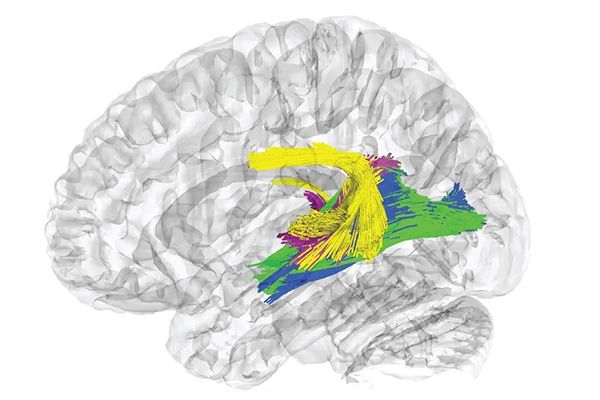
- Diffusion MRI: Identifies underlying white matter fibers that structurally connect areas on the brain surface.
Together, these techniques give our multidisciplinary team important information before surgery. They help neurosurgeons plan the safest approach, protect critical brain functions, and support recovery after surgery.
Who Benefits From Brain Mapping?
Brain mapping may be recommended if you have a brain tumor, epilepsy, or another condition that affects areas of the brain responsible for important functions such as movement, speech, memory, or thinking.
Our Approach
The Translational Brain Mapping Program brings together clinicians and scientists to use the latest advances in personalized brain mapping. Our goal is to improve patient care while also advancing research and our understanding of the brain.
Call us with questions or to schedule a clinical consultation.
Call (585) 225-5767Patient Stories
Saxophone Serenades Surgeons
Music is not only a major part of Dan Fabbio’s life, as a music teacher it is his livelihood. So, when doctors discovered a tumor located in the part of his brain responsible for music function, he began a long journey that involved a team of University of Rochester physicians, scientists, and a music professor and culminated with him awake and playing a saxophone as surgeons operated on his brain.
Brain Mapping Protects Brain During Surgery
Gabe Abdella was diagnosed with a tumor in the area of his brain responsible for language and movement.
What Sets Us Apart?
All patients in the URochester Medicine Translational Brain Mapping Program are cared for at the cutting edge of discovery. The Program combines expertise from neurosurgery, neuroanesthesia, neurophysiology, cognitive neuroscience, and neuropsychology.
Cutting-edge techniques from neuroimaging, machine learning, and statistics are used to create detailed maps of brain function. We can then compare what we are seeing in prior patients to patterns of data we’ve observed in research participants without a brain injury to learn all we can about the many complex cognitive processes in the brain. This is made possible by our partnership with MindTrace, a company that develops software to facilitate cognitive testing and awake brain mapping.
Our Goal
We use personalized brain mapping to inform neurosurgical planning and advance scientific understanding. Our goal is to advance understanding of the cognitive processes that underlie our ability to speak, think, and interact with the world.
This program is made possible by philanthropic contributions, institutional support from the University of Rochester School of Medicine & Dentistry, and research grants from the National Institute of Health and the National Science Foundation. Personalized brain mapping is provided with no cost to patients and without billing insurance.
Advance the Future of Brain Care
Your support will advance groundbreaking research to deepen our understanding of the human brain and will provide personalized brain mapping at no cost to patients. Your support will fuel innovation and expand our research.
Providers
Locations
View All LocationsWe serve you in the Rochester metropolitan area and surrounding region. Locations are ordered by distance, with those closest to listed first.
1 location
Translation Research
The Program for Translational Brain Mapping aims to improve patient outcomes by enhancing our understanding of the human brain. We run multiple studies that serve that goal. Email Frank Garcea, PhD for more information.