
News
T32 Alum Courtney Jackson Publishes Research on B Cell Response and Farm Exposure
Monday, December 15, 2025
Former T32 post-doctoral fellow Dr. Courtney Jackson published her groundbreaking research on how farming lifestyle protects children from developing asthma and allergies in Science Translational Medicine, and was featured on the cover of the December 10, 2025 issue. Courtney’s exciting research (supervised by T32 Mentor Dr. Kirsi Jarvinen-Seppo) identified and characterized a novel subset of B cells that was associated with protection from allergies. Congratulations to Courtney and team!
Read the article: Farm Exposure in Infancy is Associated with Elevated Systemic IgG4, Mucosal IgA Responses, and Lower Incidence of Food Allergy
Congratulations to Kari Thrasher on her Fellowship Award
Wednesday, October 15, 2025
Congratulations to Pulmonary T32 Postdoctoral Fellow Dr. Kari Thrasher for receiving a Postdoctoral Research Fellowship Award from the Cystic Fibrosis Foundation for her project titled, “Determining How mRNA Context Affects ACE-tRNA Mediated Suppression of Stop Codons.” Working in the laboratory of T32 mentor Dr. John Lueck, Associate Professor of Pharmacology and Physiology, Dr. Thrasher’s research will advance our understanding of the regulation of gene expression relevant to cystic fibrosis and other genetic disease. She also received the 2025 Cystic Fibrosis Foundation Ann Weinberg Memorial Research Fellow award for her outstanding proposal. Congratulations Kari!
Irfan Rahman quoted in "Nicotine-free’ vapes and pouches promise a buzz without the downsides. Health concerns remain"
Thursday, September 18, 2025
In the past couple of years, “nicotine-like” products have hit the market in the U.S., Europe, Australia and South Korea. They look like nicotine vapes and pouches, with similar flavors and sleek designs. Some provide a nicotine-like buzz.
But there’s a crucial difference: Outside Europe, these products aren’t subject to government oversight.
Researchers warn that at least one of these products’ nicotine-like chemicals, called nicotine analogs, may be more potent and addictive than nicotine itself — and that these products are sometimes marketed in misleading ways.
Nicotine analogs are synthetic, chemical compounds that closely resemble nicotine. Some activate the same brain receptors as nicotine, with a similar buzz and addictive properties.
These compounds aren’t new; tobacco companies started researching nicotine analogs in the 1970s in anticipation of future regulations that could reduce how much nicotine would be allowed in their products, according to a study of industry documents. But the companies feared this research would trigger more regulation, so the studies were shelved.
In 2022, the U.S. Congress acted in response to the proliferation of vapes containing synthetic nicotine. That lab-made compound has the same chemical structure and properties as nicotine extracted from tobacco, so lawmakers authorized the U.S. Food and Drug Administration to regulate products containing synthetic nicotine just as it does those containing naturally occurring nicotine.
After that, the industry showed renewed interest in nicotine analogs. Products containing these compounds soon appeared on the market.
“These products were intentionally designed to bypass regulation,” said Sven Eric Jordt, a professor of pharmacology and cancer biology at Duke University who has studied nicotine analogs.
Though sales data is limited, research studies say the market for nicotine alternatives is growing. Some companies that produce vapes containing nicotine also produce vapes with nicotine-like ingredients.
Irfan Rahman, a professor of environmental pulmonary health and disease at the University of Rochester, analyzed research studies of 6-methyl nicotine and found that it may cause more inflammation in lung capillary cells than nicotine. 6-methyl nicotine can damage those cells, potentially contributing to lung diseases such as chronic obstructive pulmonary disease (COPD) and lung cancer, he said.
Read More: Irfan Rahman quoted in "Nicotine-free’ vapes and pouches promise a buzz without the downsides. Health concerns remain"Irfan Rahman is honored as a ScholarGPS Highly Ranked Scholar
Wednesday, August 6, 2025
Dr. Rahman has been ranked in the top 0.02% worldwide and in the top 26 at the University of Rochester in his field.
Congratulations!
Read More: Irfan Rahman is honored as a ScholarGPS Highly Ranked ScholarForever Chemicals, Lasting Effects: Prenatal PFAS Exposure Shapes Baby Immunity
Wednesday, July 23, 2025
 New research reveals that tiny amounts of PFAS—widely known as “forever chemicals”—cross the placenta and breast milk to alter infants’ developing immune systems, potentially leaving lasting imprints on their ability to fight disease.
University of Rochester Medical Center (URMC) researchers tracked 200 local healthy mother–baby pairs, measuring common PFAS compounds in maternal blood during pregnancy and then profiling infants’ key T‑cell populations at birth, six months, and one year. By age 12 months, babies whose mothers had higher prenatal PFAS exposure exhibited significantly fewer T follicular helper (Tfh) cells—vital coaches that help B cells produce strong, long‑lasting antibodies—and disproportionately more Th2, Th1, and regulatory T cells (Tregs), each linked to allergies, autoimmunity, or immune suppression when out of balance.
“This is the first study to identify changes in specific immune cells that are in the process of developing at the time of PFAS exposure,” said Kristin Scheible, MD, an associate professor of Pediatrics and Microbiology & Immunology at URMC and lead author of the study, which appears in the journal Environmental Health Perspectives. “Identification of these particular cells and pathways opens up the potential for early monitoring or mitigation strategies for the effects of PFAS exposure, in order to prevent lifelong diseases.”
Read More: Forever Chemicals, Lasting Effects: Prenatal PFAS Exposure Shapes Baby ImmunityJustin Brennan Presents at Microbial Pathogenesis Conference
Wednesday, May 28, 2025
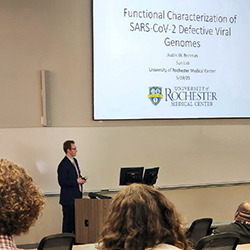 Current Pulmonary T32 Trainee Justin Brennan, MS was one of four finalist abstract entries selected to present at the 35th Annual Buffalo Conference on Microbial Pathogenesis. His oral presentation was entitled, “Functional Characterization of SARS-CoV-2 Defective Viral Genomes.” The conference showcases plenary speakers in the fields of mycology, bacteriology, parasitology and virology and provides a forum for scientists to present and discuss cutting-edge advances. Congratulations, Justin!
Eric Merrell Publishes Editorial in Chest
Wednesday, April 30, 2025
Pulmonary post-doctoral fellow and Pulmonary T32 Trainee Eric Merrell, M.D. was 1st author on an editorial in Chest titled “Is tissue the issue when it comes to severe asthma?”. The editorial highlights the importance of accurate patient characterization when it comes defining endotypes of severe asthma. Congratulations Eric!
Imran Tahir Receives Shock Society Presidential Travel Award
Tuesday, April 15, 2025
Biology graduate student and Pulmonary T32 Trainee Imran Tahir was awarded a Shock Society Presidential Travel Award to attend the 48th Annual Conference on Shock in Boston and present his cutting-edge research on regulation of lung capillary permeability by mTOR proteins. Congratulations Imran!
10 small things neurologists wish you’d do for your brain
Thursday, April 3, 2025
There’s growing research linking air pollution exposure to cognitive decline; scientists think very fine, inhalable particles in the air could trigger chemical changes once they reach the brain, says Deborah Cory-Slechta, a professor of environmental medicine and of neuroscience. She adds that wearing an N95 or surgical mask and using indoor air filters on days when air quality is worse (including because of wildfire smoke) can minimize your exposure.
Read More: 10 small things neurologists wish you’d do for your brainDr. Elder featured in Nature: "Your brain is full of microplastics: are they harming you?"
Tuesday, February 11, 2025
Plastics might affect each organ or cell type differently. The dose matters, too, as well as the route of ingestion, says Alison Elder, an associate professor of environmental medicine. “The inhalation route is a major concern because if inhaled plastics can get into the deep lung and cause an inflammatory reaction, they don’t need to go anywhere to cause health outcomes.”
Read More: Dr. Elder featured in Nature: "Your brain is full of microplastics: are they harming you?"70 countries have banned this pesticide. It’s still for sale in the US
Wednesday, January 22, 2025
The Washington Post, January 22
“The data is the data,” says Deborah Cory-Slechta, a professor of environmental medicine and of neuroscience. She says paraquat exposure is associated with the loss of dopamine neurons, which can cause slow and uncoordinated movements, tremors, and difficulty communicating, all of which are consistent with Parkinson’s disease.
“The evidence is very strong, both based on animal studies and on epidemiological evidence the fact that it kills dopamine neurons,” she said.