


ACT (Activate, Connect, Transform) Center
ACT (Activate, Connect, Transform) Center
The ACT (Activate, Connect, Transform) Center aims to advance scholarship and strengthen institutional capacity to design, study, implement, and evaluate social and collaborative interventions that Activate, Connect, and Transform individuals, organizations, health systems, and communities.
The ACT Center aims to be a pioneering research and education hub to advance the science of Dissemination and Implementation (D&I), patient and community engagement, and collective action and resilience.
What Are Wicked Problems?
What Are Wicked Problems?
Wicked problems are persistent, complex challenges such as the underuse of research in healthcare, the lack of trust in healthcare organizations, or the disconnect between health and social systems. These issues demand adaptive, multi-component, and collaborative interventions that are theory-informed, community-driven, locally adapted, and continuously evaluated.
The ACT Center responds to pressing needs in healthcare: how to meaningfully engage patients and community members in decision-making, research, and policy; how to leverage social networks for the dissemination and implementation of high-quality innovations in clinics and communities; how to establish and sustain equitable partnerships between health systems and communities; and how to create networks of learning and improvement in clinical settings towards the formation of Learning Health Systems.
The ACT Center aims to advance the design, delivery, and evaluation of social and collaborative interventions to support implementation and action.
The Three Pillars of the ACT Model
Meaningful and sustainable change requires more than changing individual behaviors. It also involves strengthening relationships and creating environments that support action.
The ACT (Activate, Connect, Transform) model provides a practical framework for designing, implementing, and evaluating interventions that promote behavior and system change. It brings together three interconnected dimensions of change:
Activate: Empowering People to Act
Activate focuses on strengthening the capabilities and motivation of individuals and groups to take action. This includes building knowledge and skills, supporting confidence and motivation, and developing habits that sustain desired behaviors.
Connect: Strengthening Relationships and Networks
Connect focuses on how people, teams, and organizations build relationships, share knowledge, and influence one another. It includes strengthening existing connections, bridging disconnected groups, and engaging influential individuals to support collaboration and collective action.
Transform: Creating Environments That Support Change
Transform focuses on organizational and system-level conditions that enable or constrain change. This includes improving workflows and structures, strengthening leadership and governance, shaping organizational cultures, and ensuring access to necessary resources.
Explore the ACT model at ACTRadar.com
ACT Radar: A Tool for Designing and Improving Interventions
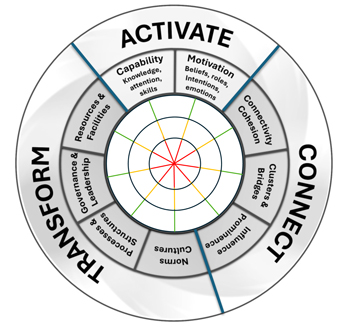 The ACT Radar is a practical, team-based reflection and assessment tool that helps teams design, refine, and evaluate complex interventions using the ACT model.
The ACT Radar helps teams:
- Visualize strengths and gaps across the three ACT dimensions.
- Develop shared language and alignment about priorities and actions.
- Identify unmet needs and opportunities to strengthen an intervention.
- Make informed decisions about adapting existing strategies or adding new components.
By making the different dimensions of change visible, the ACT Radar supports collaborative decision-making and helps teams develop more comprehensive and context-sensitive interventions.