News Lab
News Lab
Introducing Dr. Sharipol - Azmeer Successfully Defends his PhD Thesis
Wednesday, June 17, 2026
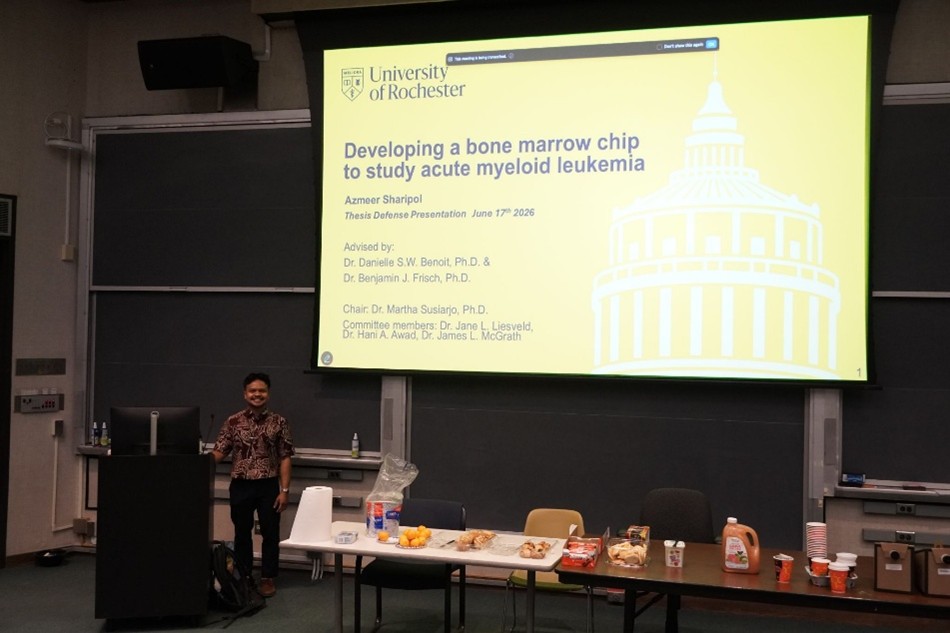
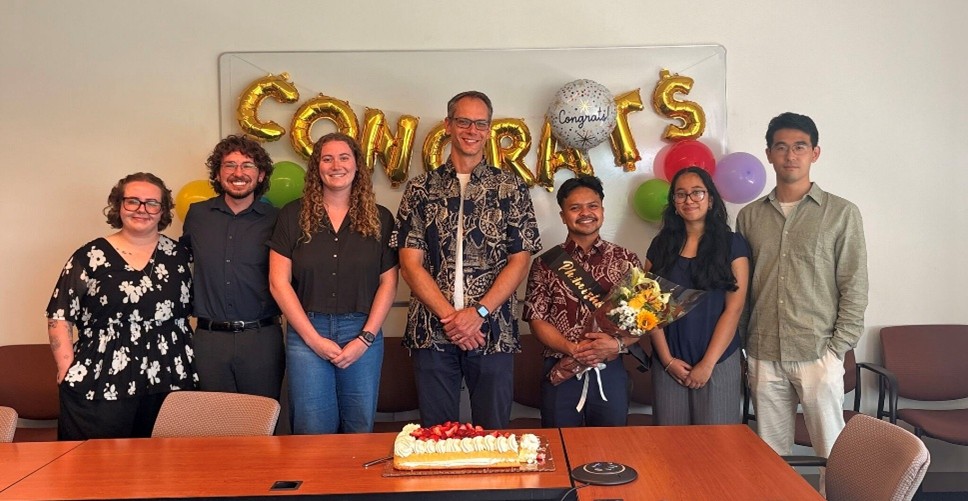
We are happy to announce that Azmeer is officially Dr. Sharipol! On June 17, 2026, he successfully defended his thesis work on the development of a bone marrow-on-a-chip platform that recapitulates microenvironmental dysregulation in AML. He will be beginning his next adventure as a Postdoctoral Researcher in the lab of Dr. Shuichi Takayama at the Georgia Institute of Technology this coming Fall.
3 Talented Undergraduates Secure Funding to Join the Lab for the Summer
Friday, May 1, 2026
 Returning to spend a second summer with us, Owen Hodges, a Biochemistry major from Earlham College (Class of 2027), is working on the use of flow cytometry to characterize CD8 T cell senescence and dysregulation within the bone marrow and spleen during AML. He is funded by the generous donors backing Earlham’s Epic Advantage Development Fund.
Continuing her work from this past academic year, Mahirah Morshed (URochester; 2027) a Clinical and Translational Sciences major, is working with us to characterize the role of CCL3-CCR1/CCR5 signaling on BMME dysfunction in AML using a female murine model to better capture the sex-based differences in disease progression. She is funded by the University of Rochester’s Schwartz Scholarship program.
Helping to bolster other lab-wide sustainability projects, Penelope Paul (URochester; 2027), a Neuroscience Major, joined the lab with the goal of evaluating laboratory sustainability practices across the University of Rochester through laboratory observations, informal interviews, and an educational survey. Her work has identified barriers to sustainable laboratory practices, allowing her to provide recommendations to improve institutional sustainability through targeted education, infrastructure enhancements, and institutional support. She is funded by the Institute for Human Health and the Environment - Summer in Environmental Health Research Fellowship.
New Paper Alert: Elevated Lactate in AML Bone Marrow Contributes to Macrophage Polarization via GPR81 Signaling
Tuesday, March 10, 2026
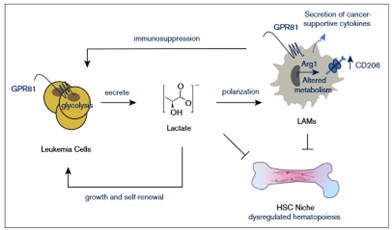 A new paper, based on Lab Alumna Dr. Celia Soto’s thesis work, was published in Blood Advances. This paper details a novel mechanism through which the bone marrow microenvironment (BMME) is remodeled in Acute Myeloid Leukemia (AML). We found that the bone marrow (BM) of AML patients has elevated levels of lactate and that these elevated lactate levels cause macrophages to polarize from an immunologically active, inflammatory state (M1-like macrophages) to an immunosuppressive, M2-like state. We also found that this shift is mediated by the lactate receptor GPR81. Through the use of patient samples and preclinical mouse models, we showed that GPR81 inhibition reduced M2 polarization, slowed disease progression, and preserved the hematopoietic stem cells (HSC) niche. Combined, these results suggest that GPR81 is a promising therapeutic target for AML management.
Amanda and Ben Attend the Cancer and Bone Society Annual Conference in Tampa Florida
Tuesday, March 3, 2026
Amanda presented her work regarding the role of CCL3 signaling on bone marrow microenvironmental dysfunction in AML during a lightening talk and a poster presentation. She was awarded a high scoring abstract award. Ben presented the lab’s work on developing a bone-marrow-on-a-chip system to model AML as an invited speaker.