

Multiphoton Surgical Imaging
Multiphoton imaging has had a revolutionary impact on life sciences because of its ability to rapidly image living tissue at cellular resolution, but has not been accepted in clinical medicine, which continues to use conventional light microscopy techniques developed in the 19th century that are slow and cumbersome. However, recent advances in cost-effective femtosecond lasers, high-speed silicon detectors, and advanced graphics processing have made the application of multiphoton imaging to cancer surgery attractive.
We have designed compact two-photon imaging equipment for use in a dermatologic surgery. We integrate a compact fiber laser system, custom detection electronics based on silicon photomultipliers, real-time virtual H&E rendering, and white-light imaging for rapid identification of tissue features. Additionally, the use of strip-scanning enables the system to perform 20X magnification imaging at an area rate of 45 seconds per square centimeter.
To date, we used the system to image more than 300 patients during diagnostic or surgical procedures.
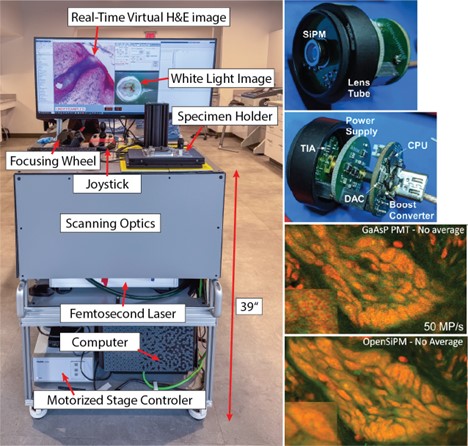
Two photon system deployed in a surgical clinic with skin cancer specimen. Custom silicon photomultiplier detectors are utilized to accelerate imaging and improve image quality.
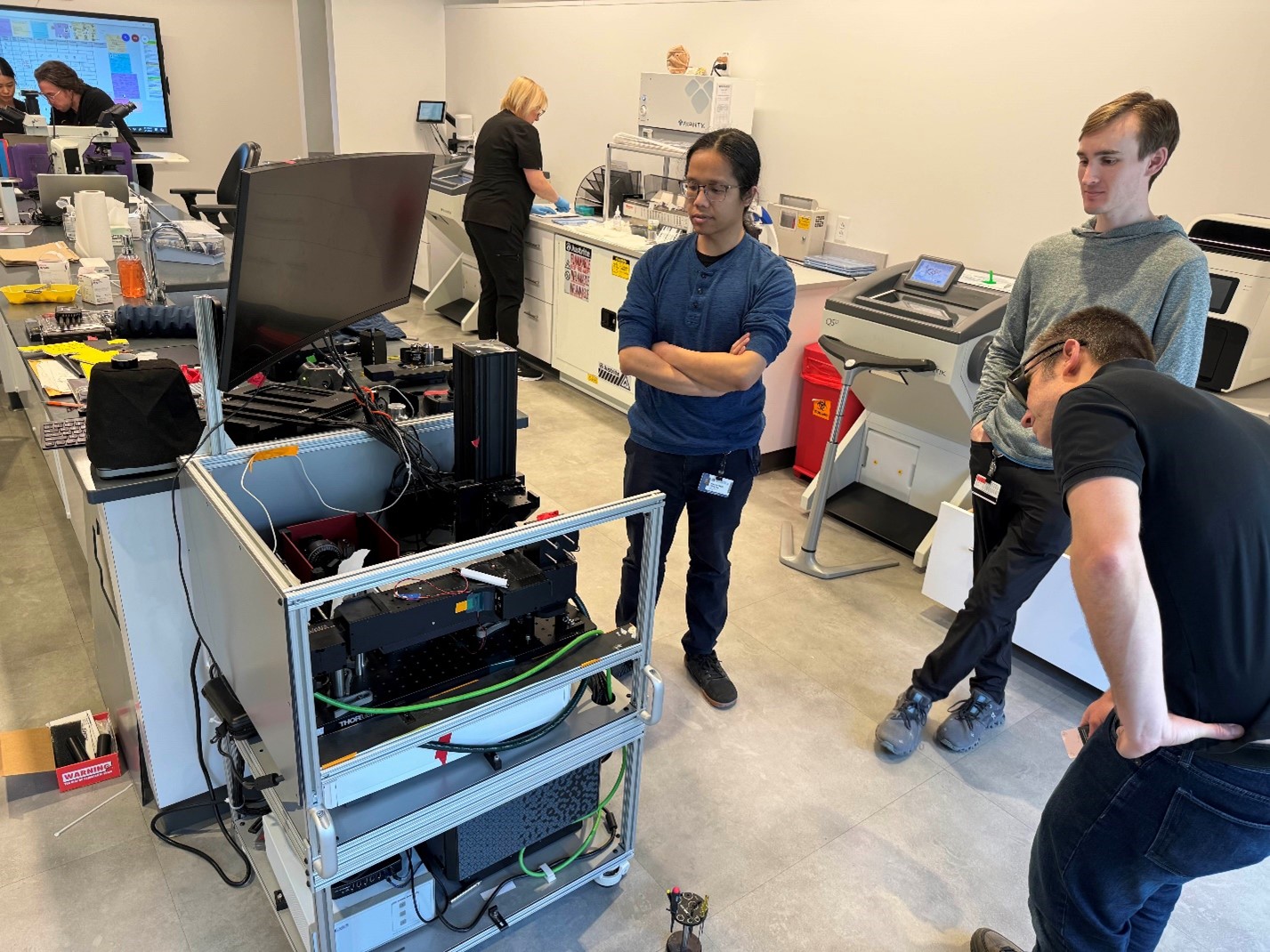
Students upgrading the laser system in the two-photon microscope.
A major challenge in surgical imaging is flatten tissue specimens to align with the flat imaging plane of a high resolution microscope system. We have designed vacuum-sealing specimen holders that flatten tissue under the weight of the atmosphere, enabling easy mounting and imaging.
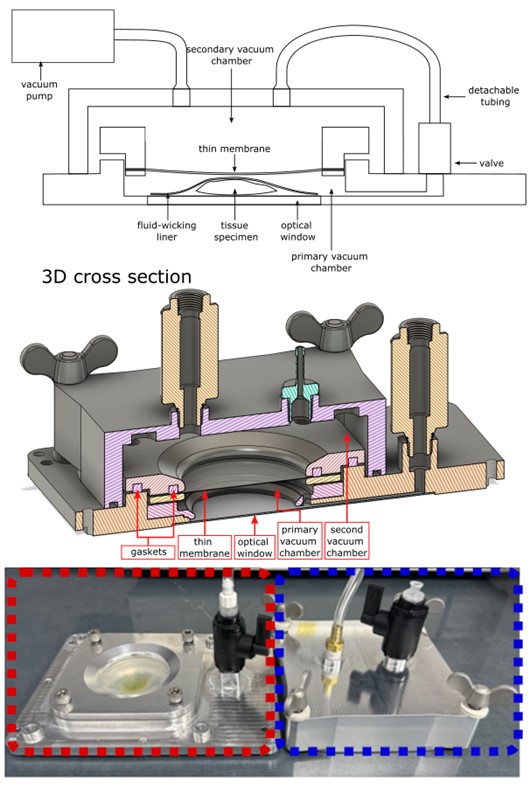
Vacuum mounting system used to flatten tissue to a cover slip during imaging. Because compression is provided by the weight of the atmosphere which is equal above and below the coverslip, there is no net deflection of the sample even under strong compression.
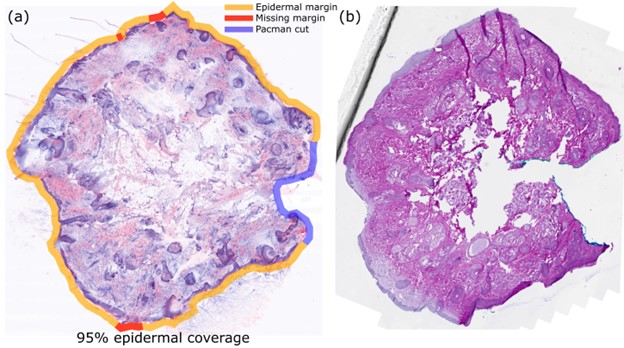
Comparison between a surgical margin imaged fresh during surgery and cryosectioning of the same tissue. Two-photon imaging enables visualization of more of the margin with less tissue damage.