

News
News
Neuroscience and Innovation: Redefining Stroke Care & Recovery
Tuesday, July 14, 2026
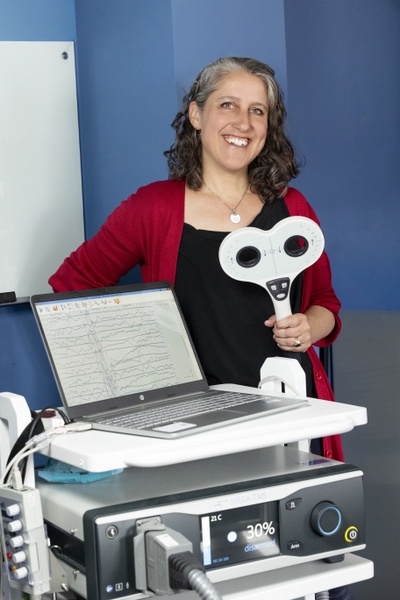 In the Movement and Plasticity Lab, stroke neurologist Ania Busza, MD, PhD, studies how the brain relearns movement after stroke and how rehabilitation can better harness that recovery process. Her work focuses on motor system plasticity, the way practice and experience reshape surviving brain circuits after injury. “Recovery after stroke isn’t just about getting stronger,” Busza said. “It’s about helping the brain learn how to use the remaining circuits it still has.”
For decades, rehabilitation often followed a relatively simple principle: more therapy leads to better outcomes. But researchers now recognize that stroke patients develop very different motor control problems depending on which neural pathways are damaged. Some struggle with delayed movement, others with fatigue or involuntary activation of opposing muscles.
“Two people may both have weakness after a stroke, but the underlying control problem may be completely different,” Busza said. “If we understand those differences, we can start designing rehabilitation that is much more personalized and targeted.”
Her lab combines neuroscience, imaging, biomechanics, engineering, and rehabilitation science to better understand those differences. In one project, patients use faint electrical signals from weakened muscles to control a simple video game through surface electromyography (EMG). Even patients unable to lift their arms can participate. The system helps researchers track how motor impairments evolve during the first months after stroke and identify early warning signs of long-term disability.
Researchers are also studying whether interventions such as vagal nerve stimulation, transcranial magnetic stimulation, and other neuromodulation approaches can safely amplify the brain’s natural plasticity and improve recovery.
The broader goal is to understand not only whether patients recover, but also how recovery occurs within the brain itself. Modern neuroscience has changed how researchers think about that process. Rather than the brain simply “rewiring” around damage, scientists now believe recovery depends on whether alternative, partially redundant circuits can be strengthened and refined through practice.
“Practice after stroke is really a form of learning,” Busza said. “The brain is constantly adapting based on experience, and rehabilitation is trying to shape that adaptation in a productive way.”
Read More: Neuroscience and Innovation: Redefining Stroke Care & Recovery