

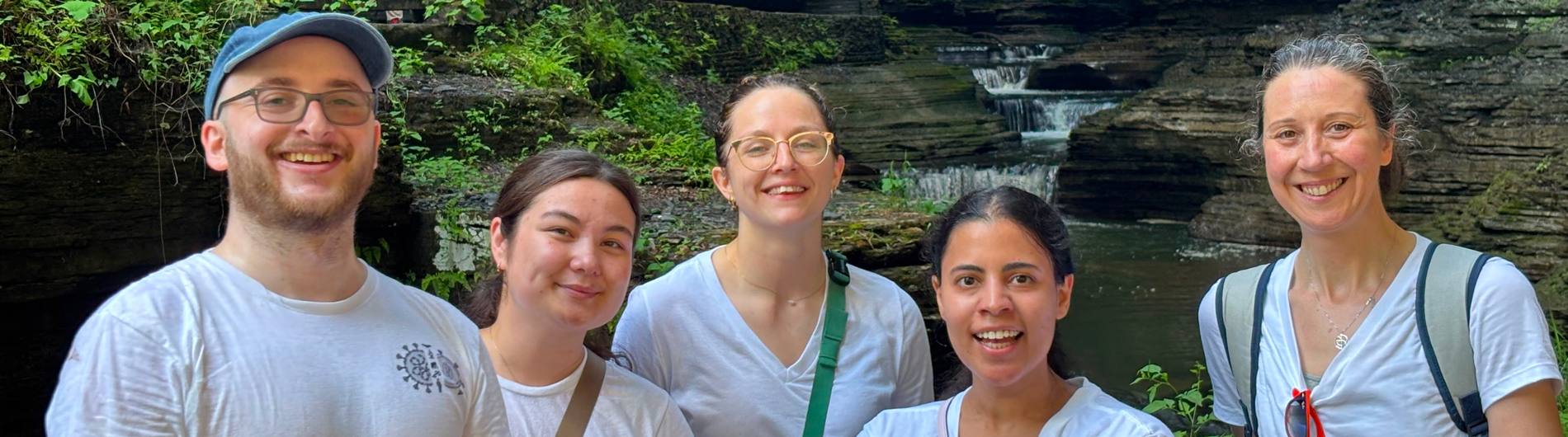
Welcome to the Serra-Moreno Lab
Our Research
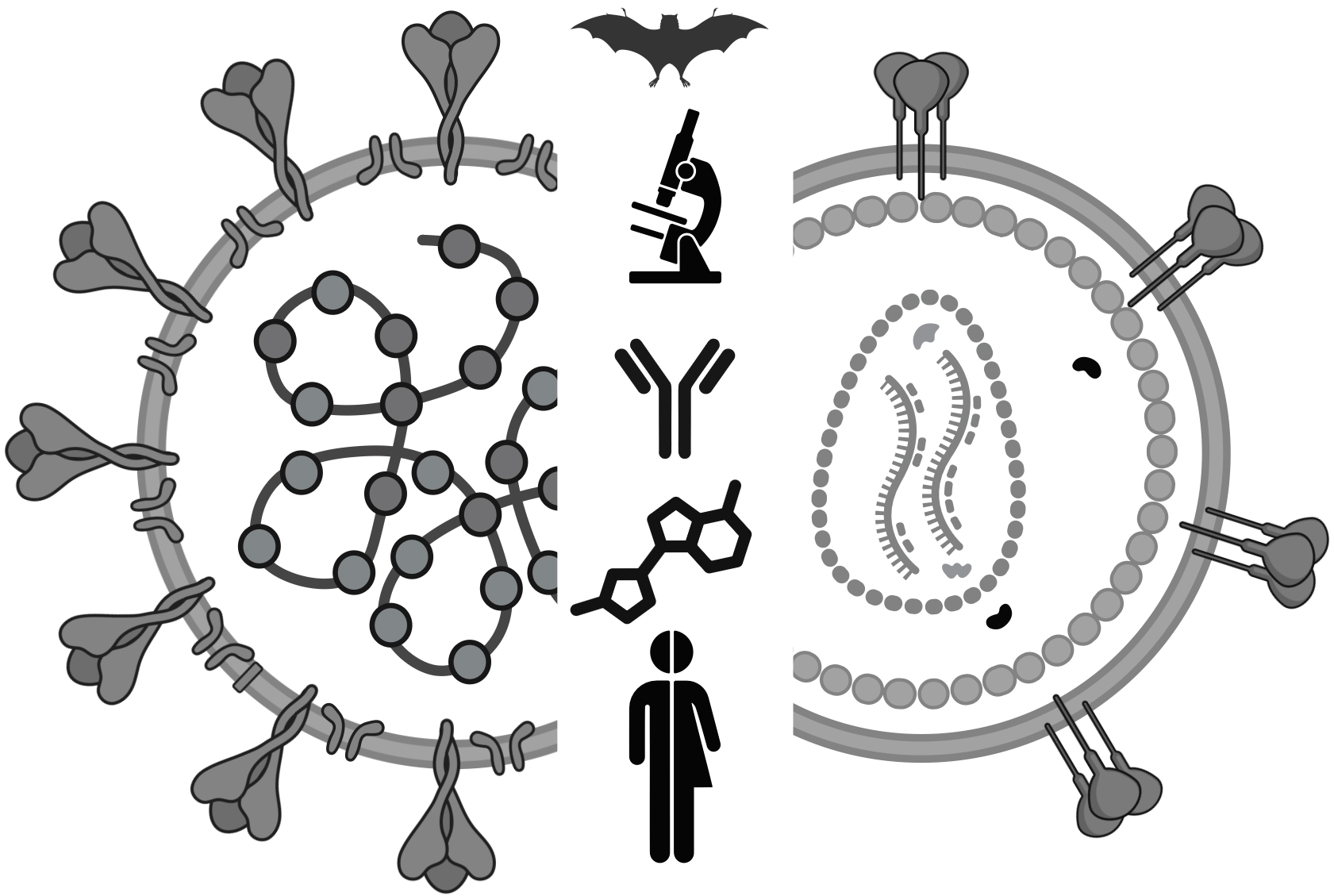
The Serra-Moreno lab studies the interactions between virus pathogens and host cells at the molecular level, using HIV and SARS-CoV-2 as models. Specifically, we want to understand (i) how these viruses overcome innate barriers to establish a productive infection; and (ii) what cellular components are hijacked during infection for successful virus spread. The information learned from these studies is critical to design approaches to contain virus replication and propagation. Since joining MBI, our work has been steadily funded through federal (NSF, NIH), state (NYFirst) and university awards (URA and MBI pilot).
Projects on virus-innate immunity interactions
Role of autophagy in HIV infection. Autophagy is a conserved cell survival pathway that has recently become prominent as a mechanism of defense to eliminate viruses. Consistent with this notion, we found that autophagy targets the HIV internal structural proteins (Gag) for degradation, causing a defect in HIV replication. More recently, we uncovered that the HIV virulence factor Vpr is another autophagy target. However, Vpr and Gag proteins from HIV isolates implicated in person-to-person transmission are highly resistant to autophagy, suggesting that autophagy resistance/antagonism is important for transmission. Remarkably, HIV has evolved the viral protein Nef to counteract autophagy restriction by blocking the formation of autophagosomes, a set of double-membrane vesicles destined to deliver their cargo to lysosomes. These findings have been published in the journals Autophagy (Castro-Gonzalez, Shi et al., 2021), Retrovirology (Castro-Gonzalez, Chen, Shi et al., 2021), and PLoS Pathogens (Chen et al., 2026). These studies are funded through a NIH R01 (AI155012; Serra-Moreno PI).
Role of SERINC5 in host defense. SERINC5 is a host restriction factor that impedes the infection of multiple enveloped viruses, including HIV and SARS-CoV-2, by interfering with the entry step. However, the underlying mechanism and overall role of SERINC5 in host defense remains largely unknown. Our recent work has revealed that SERINC5 also senses non-self-DNA and silences its expression, indicating that its roles in innate immunity go beyond preventing virus entry and expand to multiple DNA pathogens. These findings have been published in Viruses (Shi, Simpson, Ahmed, Chen et al., 2023) and were funded through a MBI Pilot Award (Serra-Moreno, PI). We are currently studying the underlying molecular mechanism by which SERINC5 attacks non-self-DNA. Part of this work has been presented at the Annual Retrovirus Meeting in Cold Spring Harbor in 2024, at the American Society for Virology (ASV) annual meetings in 2024 and 2025, and at the Annual Buffalo Conference of Microbial Pathogenesis in 2025 and 2026.
Role of BST2/Tetherin in the host adaptation of SARS-CoV-2. BST2 is a cellular transmembrane protein that traps nascent virions, including coronaviruses, to the plasma membrane, thereby, impeding their release and spread. We recently found that SARS-CoV-2 virion release is impacted by BST2, but in turn the virus uses the Spike protein to target BST2 for lysosomal degradation through a process that requires Clathrin-mediated endocytosis and ubiquitination. Remarkably, the most recent variants of concern are more efficient at counteracting BST2, which increases their virion release and spread. This is due to enhanced binding between the Spike and BST2, suggesting that BST2 antagonism contributes to the host adaptation of SARS-CoV-2. This work was funded by a University Research Award (Serra-Moreno, PI), and has been presented at the Conference on Retroviruses and Opportunistic Infections (CROI) in 2023, ASV 2023, 2024 and 2025, the American Association of Immunologists (AAI) in 2025 and the Gordon Research Conference in 2026. Part of these findings were published in PLoS Pathogens (Shi, Simpson, Chen, Aull et al., 2024). We are currently investigating whether BST2 represents an important cross-species barrier for coronaviruses, and how BST2 antagonism by SARS-CoV-2 relates to immune evasion.
Projects on cellular factors for virus replication
Characterization of the SARS-CoV-2 replication organelles. All coronaviruses need to remodel cellular membranes to create replication organelles (ROs) that allow the active replication and transcription of their genome. However, the biogenesis mechanism, the origin, and type of these replication organelles are still a major focus of debate. We recently uncovered that SARS-CoV-2 uses RAB5-early endosomes to generate ROs in a Clathrin- and COP-I dependent manner, and that the virus NSP6 protein is critical in this process. Since RO formation needs to occur prior to genome replication, we reasoned that an emerging coronavirus that needs to adapt to a new host through the accumulation of mutations should be capable of remodeling cellular membranes for RO biogenesis, and this could only be achieved if the virus uses a highly conserved cellular process. Interestingly, molecules of the vesicular trafficking like COP-I, Clathrin and RAB5 are highly conserved across mammals, which may have facilitated the rapid spread of SARS-CoV-2 across different mammalian species. Ongoing work is investigating the role of COP-I, Clathrin and RAB5 in the replication of other human coronaviruses as well as coronaviruses naturally infecting bats. Part of this work has been published in mBio (Chen et al., 2025). These studies have been funded through an NSF grant (RAPID MCB 2032518, Serra-Moreno PI), and have been presented at the CROI 2023 and ASV 2023 conferences.
Mentoring Philosophy
I personally mentor undergraduate students, graduate students as well as post-doctoral fellows in my lab. As part of my mentoring strategies, I require rigor, diligence, and hard work, but I also encourage creativity and critical thinking. Everyone is part of a team, in which all voices are heard equally. As a research mentor, I supervise my mentees in a customized manner. Once they are used to the lab safety procedures and are proficient in general lab techniques, we (the student and I) decide on the mentoring approach that fits best their needs. Regardless of the mentoring style, my purpose is to foster independent scientists able to lead their own research projects by applying critical thinking and the scientific method to test their hypotheses in an unbiased manner. Therefore, mentees graduating from my lab are provided with a skillset that will allow them to successfully join the workforce, either in industry or academia.
If you are interested in joining the lab or learning more, please contact Dr. Serra-Moreno.

Ruth Serra-Moreno, Ph.D.
Principal Investigator
Selected Publications
Castro-Gonzalez, S., Shi Y., Colomer-Lluch, M., Song, Y., Mowery, K., Almodovar, S., Bansal, A., Kirchhoff, F., Sparrer, K., Liang, C., and Serra-Moreno, R. 2020. HIV-1 Nef counteracts autophagy restriction by enhancing the association between BECN1 and its inhibitor BCL2 in a PRKN-dependent manner. Autophagy. 2020 Feb 25.
Colomer-Lluch, M., Gonzalez-Castro, S., and Serra-Moreno, R. SUMOylation and Ubiquitination in HIV infection. Current Issues in Molecular Biology. Vol 35. 2020
Castro-Gonzalez, S., Colomer-Lluch, M., and Serra-Moreno, R. Barriers for a HIV cure: the latent reservoir. AIDS research and Human Retroviruses. 2018 Sep.
Colomer-Lluch, M. and Serra-Moreno R. 2017. BCA2/RABRING7 Interferes with HIV-1 Proviral Transcription by Enhancing the SUMOylation of IκBα. J Virol. 2017 March 29; 91(8).
Arias, J., Colomer-Lluch, M, von Bredow, B., Greene, J., MacDonald, J., O'Connor, D., Serra-Moreno, R., and Evans, D. 2016. Tetherin Antagonism by HIV-1 Group M Nef Proteins. J Virol. Sept. 2016 (JVI01465-16R1). PMID: 27654287
Colomer-Lluch, M., Gollahon L.S. and Serra-Moreno R. 2016. Anti-HIV factors: targeting each step of HIV's replication cycle. Curr. HIV. Res. 2016; 14(3):175-182
Serra-Moreno, R. 2014. The end of Nef's tether. Trends Microbiol. Dec; 22(12):662-664. PMCID: PMC4258156.
Nityanandam, R. and Serra-Moreno, R. 2014. BCA2/Rabring7 targets HIV-1 Gag for lysosomal degradation in a tetherin-independent manner. PLoS Pathogens. May 22;10(5):e1004151.
Serra-Moreno, R*., Zimmermann, K., Stern, L.J., and Evans, D.T. 2013. Tetherin/BST-2 Antagonism by Nef Depends on a Direct Physical Interaction between Nef and Tetherin, and on Clathrin-mediated Endocytosis. PLoS Pathogens. July;9(7):e1003487. *corresponding author
Serra-Moreno, R., and Evans D.T. 2012. Adaptation of Human and Simian Immunodeficiency Viruses for Resistance to Tetherin/BST-2. Current HIV Research. Jun;10(4):277-82.
Serra-Moreno, R., Jia, B., Breed, M., Alvarez, X., and Evans, D.T. 2011. Compensatory changes in gp41 restore resistance to tetherin in a pathogenic nef-deleted SIV. Cell Host & Microbe. Jan 20; 9(1): 46-57.
Evans, D.T., Serra-Moreno, R., Singh, R.K., and Guatelli, J.C. 2010. BST2/Tetherin: a new component of the innate response to enveloped viruses. Trends Microbiol. Sep 18(9): 388-396.
Jia, B*., Serra-Moreno, R*., Neidermyer, W., Rahmberg, A., Mackey, J., Fofana, I.B., Johnson, W.E., Westmoreland, S., and Evans, D. 2009. Species-specificity Activity of SIV Nef and HIV-1 Vpu in Overcoming Restriction by Tetherin/BST2. PLoS Pathog. May;5(5):e1000429. Epub 2009 May 15. *Both authors collaborated equally in this work.
Serra-Moreno R., Jofre J. and Muniesa M. 2008. The CI repressors of Shiga toxin-converting prophages are involved in coinfection of Escherichia coli strains, which causes a down regulation in the production of Shiga toxin 2. J Bacteriol. Jul;190(13):4722-35. Epub 2008 May
Serra-Moreno R., Jofre J. and Muniesa M. 2007. Insertion site occupancy by stx2 bacteriophages depends on the locus availability of the host strain chromosome. J Bacteriol. Sep;189(18):6645-54. Epub 2007 Jul 20.
Serra-Moreno R., Acosta S., Hernalsteens J.P., Jofre J. and Muniesa M. 2006. Use of the lambda Red recombinase system to produce recombinant prophages carrying antibiotic resistance genes. BMC Mol Biol. Sep 19;7:31
View All PublicationsAffiliations
Contact Us
Serra-Moreno Lab
601 Elmwood Ave
Rochester, NY 14642