

Elizabeth Doty Lecture Series
Upcoming Event
Elizabeth Doty Lectureship
Consciousness from Neurons
The Department of Neuroscience is proud to host the Elizabeth Doty Lectureship. Robert W. Doty, PhD, created this neuroscience lectureship to honor his wife and the 58 years they shared in marriage. The Dotys came to the University of Rochester in 1961, where Dr. Doty established his successful research program in which her remained an active scientist until his death in 2011. He was among the group of scientists who created the Society for Neuroscience in 1969 and served as the 7th President of SfN.
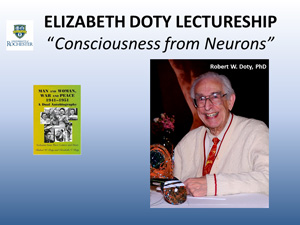 Dr. Doty is best known for his work on how the left and right hemispheres of our brain work together through the corpus callosum. A particular passion of Dr. Doty’s was a quest to understand the meaning of consciousness and its underlying neural basis. Hence, the topic of this lectureship is, “Consciousness from Neurons.” In his publication of the same title, Dr. Doty enthusiastically states: “What more challenging quest than to learn how the multi-millioned shuttling of damp sparks can weave a comprehending self, within the fatty fabric of the brain!”
The Department of Neuroscience is proud to call Dr. Doty one of our own. We are thankful for the remarkable gift he has given us in the Elizabeth Doty Lectureship, and we look forward to hosting world-class speakers for years to come.
Précis, by Dr. Robert W. Doty
Mankind faces two all-encompassing enigmas: the nature of reality, and the nature of mental existence. Physics has studiously probed the former, and returned a baffling series of conundrums, albeit experimentally and mathematically precise: space, warped by matter, aboil with virtual particles, particles themselves, bosons or fermions, concurrently diffusely wavelike yet punctuate, and by entanglement instantaneously linked across distances outside of time.
While the suspicion is readily entertained that these mysteries of physics may yet clarify the mysteries of the mind used to reveal them, science is not yet there. The evidence is overwhelming, however, that the brain is the origin of thought and experience; and, given the seeming necessity for rapid intercommunication among the functioning elements, the role falls unequivocally upon neurons. Yet it is equally clear that not all neurons or neuronal activity yield conscious perception. The profound question must thus be faced as to just what form of neuronal activity underlies consciousness, and how its nature is to be distinguished from the vast neuronal interplay that lacks the magic of this capacity. Even were that distinction in hand, the experience so engendered by the neuronal tumult is utterly devoid of palpable reference, a gap between neurons and mind that may forever be unbridgeable, though undeniable.
The annual lectures here proposed are to be dedicated to contending with these riddles of mind, how (and why?) consciousness emanates from the activity of certain populations of neurons, and not from others. This is, indeed, the quintessential question of science, in that the nature of reality is apprehended only by these processes of the brain.
Past Events
Prefrontal-amygdala interactions in social cognition and decision making
Elisabeth A. Murray, PhD - Chief, Section on the Neurobiology of Learning & Memory
Laboratory of Neuropsychology
National Institute of Mental Health, NIH
January 22, 2026
The Internal Focus of Attention
Anna Christina Nobre, PhD - Wu Tsa Professor of Psychology
Director, Center for Neurocognition and Behavior, Wu Tsa Institute, Yale University, New Haven, CT
May 2, 2024
Gamma Oscillations, Long-range Inhibition And Prefrontal-Dependent Cognition
Vikaas Sohal, MD, PhD - Associate Professor, Psychiatry, Weill Institute for Neurosciences
University of California at San Francisco
Jan 12, 2023
How Nature and Nurture Conspire to Control Brain Development, Function, and Plasticity
Michael Eldon Greenberg, PhD - Nathan Marsh Pusey Professor of Neurobiology, Harvard Medical School
Nov 3, 2022
Rethinking brain areas: Embedded functional subnetworks in the macaque face patch system
David Leopold, Ph.D. - Chief, Section on Cognitive Neurophysiology and Imaging (SCNI), NIMH, National Institutes of Health
Mar 18, 2020
Stability and Change in Human Functional Brain Networks
Steven Petersen, Ph.D. - The James S. McDonnell Professor of Cognitive Neuroscience in Neurology
Professor of Neuroscience, Biomedical Engineering, Psychological & Brain Sciences, and Radiology
Washington University
Mar 14, 2019
Multiscale Studies of Human Cortical Oscillations during Sleep and Cognition
Syd Cash, MD, PhD - Harvard Univ.
May 24, 2018
Human Brain Networks for Task-Directed Attention & Perceptual Working Memory
David Somers, PhD - Boston University
May 03, 2018
Neural mechanisms that support and constrain working memory
Clayton Curtis, Ph.D. - Asst. Prof. Psychology & Neural Science
New York University
May 11, 2017
Functional Modules: How do we get them and what good are they?
Margaret Livingstone, PhD - Harvard Medical School
Apr 13, 2017
Individual Differences in Executive Function: Genes, Brain, and Behavior
Chandan Vaidya, PhD - Georgetown Univ.
Apr 13, 2016
Organization and Function of Thalamus
S. Murray Sherman - Maurice Goldblatt Professor and Chairman, Department of Neurobiology, The University of Chicago
Sep 17, 2015
Attention, Perception, and the Representations of Visual Stimuli by Neuronal Populations
John H. R. Maunsell, Ph.D. - Alice and Rodman W. Moorhead III Professor of Neurobiology Harvard Medical School
May 12, 2014
There are no upcoming seminars.
Please review past seminars.