

News
B&B Professor Harold Smith and Oyagen's Drug Development Highlighted on Local TV for World Aids Day
Friday, December 4, 2015
OyaGen, a small medical research firm off Jefferson Road in Henrietta, has used federal grants for its HIV drug discovery programs with the goal of finding a cure. Dr. Harold Smith, Professor of Biochemistry & Biophysics at the University of Rochester, and the company's founder, president and CEO got his start as a molecular biologist studying heart disease.
"It became clear to me that the things we were doing to study heart disease and find out why things were happening translated directly into the HIV research arena," Smith said.
By 2010, things kicked into high gear. Advanced robotics were added allowing scientists to work with advanced chemistries. They've now identified a weak point in the HIV virus that's never been exploited before. Vif is a viral defense HIV releases into cells it infects. It destroys the body's natural defense against infections. OyaGen discovered a way to defeat HIV by disabling Vif.
"If we can proceed along track, we will be looking at entering clinical trials within a completely different way of approaching the virus and the disease within three years," Smith said.
Gloria Culver to Be Installed as Dean
Tuesday, December 1, 2015
Former Biochemistry graduate student and current Chair of Biology, Dr. Gloria Culver, will be formally installed as dean of the School of Arts & Sciences during an investiture ceremony at 4 p.m. today in the Interfaith Chapel on the River Campus.
University Trustee Ani Gabrellian ’84 will provide opening remarks, followed by words from Provost Peter Lennie, the Robert L. and Mary L. Sproull Dean of the Faculty of Arts, Sciences & Engineering. Mariette Westermann, vice president of the Andrew W. Mellon Foundation, and Jon Lorsch, director of the National Institute of General Medical Sciences, will serve as guest speakers. Following the ceremony, a reception will be held in the Hawkins-Carlson Room of Rush Rhees Library.
Lynne Maquat Receives Canada’s Top Prize for Biomedical Research
Thursday, October 29, 2015
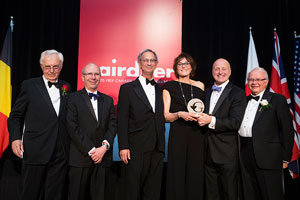
On October 29, Dr. Lynne E. Maquat received a 2015 Canada Gairdner International Award, for her work discovering and elucidating the mechanism of mRNA decay pathways. Dr. Maquat was accompanied during presentation of the award by University of Rochester President Joel Seligman, Dean Mark Taubman, and the US Ambassador to Canada, Bruce Heyman (see photo). The sold out annual black tie gala took place at the Royal Ontario Museum in Toronto, Canada and was attended by members of the health care, academic, private and public sectors. Among the attendees were Nobel Laureate Dr. Phillip Sharp, His Excellency the Right Honourable David Johnston, Governor General of Canada, and the Swiss and Japanese Ambassadors to Canada, who accompanied recipients of the Canada Gairdner International Award from those countries.
Leading up to this event, Dr. Maquat visited four local universities where she spoke to high school students about her personal story of how she became interested in research and what she hopes to achieve through her work. She also met with post-docs and graduate students at each university as well as speaking to faculty members about their research. Following the gala, Dr. Maquat attended and spoke at a 2015 Gairdner Symposium RNA and The New Genetics
at the University of Toronto, which she helped coordinate. Her last event occurred at the University of New Brunswick, Fredericton where she once again spoke to high school students On being a Scientist: Uncovering the mysteries of life
and met with post-docs and graduate students about their research. Dr. Maquat took every opportunity to be part of the National Program, where the goal of these programs is to contribute to Canadian science culture and innovation,
and to be part of the Student Outreach Programs where she helped realize one of the Gairdner Foundation's missions to inspire young people to consider a career in science, and to increase their awareness of the value of scientific research.
A local reception was also held to honor Dr. Maquat; pictures available here.
Maquat and Kurosaki Awarded Fellowship
Friday, April 24, 2015
Lynne Maquat, the J. Lowell Orbison Distinguished Service Alumni
Professor in the Department of Biochemistry and Biophysics, and Research
Assistant Professor, Tatsuaki Kurosaki, Ph.D. have been awarded FRAXA Postdoctoral Fellowship for their application
entitled, Re-purposing clinically approved drugs to dampen hyperactive nonsense-mediated mRNA decay in fragile X
syndrome
.
The FRAXA Research Foundation was extremely impressed with
their proposed research, and delighted to support this exciting work
. Funding of 45,000 has been authorized
for the period from May 1, 2015 to April 30, 2016.
Congrats to both Lynne and Tatsuaki!
Gloria Culver, Biochemistry Program Graduate, Appointed Dean of the School of Arts & Sciences
Wednesday, April 22, 2015
Gloria Culver, former Biochemistry graduate student in the Phizicky Lab, has been appointed dean of the School of Arts & Sciences, effective immediately. Culver is currently a professor of Biology and Biochemistry & Biophysics. Peter Lennie, the Robert L. and Mary L. Sproull Dean of the Faculty of Arts, Sciences & Engineering, made the announcement following a yearlong national search. Culver has been serving as interim dean since July 1, 2014.
Harold Smith Awarded Drug Development Pilot Award
Tuesday, April 14, 2015
Biochemistry & Biophysics Professor, Harold Smith, PhD has been awarded a Drug Development Pilot Award for his project, Development of an Assay for High Throughput Screening for Antagonists of the Ebola VP40 Protein Function
. The project was externally reviewed by leading drug development researchers and received a meritorious score. To learn about Dr. Smith's research please visit the Smith lab site.
Congrats Harold!
Blocking Cellular Quality Control Mechanism Gives Cancer Chemotherapy a Boost
Friday, March 27, 2015
A University of Rochester team found a way to make chemotherapy more effective, by stopping a cellular quality-control mechanism, according to a study published today in Nature Communications.
The mechanism is known as NMD (nonsense-mediated mRNA decay), and scientists found that exposing breast cancer cells to a molecule that inhibits NMD prior to treatment with doxorubicin, a drug used to treat leukemia, breast, bone, lung and other cancers, hastens cell death.
The research team, led by Lynne E. Maquat, Ph.D., director of the Center for RNA Biology at the University of Rochester, acknowledges that the work is in the early stages and a long way from being applied in humans. But, they believe their data provide insights that could lead to new treatment strategies for cancer patients in the future.
Lynne Maquat Receives 2015 Gairdner International Award
Thursday, March 26, 2015
Lynne E. Maquat, Ph.D. received the 2015 Gairdner International Award for the discovery and mechanistic studies of nonsense-mediated mRNA decay, a cellular quality control mechanism that derails the production of unwanted proteins in the body that can disrupt normal processes and initiate disease. She is one of five scientists honored with the award, which is given every year to recognize the achievement of medical researchers whose work contributes significantly to improving the quality of human life.
The J. Lowell Orbison Endowed Chair and Professor of Biochemistry and Biophysics at the University of Rochester Medical Center, Maquat is known around the world for her work on nonsense-mediated mRNA decay, which is critically important in both normal and disease states. She is considered the uncontested pioneer on the subject and in 2011 was elected to the National Academy of Sciences for her exceptional research, which has been published in more than 130 peer-reviewed scientific articles.
Maquat is the first scientist from upstate New York to receive the Gairdner International Award, which is recognized for its rigorous peer-led selection process. A panel of active Canadian scientists reviews all nominations and passes their recommendations to a board of two dozen senior scientists from across Canada, the United States, Europe, Australia and Japan. After in-depth study and review, board members cast votes for the nominees whose achievements rise above all others in their field. According to the Gairdner Foundation, of the 313 winners to date, 82 have gone on to receive a Nobel Prize in Physiology or Medicine, a testament to the quality of the awardees.
The award was also highlighted in the Opinion pages of Saturday’s Democrat and Chronicle in the Thumbs up, thumbs down
section: Thumbs up: For Dr. Lynne Maquat, who is one of five biomedical researchers from around the world to win this year's Gairdner International Award. The University of Rochester Medical Center scientist has joined a prestigious group. Since 1959, more than a quarter of the Gairdner International winners have gone on to win a Nobel Prize, too.