

News from the Irfan Rahman Lab
News from the Irfan Rahman Lab
ScholarGPS recognizes Dr. Rahman for exceptional performance
Monday, December 22, 2025
ScholarGPS announced the release of the 2025 ScholarGPS Scholar, Institutional, and Country Rankings, along with our revolutionary AI-driven search experience—transforming how users explore scholars, institutions, and publications on ScholarGPS.com.
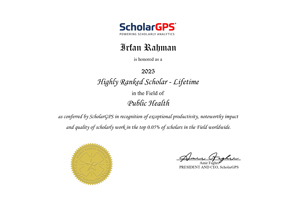
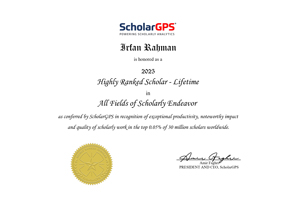
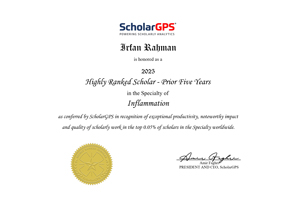
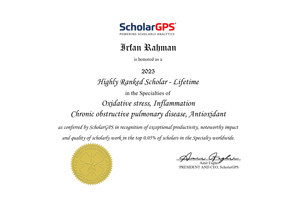
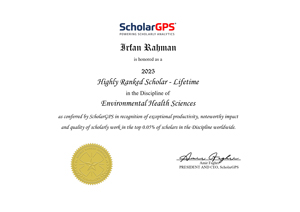
ScholarGPS celebrates Highly Ranked Scholars™ for their exceptional performance in various Fields, Disciplines, and Specialties. Your prolific publication record, the high impact of your work, and the outstanding quality of your scholarly contributions have placed you in the top 0.05% of all scholars worldwide according to the most recent 2025 ScholarGPS.
Irfan Rahman quoted in "Nicotine-free’ vapes and pouches promise a buzz without the downsides. Health concerns remain"
Thursday, September 18, 2025
In the past couple of years, “nicotine-like” products have hit the market in the U.S., Europe, Australia and South Korea. They look like nicotine vapes and pouches, with similar flavors and sleek designs. Some provide a nicotine-like buzz.
But there’s a crucial difference: Outside Europe, these products aren’t subject to government oversight.
Researchers warn that at least one of these products’ nicotine-like chemicals, called nicotine analogs, may be more potent and addictive than nicotine itself — and that these products are sometimes marketed in misleading ways.
Nicotine analogs are synthetic, chemical compounds that closely resemble nicotine. Some activate the same brain receptors as nicotine, with a similar buzz and addictive properties.
These compounds aren’t new; tobacco companies started researching nicotine analogs in the 1970s in anticipation of future regulations that could reduce how much nicotine would be allowed in their products, according to a study of industry documents. But the companies feared this research would trigger more regulation, so the studies were shelved.
In 2022, the U.S. Congress acted in response to the proliferation of vapes containing synthetic nicotine. That lab-made compound has the same chemical structure and properties as nicotine extracted from tobacco, so lawmakers authorized the U.S. Food and Drug Administration to regulate products containing synthetic nicotine just as it does those containing naturally occurring nicotine.
After that, the industry showed renewed interest in nicotine analogs. Products containing these compounds soon appeared on the market.
“These products were intentionally designed to bypass regulation,” said Sven Eric Jordt, a professor of pharmacology and cancer biology at Duke University who has studied nicotine analogs.
Though sales data is limited, research studies say the market for nicotine alternatives is growing. Some companies that produce vapes containing nicotine also produce vapes with nicotine-like ingredients.
Irfan Rahman, a professor of environmental pulmonary health and disease at the University of Rochester, analyzed research studies of 6-methyl nicotine and found that it may cause more inflammation in lung capillary cells than nicotine. 6-methyl nicotine can damage those cells, potentially contributing to lung diseases such as chronic obstructive pulmonary disease (COPD) and lung cancer, he said.
Read More: Irfan Rahman quoted in "Nicotine-free’ vapes and pouches promise a buzz without the downsides. Health concerns remain"Irfan Rahman is honored as a ScholarGPS Highly Ranked Scholar
Wednesday, August 6, 2025
Dr. Rahman has been ranked in the top 0.02% worldwide and in the top 26 at the University of Rochester in his field.
Congratulations!
Read More: Irfan Rahman is honored as a ScholarGPS Highly Ranked ScholarJust how harmful is vaping? More evidence is emerging
Wednesday, July 9, 2025
“When vapes heat liquids to higher temperatures, they can release larger amounts of harmful chemicals that can seep into the lungs, enter the bloodstream, and flow to the heart,” says Irfan Rahman, a Dean’s Professor in the Department of Environmental Medicine.
Read More: Just how harmful is vaping? More evidence is emergingImran Tahir Receives Shock Society Presidential Travel Award
Tuesday, April 15, 2025
Biology graduate student and Pulmonary T32 Trainee Imran Tahir was awarded a Shock Society Presidential Travel Award to attend the 48th Annual Conference on Shock in Boston and present his cutting-edge research on regulation of lung capillary permeability by mTOR proteins. Congratulations Imran!
Does E-Cigarette Use Increase the Risk of Cancer?
Monday, March 3, 2025
New research explores effects of e-cigarette use on RNA expression
E-cigarette use, including vaping, is often seen as a safer and trendier alternative to traditional tobacco products. However, a new study from researchers at the University of Rochester Medical Center published in Scientific Reports suggests an elevation of carcinogenic cellular signaling pathways in exclusive e-cigarette users when compared to non-users.
“Exosomal microRNAs play a crucial role in inflammation and disease processes like cancer,” said Dongmei Li, PhD, first author, professor of Clinical and Translational Research, and the director of Translational Science Statistical Support Services for the Clinical and Translational Science Institute. “However, little is known about how exclusive e-cigarette use affects exosomal microRNAs, which regulate genes that influence cancer-causing pathways.”
By comparing exosomal microRNA profiles between exclusive e-cigarette users and non-users, the researchers identified several exosomal microRNAs that are upregulated—more active than normal—in exclusive e-cigarette users. These overactive microRNAs are involved in cancer pathways, suggesting an elevation of carcinogenic cellular signaling pathways in exclusive e-cigarette users.
E-cigarettes are electronic smoking devices that vaporize liquid for inhalation by the user. These liquids and aerosols typically contain various combinations of propylene glycol, vegetable glycerin, nicotine, flavoring agents, and other chemicals.
With the National Youth Tobacco Survey of 2024 reporting that 7.8% of high school students and 3.5% of middle school students self-reported current e-cigarette use, and with e-cigarettes the most prevalent tobacco product used by those groups, exploring the potential link the behavior has with cancer is increasingly important to inform the public and future regulatory policies.
This study was funded by an R21 grant from the National Institutes of Health. Li and Zidian Xie, PhD, utilized blood plasma specimens from the Population Assessment of Tobacco and Health Study biorepositories to analyze exosomal epigenetic biomarkers—microRNAs—associated with flavored e-cigarette usage. They recorded changes in the epigenetic biomarkers and related biological pathways in the group of users, using non-users as a reference.
Li and Xie then collaborated with Irfan Rahman, PhD, professor of Environmental Medicine, and Sadiya Bi Shaikh, PhD, to conduct innovative experiments on primary airway epithelial cells, including wound-healing and DNA damage assays from non-users, to determine the toxicity and inflammatory response. Shaikh, a postdoctoral researcher in Rahman’s lab, conducted the wound-healing and DNA damage assays.
Read More: Does E-Cigarette Use Increase the Risk of Cancer?