

Research Projects
Research Projects
The lab runs five projects across three areas: basic science, clinical translation, and data science.
Basic Science
 SPP1+ Macrophages and Immune Suppression in Pancreatic Cancer
Macrophages are immune cells that can either fight cancer or help it grow. In pancreatic cancer, a subset of macrophages makes a protein called SPP1 (osteopontin). Our working model is that SPP1 reshapes nearby fibroblasts into a tumor-promoting state and leaves CD8 T cells, the immune system’s main cancer killers, exhausted. Using spatial RNA sequencing of human pancreatic tumors, we map where SPP1-producing macrophages sit relative to these fibroblast neighborhoods. We are testing whether blocking SPP1, including with the drug nilotinib, can restore T-cell function, with a focus on pancreatic cancers that spread to the liver. This project is supported by a Wilmot Cancer Institute Physician-Scientist Fellowship.
Semaphorin 4D Blockade and T-cell Responses
Semaphorin 4D (SEMA4D) is a signaling protein that helps keep T cells out of tumors. We study how the balance between CD8 T cells and SEMA4D in human pancreatic tumors relates to patient survival. In a genetically engineered mouse model of pancreatic cancer (KPPC), we test SEMA4D-blocking antibodies combined with FOLFIRINOX chemotherapy and immune checkpoint inhibitors. These studies provide the rationale for the clinical trial below.
Clinical Translation
Pepinemab Plus Avelumab in Metastatic Pancreatic Cancer (NCT05102721)
This phase 1b/2 trial at the Wilmot Cancer Institute, sponsored by Vaccinex in collaboration with the University of Rochester, combines pepinemab, an antibody that blocks SEMA4D, with avelumab, a PD-L1 checkpoint inhibitor, for patients with metastatic pancreatic cancer receiving second-line treatment. The trial uses a Bayesian optimal interval (BOIN) design to find the safest effective dose, followed by a Simon two-stage design to assess efficacy. Paired tumor biopsies taken before and during treatment let us see how the drugs change the tumor’s immune environment. The lab leads the correlative science, including RNA sequencing of paired biopsies with immune and stromal deconvolution (MCP-counter and CIBERSORTx). The goal is to identify tissue biomarkers of response and resistance that will guide the next generation of mechanism-based trials.
Data science
Liver Metastases and Immunotherapy Outcomes (MSK-IMPACT)
Led by Benjamin Dale, MD
Patients whose cancer has spread to the liver often respond poorly to immune checkpoint inhibitors. Using MSK-IMPACT clinical-genomic data from more than 8,000 patients treated with immunotherapy across 13 cancer types, this project measures how liver metastases affect survival and looks for tumor genomic features that explain the difference.
Liver Metastases Across Cancer Types (National Cancer Database)
Led by Mitchell Breitenbach, MD
This project uses the National Cancer Database to study liver metastases and survival on immunotherapy in more than 150,000 patients across 17 cancer groups. It tests whether the pattern seen in institutional data holds at a national scale.
Collaboration and Training
Trainee projects span patient-tissue biology, mouse models, bioinformatics and clinical outcomes research, matched to each trainee’s interests and skills. The lab collaborates with Memorial Sloan Kettering Cancer Center, Washington University in St. Louis, The Rockefeller University, City of Hope and the Medical University of South Carolina. Prospective students, residents and fellows are welcome to contact Dr. Ruffolo.
Outcomes Research
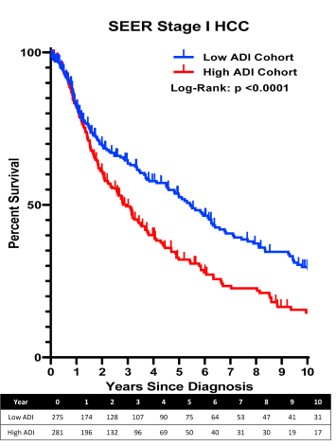
Overall survival in more than 550 patients with stage I liver cancer (hepatocellular carcinoma), split by neighborhood socioeconomic deprivation (Area Deprivation Index). Patients from high-deprivation neighborhoods had worse survival (log-rank p<0.0001). From Ruffolo LI, et al. J Surg Res. 2022;279:228-239, Figure 1B (CC BY-NC-ND 4.0).