

Frequently Asked Questions
Frequently Asked Questions
How do I know if I am in a department that has bioinformatics support?
The GRC bioinformatics team currently provides computational analysis and support services to the following departments:
- Department of Medicine
- Wilmot Cancer Center
- Environmental Health Sciences Center
- Center for Musculoskeletal Research
If you are a member of one of these departments and would like to request analysis support, please follow the hyperlinks above to submit your request.
How many replicates should I include in my experiment?
As a rule of thumb we always recommend at least 3 biological replicates for any experiment looking to perform a differential expression analysis. We also recommend you speak with the URMC Biostatistics Department as they can discuss any power calculations you might want to consider before designing your experiment.
What are the limitations of only doing 1 biological replicate in my bulk RNAseq study?
If you are unable to include additional replicates (due to cost, mice, other factors) in your experiment, please note that there are limitations in the analysis to be aware of. Single sample comparisons remove the ability to tie significance to differential expression because there is no ability to detect biological variation within conditional groups. For this reason, DESeq2 deprecated unreplicated designs in v1.20.0. It is not recommended to use single samples for the analysis of gene expression changes. Generally, we recommend performing a minimum of 3 biological replicates for an RNA-Seq experiment. We also recommend contacting the URMC Biostatistics Department to discuss statistical power analyses.
Can you modify the pipelines to meet our experimental questions?
Yes, we often modify our pipelines to meet the needs of individual experiments. Depending on the amount of effort required, there may be an additional service charge that will cover our time to make these project specific changes. If you are a member of a department with bioinformatics support, some additional analysis may be covered.
Can the GRC re-analyze my RNA-Seq experiment?
Yes, we request you email us and provide the PI and submission date associated with the project. Project re-analysis will be charged an hourly service fee to cover our bioinformatician's time to re-analyze the data.
HyperGen is another resources available to the community that allows users to re-analyze bulk RNAseq data and generate figures for differential gene expression. Please reach out to the GRC informatics team for more information on this resource.
Where can I find additional resources for analyzing or interpreting my data?
The GRC Informatics team continuously generates and shared educational materials to aid the University of Rochester research community in data analysis. We provide tutorials and workshop materials for many common bioinformatics analyses and some computer science basics.
You can find all our educational materials on our Blackboard Course, which includes short tutorials. These short tutorials are designed to introduce the user to one specific bioinformatic task. These include both markdown documents with well documented code and short videos demonstrating tasks that involve a GUI. You can also find materials from our workshops.
To join the Blackboard course, follow this link and enter the passcode: GenomicsWorkshop
I see outliers within my bulk RNAseq experiment. Can I remove them?
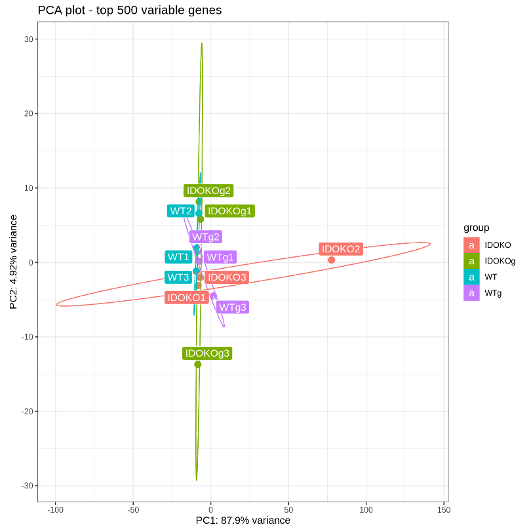
We don't recommend removing outliers without sufficient justification. Variation is expected within biological systems, and removing samples purely based on this variation can be seen as "cherry picking" the data. If you have samples that are very different from expectation, for instance IDOKO2 within the PCA plot below, consider a deeper dive into why this sample may be an outlier. Experimentally, was the sample left on a desk too long after extraction? How did the library look? When evaluating our delivered MultiQC report, was the number of reads captured or the alignment rate substantially different compared to other samples? Was there potential sample contamination? We are happy to help you though this investigation. If the sample is identified as a true outlier, we can help run analysis again without it.
What is SMDNAS and why is my data going there?
SMDNAS is a server maintained by the Office of Research IT for storage and data delivered by the GRC, and accessible through the Momentum platform for visualization and analysis. Contact the Office of Research IT, researchsupport@rochester.edu, for more information on using Momentum.
How do I request access to my smdnas share?
Instructions for requesting permissions for a PI folder change periodically. Please refer to your delivery email for the most up to date instructions.
How do I access my SMDNAS folder?
We have a video tutorial that illustrates how to mount SMDNAS to your local device on our Blackboard page. To join our Blackboard course, use this link and enter the passcode: GenomicsWorkshop. Brief instructions are additionally included below:
If you have a Mac device, you will first go to your Finder and in the Menu bar, click "Go" and then "Connect to Server". You will type smb://smdnas02/ in the pop-up window, and press "Connect". You will need to type in your Active Director login and password, and then press "Connect" and select your lab folder.
On a Windows device, you will go to your file explorer and type in the path \\smdnas02.urmc-sh.rochester.edu. You will need to type in your Active Directory login and password. Please enter and navigate to your lab folder.
Your lab folder is usually in the format "GRC_PIName". To access your specific project of interest, you will navigate to the path of the folder that corresponds to your project. You can find this information in your delivery email.
Can I open my RNAseq delivered text files in excel?
While we do not recommend working with these files in excel, you can view your data in excel by importing from a text file. We have a tutorial to walk you through how to safely work with gene symbols within excel.
Why are FASTQ and BAM files not included in my SMDNAS folder?
Due to storage considerations on SMDNAS, the raw FASTQ files and BAM files are not included in the initial delivery. However, we securely retain these files in our archives. Should you require access to these files for further analysis or submission purposes, please contact the GRC Bioinformatics team and we will be happy to arrange their delivery.
Why can't I save files to my SMDNAS folder?
Users are unable to save new files to your SMDNAS folder, as they are meant for long-term storage of sequencing data delivered by the GRC and not scratch space for investigators. If you do need additional scratch space, please reach out to the Center for Integrated Research Computing (CIRC).
What is Nextflow, and what does that mean for your data delivery?
Nextflow is a workflow management system that allows the GRC Informatics team to run analyses in a standardized, reproducible, and automated way. It coordinates the different software tools and analysis steps while keeping track of how the analysis was performed. NF-core is a community-developed initiative that provides version-controlled, peer-reviewed, and standardized workflows written in Nextflow that implement accepted best practices. We are in the process of changing the majority of our standard analysis pipelines (e.g., bulk RNAseq, smRNAseq, CUT&TAG, ATACseq) to nf-core. For you, this means that your data are processed through a consistent and reproducible analysis workflow that allows us to maintain detailed records of the software, versions, parameters, and computational steps used during analysis.
Implementing this nf-core workflow means that we have transitioned from our previous pipeline in an effort to improve standardization and reproducibility. As a result, deliverables from projects processed after March 2026 may differ slightly from prior deliveries. If you prefer that we process your data using our previous workflows, you may request this option prior to the start of your analysis.
Can the GRC re-analyze my RNA-Seq experiment?
Yes, we request you email us and provide the PI and submission date associated with the project. Project re-analysis will be charged an hourly service fee to cover our bioinformatician's time to re-analyze the data.
We also have HyperGen which will allow you to generate figures for differential gene expression.
How do I request access to my smdnas share?
The PI must email smdithelp@urmc.rochester.edu to request users have access to their share drive.