About the Program
About the Program
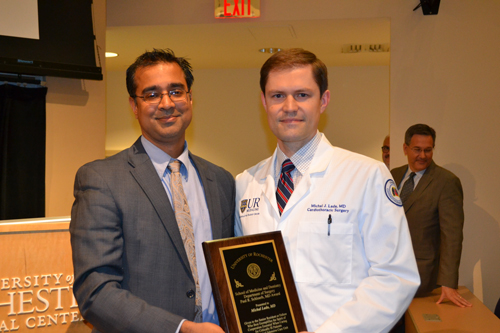
Michal Lada presented with the Paul R. Schloerb, MD Award 2017 – 2018.
Our Program Focus
- Fellows receive training of the highest caliber by dedicated Cardiac and Thoracic Surgery faculty from the University of Rochester that are strongly committed to preparing trainees for clinical practice as well as developing skills in teaching, research and leadership for their future careers.
- Training takes place at the University of Rochester Medical Center, a quaternary, academic hospital servicing all of upstate New York. As the premiere medical center in the region, we are fortunate to have robust clinical volumes in all aspects of cardiothoracic surgery and have developed rich programs in valvular heart disease, heart failure and mechanical circulatory support, congenital heart disease, thoracic surgical oncology and benign esophageal disease.
- The faculty are focused on minimally invasive approaches to all aspect of adult cardiac and thoracic surgery including endovascular and mini-transthoracic approaches to valvular heart disease, non-sternotomy approaches to ventricular assist device insertion, endoscopic approaches to benign and malignant esophageal disease and utilization of robotic, VATS or laparoscopic techniques in nearly every major thoracic case.
- Progressive responsibility at all levels, with emphasis placed on academic knowledge and technical advancement for the development of expertise in patient care.
Our Training Model
- We are dedicated to the integrated six-year (I6) training paradigm, the traditional fellowship pathway (5+2) and Accelerated 4+3 pathways for training future CT surgeons. We typically train a total of 7 or 8 trainees each year across all 3 pathways creating a special camaraderie and collegiality amongst all CT trainees.
- Our program is uniquely equipped to offer robust opportunities in every area of Cardiothoracic Surgery; including Adult Cardiac, Congenital, Heart Failure and Mechanical Circulatory Support, Cardiac Transplantation, General Thoracic and Esophageal Surgery.
Technology
Fellows at University of Rochester are exposed to, and trained in the use of the latest cutting edge technology. We have a robust minimally invasive structural heart practice spearheaded by Dr. Knight that includes minimally invasive and endovascular valve replacement. The Mechanical Circulatory Support program at URMC is a national leader in left ventricular assist devices (LVAD), minimally invasive LVADs, and extracorporeal membrane oxygenation (ECMO). Residents will learn novel approaches to aortic surgery (TEVAR, EVAR), off pump and robotic coronary surgery, minimally invasive cardiac procedures and innovative techniques in the treatment of congenital heart disease in neonates and adults.
The thoracic surgery service is at the forefront of minimally invasive techniques including VATS, laparoscopic, robotic and endoscopic therapies. Faculty are focused on both the diagnostic and therapeutic interventions for their patients. Unique to the University of Rochester, the Esophageal Diagnostic and Endoscopic Laboratory is a state of the art facility for the diagnosis and treatment of esophageal disorders run by the Thoracic surgical faculty. Diagnostic techniques such as upper endoscopy, high resolution manometry, pH monitoring and Endoflip can be performed right in the clinic. We also perform advanced endoscopic interventions including esophageal dilation and stenting, endoscopic mucosal resection (EMR) and radiofrequency ablation and per oral endoscopic myotomy (POEM). We have an outstanding research program investigating advanced diagnostics, treatment strategies, and outcomes research of esophageal disease. Time in the lab is incorporated when rotating on the thoracic surgery service. For those residents who wish to focus on thoracic surgery, there is a dedicated rotation during the third year.
Esophageal Diagnostic Laboratory
Unique to the University of Rochester, the Esophageal Diagnostic Laboratory is state of the art in the diagnosis and treatment of esophageal disorders. Diagnostic techniques such as upper endoscopy, high resolution manometry, and pH monitoring can be performed right in the clinic. We have an outstanding research program investigating advanced diagnostics, treatment strategies, and outcomes research of esophageal disease. Research of esophageal disease occurs in collaboration with research fellows who come from around the world.
Research
Fellows are encouraged to participate in research and publish an article in a reputable journal every year. Opportunities are available in outcomes research, animal models of cardiac disease, innovative new devices, FDA drug investigations, or new techniques in the surgical treatment of thoracic and cardiac disease.