

2026: Western Region Health Coalition Emergency Management Seminar
2026: Western Region Health Coalition Emergency Management Seminar
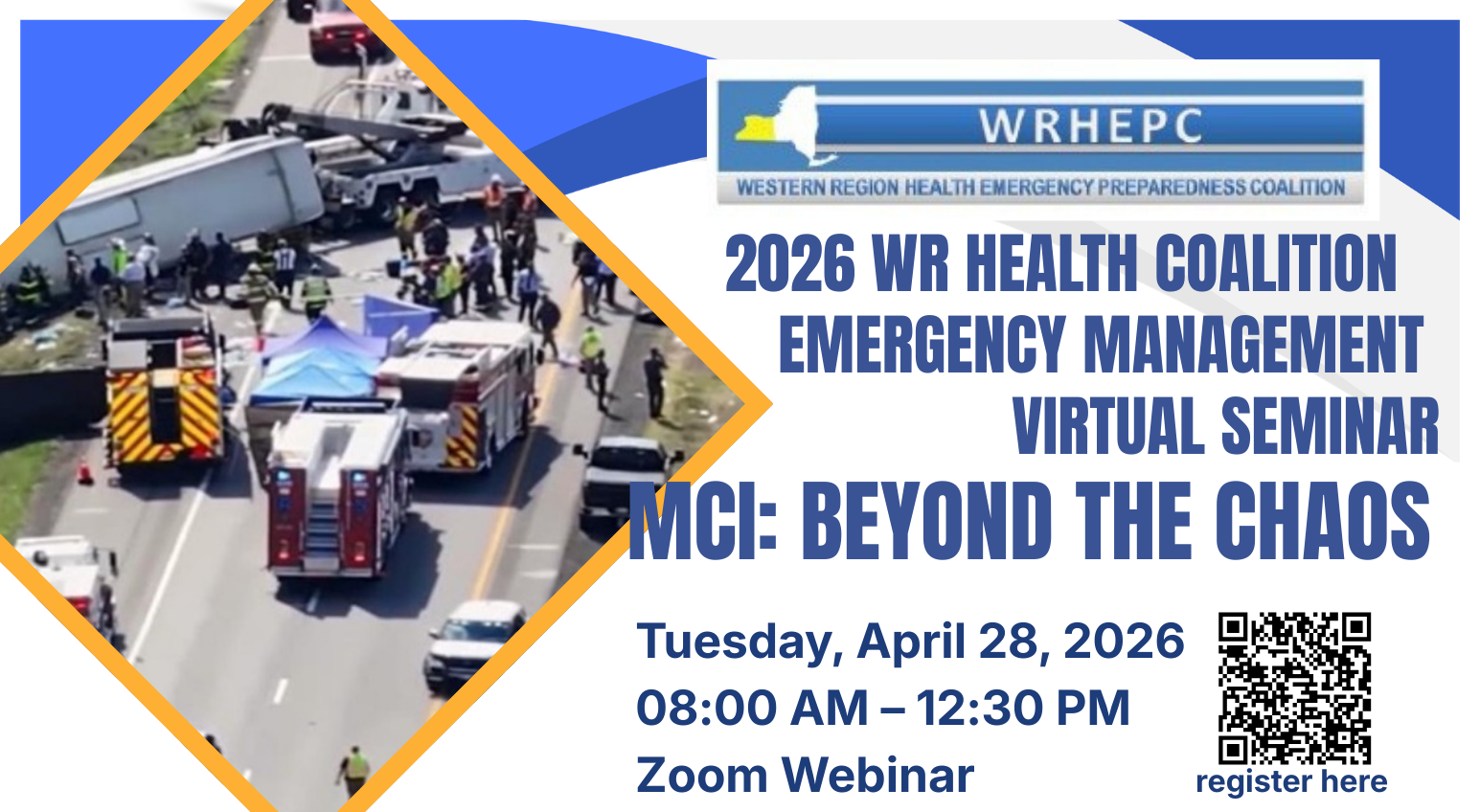
** ENROLL IN RECORDED SESSION HERE **
OHEP-WRHTC-WRHEMS2026-MCI-REC
Website: wrhems2026.urmc.edu
Recorded Session: https://www.nylearnsph.com/Public/Catalog/Description.aspx?u=kM6WW0gCRpmYu%2f4ctV7LgGKuj4OuX6jUOwrNJTSIJBhJYzZDEUZ9kgV0JVHZkz3K0q2v8Ly6950%3d
PROGRAM OVERVIEW
The 2026 Western Region Health Coalition Emergency Management Seminar, MCI: Beyond the Chaos, is a half-day virtual event focused on managing mass casualty incidents (MCIs) beyond immediate victim care. This seminar aims to provide actionable knowledge on regional planning, family support, disaster mental health, communication, and fatality management to enhance MCI preparedness, response, and recovery efforts. It also emphasizes that victim care and support is a collaborative, multi-agency response that extends past initial emergency medical treatment.
PROGRAM OBJECTIVES
Based on presentations, participants will be able to:
- Analyze regional Mass Casualty Incident (MCI) planning principles by applying lessons learned from the August 2025 thruway bus accident to improve coordination, resource allocation, and operational readiness
- Demonstrate effective mass communication strategies including real-time communication tools that enhance situational awareness and improve coordination/collaboration among coalition partners
- Assess the personal psychological impacts of caring for trauma patients and identify evidence-based strategies to support mental health and resilience during and after MCIs
- Explain the role and operational structure of Family Assistance Centers (FACs) and Family Reunification Centers (FRCs), including protocols for family support, patient tracking, and reunification during mass casualty and fatality incidents
- Review MCI fatality management practices and state-level resources, incorporating insights from the 2018 Schoharie Limousine Crash to strengthen fatality management, interagency coordination, and protocol compliance
TARGET AUDIENCE
Hospitals, EMS, public health, emergency managers and other healthcare/first response agencies who may play a role in a disaster that affects the health delivery system in the community
AGENDA - PRESENTATIONS/SPEAKERS/BIOS
(Recording Timestamp)
April 28, 2026 @ 8:00 a.m. − 12:30 p.m.
*topics and speakers subject to change*
8:00−8:10 Welcome/Opening Remarks (00:00 - 01:14)Speaker: |
8:10−8:55 NYS Thruway MCI Regional Response (01:15 - 1:00:10)In August 2025, a tour bus crash on the New York State Thruway (I-90) in Genesee County resulted in a large-scale mass casualty incident (MCI) involving dozens of patients and a complex, multi-agency response. This session will review the incident, discuss key operational lessons learned, and examine how regional planning, partnerships, and operational readiness can strengthen the response to future large-scale highway incidents. By the end of this presentation, participants will be able to:
Presenter: |
8:55−9:00 Break |
9:00−9:45 Building a Connected Coalition: Advancing Communication & Situational Awareness (1:00:11 - 1:40:27)The Central New York Healthcare Coalition’s Communication & Situational Awareness Workgroup modernized its approach over the past year, shifting from static annual surveys to a real-time communication system. Key accomplishments include an interactive GIS mapping tool for live updates, a dedicated Slack channel for daily coordination and incident response, and enhanced exercise support with HAM radio communication injects. Overall, these efforts improve situational awareness, readiness, and collaboration across coalition partners. By the end of this presentation, participants will be able to:
Presenter: |
9:45−9:50 Break |
9:50−10:35 The Pebble in the Pond - The Ripple Effect of Our Profession on Our Lives (1:40:28 - 2:20:33)
By the end of the presentation, attendees will be better able to:
Presenter: Resources: |
10:35−10:45 Break |
10:45−11:30 Family Assistance Center and Family Reunification (2:20:34 - 3:21:04)
By the end of this presentation, participants will be able to:
Presenters: Samantha Thomas Resources: |
11:30−11:35 Break |
11:35−12:20 Fatality Management and NYS DOH Mortuary Response Resources (3:21:05 - 3:55:06)
By the end of this presentation, participants will be able to:
Presenters: Jenesse Murray |
12:20−12:30 Closing Remarks/Evaluations/CertificatesSpeaker: |
CERTIFICATION
This Seminar is on the NYSDOH OHEP Pre-Approved List for HPP Vouchering. A Certificate of Attendance will be available to all attendees that complete a post-session evaluation.
This activity qualifies for a total of 3.75 hours of NYS EMS CME credit - EMS Operations: 3.0hrs; Mental Health of EMT: 0.75hr.
EMS Attendees must attend the entire seminar to claim EMS CME.
SEMINAR PLANNING COMMITTEE
- Connor Rittwage, MPH, CHEC, CHES
Infection Prevention/Control & Emergency Preparedness Program
WR Workgroup/Seminar Planning Committee Chair
Jones Memorial Hospital
- Anne D’Angelo, RN, MS
Program Director, Western Region Health Emergency Preparedness Training Center
WR Workgroup/Seminar Planning Committee Co-Chair
University of Rochester Medical Center
- Ryan Hejmanowski, CHEP, CHEC II
Corporate Emergency Management Manager
Kaleida Health
- Nicole Gerber, PhD, RBP, CEM, CHEC
Emergency and Safety Program Manager/Biosafety Officer
Roswell Park Comprehensive Cancer Center
- Molly Kabza, BS
Emergency Management Specialist
Kaleida Health - David Lanning, Jr., BS, CHEP, CHEC III
Emergency Preparedness Coordinator & Safety Officer
Arnot Health, A Member of Centralus Health
- Dan McCartan, RN, MSN, CHEP
Emergency Manager
Erie County Medical Center Corporation
- William F. Peterson III, BS, CHEC III
Emergency Management Specialist
Kaleida Health System - Lynn M. Sigeti, BS, RN
Coordinator-Regional Emergency Preparedness
Health Association of Western and Central New York
- Eileen Spezio
Senior Administrative Assistant, Finger Lakes Regional Training Center
University of Rochester Medical Center - Matthew Zurcher
System Director of Public Safety
Arnot Health
SEMINAR SPONSOR
This seminar is sponsored by the Western Region Health Emergency Preparedness Coalition (WRHEPC) and the University of Rochester Medical Center - Finger Lakes/Western Region Health Emergency Preparedness Training Center (WRHTC) through a grant from the Department of Health and Human Services (DHHS) under the 2025-2026 New York State Department of Health Office of Health Emergency Preparedness/Hospital Preparedness Program (NYSDOH OHEP – HPP)