

Health Equity Pilot Awards Support Innovative Approaches to Youth Health and Violence Prevention
Health Equity Pilot Awards Support Innovative Approaches to Youth Health and Violence Prevention
This year, the Office of Health Equity Research’s pilot awards are supporting two projects that use youth sports to improve health outcomes related to violence prevention and chronic disease. Part of University of Rochester Medicine’s Center for Community Health & Prevention (CCHP), the Office of Health Equity Research (OHER) has funded research initiatives in community-identified priority areas for the last three years.
All investigators affiliated with OHER as a Health Equity Research Core Investigator are eligible to apply for and receive OHER pilot funding, regardless of race, color, religion, sex, national origin, age, and any other protected classes under current federal anti-discrimination policies. Research involving all populations is considered.
Increasing Access to Physical Activity through Sports Bras
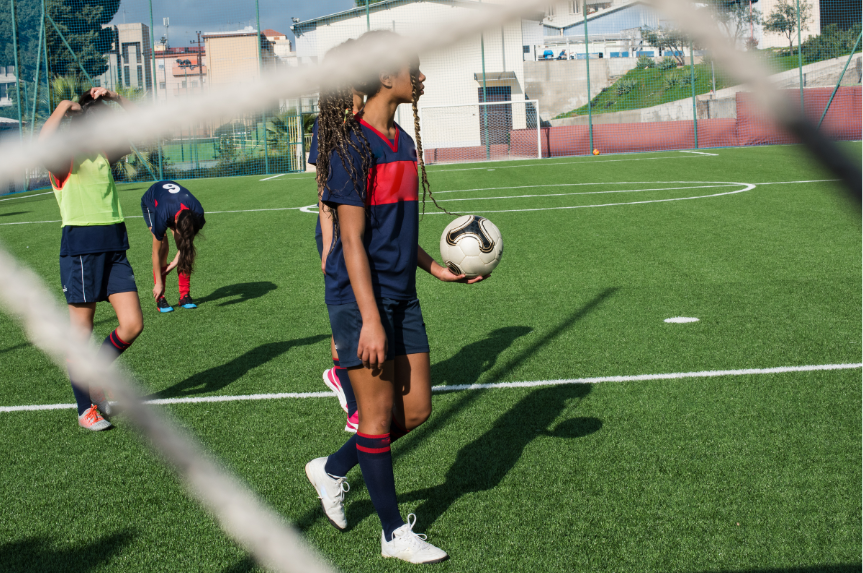 An essential piece of sporting equipment, sports bras can be a barrier to physical activity. In addition to often being costly, sports bras can contribute to breast pain, limit movement, and erode confidence when not properly fitted. These factors can discourage exercise at an age when lifelong habits are formed.
To address this issue in Rochester, principal Investigator Katherine Rizzone, MD, MPH, sports medicine physician and associate professor of Orthopaedics, and co-investigators Ram Haddas, PhD, MBA, Connor Lorenzo, MAT, Zachery Ferrara, M.Ed., and Calvin Cole, PhD, are using EmpowerFit, a University of Rochester Medicine Fitness Science program. With funding support from the Department of Orthopaedics, the team is researching the idea that personalized sports bra fitting can increase physical activity levels, optimize physical function, and reduce breast pain in high school students.
The primary objective of the “EmpowerFit Pilot Study—Optimizing Sports Bra Fit to Enhance Physical Activity, Self-Efficacy and Body Image in Marginalized Adolescent Girls” project is to quantify changes in weekly moderate-to-vigorous physical activity after personalized sports bra fitting in young women in the Rochester City School District. Secondary outcomes include measuring self-efficacy and exercise-related body image, assessing changes in breast pain scores during activity, and assessing differences related to physical capabilities, using well-known musculoskeletal motion tests, in breast support and motions associated with injury risk. As part of the group’s initial steps, they’ll engage in student interviews and focus groups to help inform approach and study design.
By leveraging established community partnerships, like the Center for Human Athleticism and Musculoskeletal Performance and Prevention (CHAMPP), and combining clinical expertise with the resources at Fitness Science and the Motion Lab, EmpowerFit aims to demonstrate a straightforward, scalable intervention that enhances both the physical and psychosocial well-being of adolescent girls, paving the way for broader implementation and sustained funding.
More Than a Game: Using Youth Sport to Strengthen Mental Health and Prevent Violence
While many existing mental health interventions focus on downstream treatment or crisis response, there remains a critical need for upstream, community-based approaches that strengthen protective factors before challenges escalate. Investing in prevention strategies that foster positive youth development, supportive relationships, and healthy coping skills can reduce risk factors associated with violence and poor mental health outcomes while building resilience. That’s the focus of “More than a Game: Using Youth Sport to Strengthen Mental Health and Prevent Violence,” a pilot project led by Connor Tumiel, MD, child and adolescent psychiatrist at University of Rochester Medicine Behavioral Health and Wellness.
 Sports provide an environment for youth to learn confidence, conflict resolution, and leadership skills, while also providing a built-in system of mentors, coaches, and peers who encourage personal growth, foster belonging, and help young people navigate challenges both on and off the field.
“Leveraging this existing infrastructure offers an accessible entry point for promoting mental health, supporting early intervention, and reducing risk factors associated with interpersonal and firearm-related violence,” shares Tumiel. “When we teach a teenager how to recognize when a teammate is struggling, or how to manage the frustration of a bad loss without exploding, or that asking for help is a sign of strength rather than weakness, we are building exactly the protective factors that the research tells us reduce violence risk.”
This project will develop and pilot an innovative, equity-informed, community-delivered intervention that uses youth sport as an entry point to promote mental health equity, reduce risk factors for violence, and strengthen supportive environments for young people. The intervention will be co-designed with community partners to reduce barriers related to access, stigma, and trust, and aims to generate preliminary data on key health outcomes relevant to youth wellbeing, safety, and access to preventive supports.
Tumiel plans to build the program from the ground up with support from parents, coaches, sport leaders, and athletes, with an ultimate goal of developing a train-the-trainer model so it is sustainable enough that communities can run it themselves in urban, suburban, and rural settings.
“These initiatives demonstrate how evidence-based research can create lasting improvements in health and well-being,” shares Edith Williams, PhD, MS, director of the CCHP and founding director of OHER. “We are proud to support investigators whose work is advancing opportunities for individuals and our communities to thrive.”
Health Equity Research Core Investigators, otherwise known as HERCI members, affiliated with OHER are eligible to apply for these pilot grants. The grant program is currently co-sponsored by OHER and the Department of Orthopedics.
The Pilot Studies in Health Equity award will open for the fifth year in January 2027. OHER can fund up to four proposals depending on the availability of funding and the merit of applications received. Researchers interested in affiliating with OHER are encouraged to contact oher@urmc.rochester.edu.